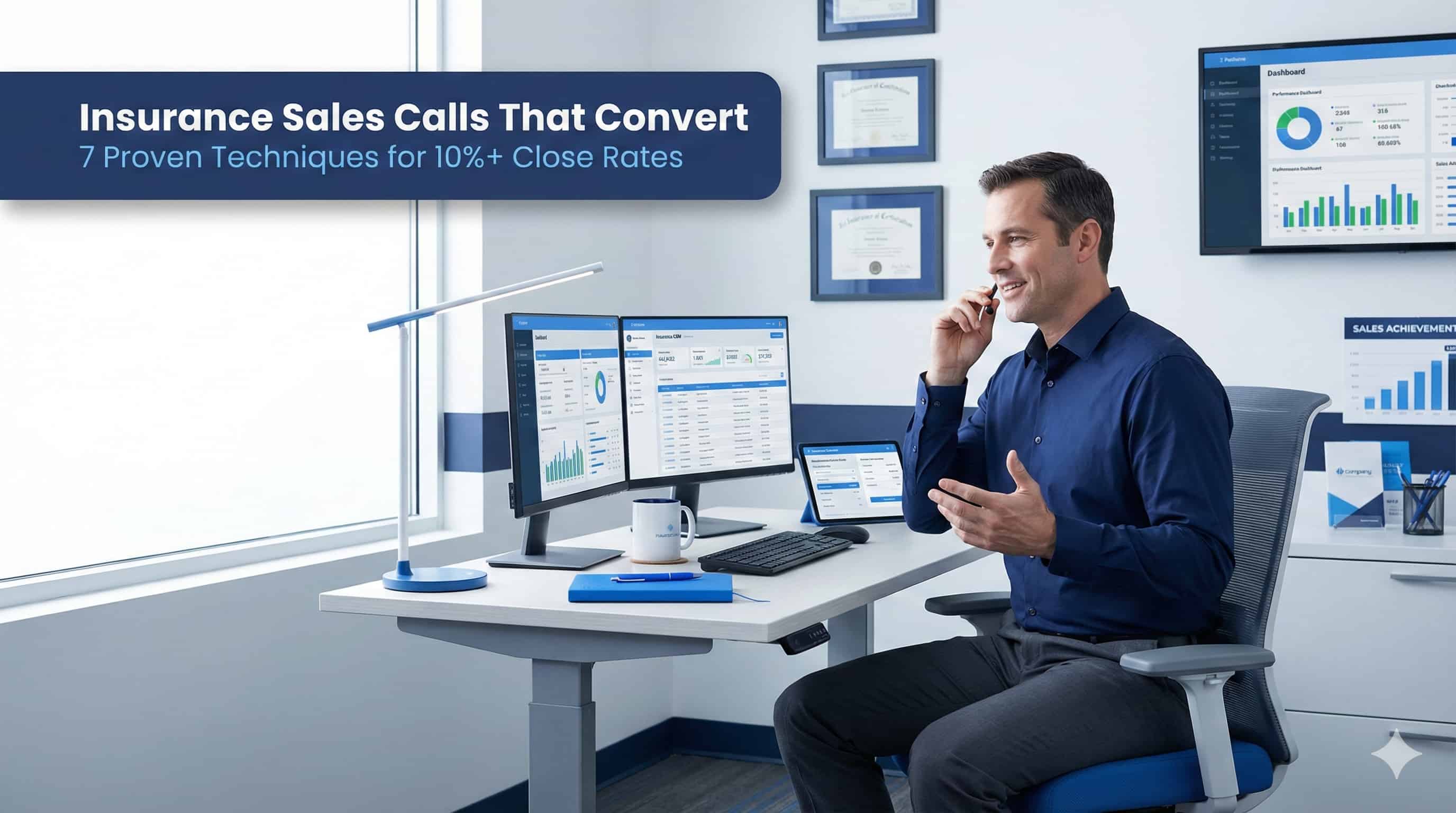
Your phone rings. A potential customer wants an insurance quote. What happens in the next 60 seconds determines if you'll earn their business or lose them forever.
Most insurance agents struggle with phone consultations. They lack structured approaches. They make critical mistakes in those crucial first moments. The result? Lost sales and frustrated prospects.
Insurance sales calls convert 10-15 times better than web leads. Phone calls are your most valuable conversion opportunity. A great call script can raise conversion rates from 2% to 10%.
You'll learn seven proven techniques that transform prospects into paying customers. These strategies work for life insurance, health insurance, and all coverage types.
What You'll Learn
Master the First 60 Seconds
Active Listening for Insurance Agents
Handle Common Insurance Objections
Benefits Over Features Approach
CRM Tools for Insurance Calls
Follow-Up and Conversion Tracking
Training Resources for Insurance Agents
The first minute of your insurance sales calls sets the tone. During this time, even the slightest mistake could cost you the sale.
Start with a professional greeting that establishes trust immediately. Confirm the caller's intent and needs right away. This shows you're listening and ready to help.
Use this proven structure for every call:
Professional greeting with your name and company
Confirm why they're calling
Ask one open-ended question about their needs
Listen without interrupting
For example: "Hi, this is Sarah from ABC Insurance. I understand you're looking for life insurance coverage. What's most important to you in a policy?" This approach immediately shows you care about their specific situation.
Preparation separates good agents from great ones. Research your prospect before making outbound calls. Use the information to personalize each conversation.
Address prospects by name. Mention specific details relevant to their situation. This makes the conversation more engaging and builds trust faster.
You'll never reach peak performance until you learn to listen. This skill takes time to develop. Stay dedicated to growing this ability.
When prospects speak, avoid interrupting. Show you're fully engaged in what they're saying. Make affirming sounds or acknowledge their concerns with phrases like "I understand" or "That makes sense."
Active listening involves more than staying quiet. Show engagement through:
Verbal acknowledgments during their responses
Asking follow-up questions about their concerns
Repeating back what you heard to confirm understanding
Taking notes during the conversation
When prospects feel heard, they're more likely to trust you. Trust leads to sales.
Insurance involves sensitive topics like health, family, and money. Demonstrating empathy helps prospects feel comfortable.
If someone mentions affordability concerns, acknowledge that budgeting is a common worry. Explain how your products offer flexibility. This approach shows you understand their situation.
Quality insurance leads respond better when agents show genuine concern for their needs.
Objections are part of every insurance sales call. How you handle them determines your success rate. The best strategies involve preparation and confident responses.
Common objections revolve around cost, trust, and perceived need. Be ready with reassuring responses for each concern.
When prospects say "It's too expensive," don't argue about price. Instead, focus on value and payment options.
Try this approach: "I understand budget is important. Let me show you how this breaks down per day. For less than your daily coffee, you're protecting your family's future."
New prospects often worry about insurance companies not paying claims. Address this directly with facts and testimonials.
Share your company's claims payment record. Mention satisfied customers. Offer to connect them with current policyholders if appropriate.
Some prospects don't see the immediate need for coverage. Use questions to help them realize the importance.
Ask: "What would happen to your family's mortgage if something happened to you?" This creates urgency without being pushy.
One of the biggest mistakes agents make is focusing on product features instead of customer benefits. Features explain what the product offers. Benefits show how it solves their problems.
Make benefits clear during your insurance sales calls. This makes policies more relevant to their lives.
Instead of saying "This policy has a $500,000 death benefit," try "This ensures your family can pay off the mortgage and maintain their lifestyle."
Here's how to convert common features:
Flexible premiums become "payments that adjust to your budget"
Cash value becomes "money you can access for emergencies"
Guaranteed renewal becomes "coverage that can't be canceled"
Multiple riders become "additional protection for specific needs"
Always connect features to their personal situation. This makes your offer more compelling.
Stories make benefits concrete. Share examples of how your products helped other customers.
"I had a client whose husband passed unexpectedly. The life insurance payout allowed her to keep the kids in the same school and maintain their home. That's the peace of mind this policy provides."
CRM software significantly improves workflow organization. It centralizes all customer interactions in one place. You no longer need different platforms to track phone calls, emails, and other exchanges.
This client management tool helps insurance agents stay organized throughout the sales process. Nothing falls through the cracks.
Look for these capabilities in your CRM system:
Call tracking and recording
Lead management and scoring
Automated follow-up reminders
Policy tracking and renewals
Email and SMS integration
Reporting and analytics
HubSpot CRM offers a built-in meeting scheduler and omnichannel inbox. The clean user interface prioritizes ease of use. Access a massive integration library through their app marketplace.
AgencyBloc's Plus Suite is built specifically for health, life, and group benefits agencies. It combines CRM, marketing automation, quoting tools, and commission processing.
EZLynx helps manage every stage of the policy lifecycle. Built-in automation and AI help agents handle quotes, renewals, and service requests faster.
The right insurance CRM can double your productivity by automating routine tasks.
Even after productive insurance sales calls, not all leads convert immediately. Following up is just as important as the initial conversation.
Prompt and consistent follow-up reminds prospects of your offer's benefits. It keeps you top of mind when they're ready to decide.
Create a systematic follow-up schedule:
Same day: Send thank you email with call summary
3 days: Check if they have additional questions
1 week: Share relevant educational content
2 weeks: Make a brief check-in call
1 month: Offer to review their situation again
Vary your communication methods. Use phone calls, emails, and text messages. Different people prefer different contact methods.
Monitor these key metrics to improve your performance:
Call-to-appointment conversion rate
Appointment-to-sale conversion rate
Average time from first call to close
Follow-up response rates
Agencies report conversion rates of 5-10% on fresh leads compared to 1-4% on aged leads. Track your sources to focus on the highest-quality prospects.
Continuous training improves your insurance sales call performance. More than 4,000 agents have used advanced training programs to attract more clients and close more sales.
Making just 12 cold calls daily can boost your leads by 25%. The more calls you make, the better your conversion rate becomes.
Insurance Sales Lab offers the One-Call Close Masterclass. Agent Vlad Cherchenko teaches in-depth sales presentations using a 6-step script.
Anthony Cole Training Group provides insurance sales training programs. They teach consultative conversations by asking the right questions to help clients make informed decisions.
Insurance sales calling is a numbers game. The more calls you make, the more sales opportunities you create. Plus, your skills improve with practice.
One of the biggest tips for perfecting insurance sales calls is making more calls. Research shows that 78% of decision-makers have agreed to meetings thanks to cold calls.
Set daily call goals. Track your progress. Celebrate improvements in both quantity and quality.
What's the average conversion rate for insurance sales calls?
Average conversion rates range from 2-5% for cold calls and 5-10% for warm leads. With proper training and scripts, agents can achieve conversion rates up to 10% or higher.
How long should an insurance sales call last?
Initial insurance sales calls typically last 15-30 minutes. This allows enough time to understand needs, present solutions, and handle objections without overwhelming prospects.
What's the best time to make insurance sales calls?
The best calling times are Tuesday through Thursday, between 10 AM and 2 PM, and again from 4-6 PM. Avoid Mondays and Fridays when people are busiest.
How many follow-up calls should insurance agents make?
Make at least 5-7 follow-up attempts using different methods (phone, email, text). Most sales happen after the 5th contact, but many agents give up after 2 attempts.
What insurance agent phone skills are most important?
The most critical phone skills are active listening, empathy, objection handling, and asking open-ended questions. These skills build trust and help identify customer needs effectively.
Ready to get auto insurance pay per call leads? Sign up for free with ResultCalls!

Hello everyone! My name is Alex and I write these blogs to help educate small business owners on different ways to grow their business. My goal is to make lead generation as easy as possible for you. After reading these blogs, I hope you leave with some actionable steps that will get you closer to growing your business :)