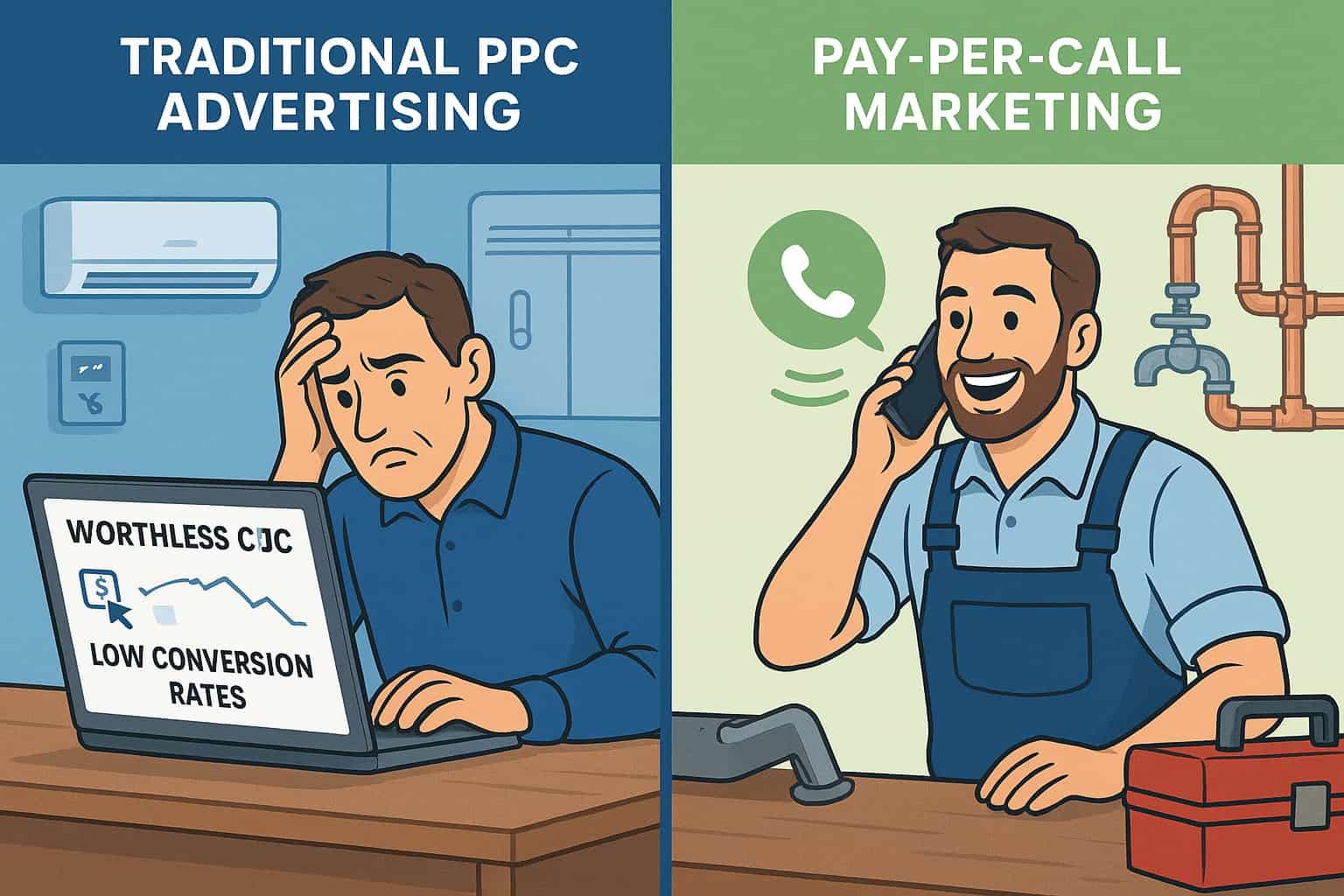
Picture this: You spend $2,000 on Google Ads last month. You got 100 clicks. But only 3 people called. And just 1 became a paying customer.
Sound familiar? You're not alone. Most home service owners are stuck in this expensive cycle. They pay for clicks from tire-kickers, competitors, and bots. Meanwhile, their phones stay quiet.
But there's a better way. Pay per call marketing flips the script. Instead of paying for clicks that might lead nowhere, you only pay when qualified customers actually call your business.
This guide shows you exactly how pay per call advertising works. You'll learn why it converts 10-15 times better than regular ads. Plus, you'll discover how to set up campaigns that bring your phone to life with ready-to-buy customers.
What Is Pay-Per-Call Marketing
Why Traditional Local Business Advertising Fails
Pay-Per-Call Success Strategies
Real Home Service Success Stories
Essential Tools and Technology
Future of Local Service Marketing
Pay-per-call marketing changes everything about how you get customers. This pay per call lead generation model is different. Instead of paying for clicks, you pay for phone calls from qualified prospects.
Here's how it works: A marketing partner creates ads for your business across Google, social media, and local directories. Their goal is simple - make your phone ring with customers ready to book jobs. These phone call leads are much more valuable than website clicks. You only pay when someone calls who meets your specific criteria.
Think about it this way. When someone clicks your ad, they might just be browsing. But when someone picks up the phone to call you? They have a problem they need fixed right now.
Your Business (The Advertiser): You define what types of calls you want and from which areas. You pay for qualified leads that meet your standards.
Marketing Partners (Publishers): These are the experts who create and manage your campaigns. They handle all the technical stuff while you focus on running jobs.
Pay-Per-Call Networks: Companies like ResultCalls connect you with multiple marketing partners and run pay per call campaigns. They provide tracking technology and manage payments. These networks make pay per lead services accessible to any size business.
The difference comes down to intent. A click costs you money but tells you nothing about the person's urgency.
A phone call is different. When a homeowner's basement floods or their AC dies in July, they don't browse around. They pick up the phone to get help fast.
This urgency translates into real results. Phone calls convert to paying customers 10-15 times more often than web leads. This is why home services lead generation strategies are shifting toward phone-focused campaigns. Plus, 84% of marketers report that phone leads result in higher order values too.
Most home service owners feel like Google Ads is a money pit. They're not wrong. Local business advertising through traditional PPC has three major problems that make it expensive and frustrating.
Competition drives up prices fast in home services. Here's what you're really paying:
Plumbers: Average $10.49 per click, but emergency keywords like "plumber near me" cost $30-$120 per click.
HVAC Contractors: Individual leads cost $150-$250 each through PPC campaigns.
Roofers: Average $10.70 per click, with local keywords ranging from $5-$20 each.
But here's the brutal truth. Most clicks don't convert. Roofing has just a 3.7% conversion rate. That means for every 100 clicks you buy, 96 result in zero business.
Do the math: Spend $2,000 on 100 clicks at $20 each. Get 4 leads with a 4% conversion rate. Your real cost per lead? $500. This is exactly why smart contractors are exploring Google Ads vs pay per call alternatives. And that's before your sales team even tries to close them.
Beyond low conversion rates, fraudulent clicks are bleeding your budget dry. Competitors, bots, and other bad actors click your ads just to waste your money.
The numbers are shocking:
Home service industries see up to 60% click fraud rates
Plumbing specifically faces 46% fraud rates
A business spending $10,000 monthly loses $12,000-$15,000 annually to fraud
That means nearly half your ad budget disappears before any real customer even sees your business.
Managing Google Ads effectively requires expert-level knowledge that most contractors don't have time to learn. You need to master:
Bidding strategies and keyword match types
Negative keyword lists and geographic targeting
Ad copy testing and landing page optimization
Campaign analysis and budget allocation
Even Google's "simpler" Local Service Ads come with strict rules. You need background checks, proper licensing verification, and perfect review management. One small mistake can tank your visibility overnight.
Getting pay-per-call right requires the right strategy from day one. Follow these proven approaches to maximize your results.
Start with laser-focused geographic targeting. Don't advertise to an entire city. Instead, target specific zip codes and neighborhoods where your most profitable jobs come from.
Use high-intent keywords that signal immediate need:
"Emergency plumber near me"
"Same day AC repair"
"Fix roof leak now"
"24/7 electrician [your city]"
Create ads that demand action. Use strong calls-to-action like "Call Now for Free Quote" or "Speak to Expert Immediately." Include trust signals like "Licensed & Insured" and "45-Minute Response Time."
Your landing page has one job: get people to call. Make your phone number the biggest, most obvious element. Use click-to-call buttons for mobile users.
But the most critical part? Actually answering your phone professionally. Research shows business owners think they answer 97% of calls. Reality? It's closer to 66%.
Every missed call is money lost. Train whoever answers to convert inquiries into scheduled appointments. Their performance determines your entire campaign ROI.
Not all pay-per-call providers are created equal. Watch for these red flags:
Avoid providers who:
Require long-term contracts
Offer suspiciously cheap leads ($2-5 per call)
Sell the same leads to multiple contractors
Have no real-time reporting dashboard
Look for partners who:
Offer flexible, performance-based pricing
Provide exclusive phone leads only to you
Have proven home service experience
Give you access to call recordings and data
Exclusive leads cost more upfront but convert much better. When you're the only contractor calling, you can build rapport instead of competing on price. This approach works particularly well for lead generation for plumbers and other trades where trust matters most.
These real examples show how switching to pay-per-call transforms struggling businesses into thriving operations.
One Call Plumbing was burning $2,500 monthly on Google Ads with terrible results. Their previous campaigns targeted wrong audiences and bid on irrelevant keywords.
After switching to a targeted pay-per-call strategy, everything changed. The new approach focused on correct service areas and high-intent keywords. They built custom landing pages designed specifically to generate calls.
Results came fast. Within 10-12 weeks, call volume and quality increased dramatically. After 12 months on the same $2,500 budget, revenue increased 500%. The owner paid off company debt and bought new equipment.
Another plumbing company doubled their business in under a year by increasing customer leads 100% through targeted campaigns.
Plumbing: 600% More Call Volume in 60 Days
911 Rooter and Plumbing hit a growth ceiling they couldn't break through. Traditional marketing wasn't scaling their business effectively.
After partnering with ResultCalls for pay per call campaigns, everything changed. Their call volume doubled quickly, then continued climbing.
Within just 2 months, 911 Rooter and Plumbing grew their call volume by 600%. This massive increase in qualified leads allowed them to finally scale past their previous limitations.
An HVAC company spent years trying to reach a high-value commercial prospect through cold calling. Nothing worked.
Then they shifted to inbound marketing. They optimized their website and online presence for local search. When the prospect finally needed their service, they found the company online and called directly.
That single inbound call resulted in a $130,000 deal that closed in 30 days. This one transaction paid for their entire year's marketing program.
This shows the incredible leverage of the pay-per-call model. While a qualified HVAC call might cost $20-$100, the average repair job is $150-$450. New installations can be worth thousands more.
A metal roofing company wanted consistent, exclusive leads for high-ticket jobs. They set a maximum cost-per-lead of $220.
Their multi-channel pay-per-call campaign generated calls, forms, and web chats. They structured campaigns by service type and location using high-intent local keywords.
Results exceeded expectations. Instead of paying $175 per lead, continuous optimization drove costs down to just $98. The system now generates over 300 exclusive leads monthly.
Another roofing contractor generated 61 leads from only $1,900 in ad spend. That's a $31 cost per lead with a 30% conversion rate.
The pattern is clear: Business owners who try to manage complex digital campaigns themselves struggle. They waste money on broad targeting and wrong keywords. But when they partner with specialists who understand home services, ROI transforms dramatically - often on the same budget.
The right technology stack makes pay-per-call campaigns measurable and profitable. Here are the essential platforms every home service business needs.
Call tracking technology is the foundation of successful pay-per-call marketing. Without it, you're flying blind.
Key features you need:
Dynamic Number Insertion: Shows different tracking numbers based on how visitors found you. See exactly which campaigns and keywords generate calls.
Call Recording: Review conversations for quality control and sales training. Identify opportunities to improve your closing rate.
Smart Routing: Direct calls to the right person based on time of day, location, or caller responses.
Platform Integration: Push call data directly into your CRM and Google Ads for better optimization.
Top platforms include:
CallRail: Most popular for small businesses. User-friendly interface with AI-powered call summaries and strong integrations.
Ringba: Advanced platform for performance marketers. Features real-time analytics and call bidding marketplace.
Invoca: Enterprise-grade solution using AI to analyze conversation content and customer intent.
Generic CRMs can't handle complex service job workflows. You need industry-specific software that manages everything from initial call to final payment.
ServiceTitan: The undisputed leader for trades businesses. It's not just a CRM - it's complete business management including:
Marketing and call booking
Technician dispatching
Field service management
Payment processing and accounting
For pay-per-call campaigns, ServiceTitan seamlessly captures inbound calls and manages them through the entire job lifecycle.
Other options: BIGContacts, HubSpot, and Freshcaller offer strong call management features for businesses heavily reliant on phone leads.
Networks provide access to expert marketers without requiring you to become a marketing expert yourself.
Established players: MarketCall, RingPartner, and Aragon Advertising specialize in high-value verticals like home services.
ResultCalls: Positions itself as a tech-driven firm using programmatic tools for direct lead generation. Their unique focus on improving Google Business Profile rankings creates powerful synergy for local search success.
The key is integration. Data must flow seamlessly from ads to call tracking to your CRM and back to advertising platforms. This creates a self-improving feedback loop where Google's AI learns which keywords generate the most profitable jobs.
The way customers find home services continues evolving rapidly. Understanding these trends helps you stay ahead of the competition.
Local search is now completely dominated by mobile devices and immediate need:
70% of home service inquiries start with mobile search
"Near me" searches increased 25% in the past year alone
76% of local mobile searches lead to a phone call or appointment the same day
The click-to-call functionality on smartphones makes it frictionless to go from search result to direct conversation. Your entire online presence must prioritize mobile experience and phone calls.
Google's Local Service Ads algorithm has shifted beyond simple bidding. As of 2025, rankings heavily prioritize:
High-quality customer reviews
Fast response times to calls and messages
Accurate, complete Google Business Profiles
AI Overviews now appear at the top of search results with integrated ads. This makes establishing trust and authority in Google's eyes more critical than ever.
Pay-per-call strategies naturally support these ranking factors. Focusing on answering calls quickly improves your responsiveness score. Excellent phone service leads to better reviews. Both boost your local search visibility.
In an age of chatbots and automation, genuine human connection has become premium. Hiring contractors involves trust, significant expense, and personal property access.
Customers want reassurance through direct conversation before making these high-stakes decisions. They need to gauge professionalism, ask specific questions, and build confidence that websites simply can't provide.
Pay-per-call facilitates this crucial human connection at the most decisive moment. For complex, high-trust services, conversation isn't a bug - it's the most important feature.
All major trends converge to favor pay-per-call principles:
Mobile dominance
Local search intent
AI-powered results
Trust signal prioritization
Google's goal is connecting urgent customer needs with the best local solutions efficiently. For a homeowner with emergency repairs needed, a direct call to a highly-rated, responsive contractor is the most efficient path.
Pay-per-call isn't just reacting to these trends. It's the business model most perfectly aligned with where consumer behavior and search technology are heading.
Ready to stop wasting money on clicks and start paying for actual customers? Pay per call marketing transforms struggling ad campaigns into profit-generating machines. The technology exists. The proven strategies work. The only question is when you'll make the switch.
Start by evaluating your current PPC performance. Calculate how much you're really paying per customer, not just per click. Then compare that to the exclusive, high-intent leads pay-per-call delivers.
Your phone should be ringing with ready-to-buy customers. Make it happen.
Once you're ready to start your first pay per call campaign, sign up for free with ResultCalls!
Pay per call lead costs vary by industry and location. For home services, expect to pay $20-$150 per qualified call. Plumbing leads typically cost $30-$80. HVAC calls range from $40-$120. Roofing leads often cost $50-$150.
The exact price depends on your service area competition and call quality requirements. Urban markets cost more than rural areas. Emergency services command higher prices than routine maintenance calls.
A qualified call meets specific criteria you set with your provider. Common requirements include:
Minimum call duration (usually 60-90 seconds)
Caller is within your service area
Caller has a genuine service need
Call isn't from a competitor or solicitor
Most providers filter out spam, wrong numbers, and job seekers automatically. You only pay for calls that meet your exact standards.
Yes. Modern call tracking shows you exactly where each call originated. You can see which keywords, ads, and campaigns generate the most calls.
Advanced platforms provide call recordings, transcriptions, and detailed analytics. This data helps you optimize campaigns and improve your phone sales process.
Most pay per call campaigns launch within 1-2 weeks. Your provider needs time to:
Set up tracking numbers
Create targeted campaigns
Configure call routing
Test all systems
Once live, calls typically start within 24-48 hours. Volume increases as campaigns optimize over the first month.
Shared leads cost less but get sold to multiple contractors. You compete with 3-5 other businesses calling the same customer. This creates price competition and lower conversion rates.
Exclusive leads cost more but go only to your business. You have the customer's full attention without immediate competition. Exclusive leads convert much better and allow relationship building.
No special equipment is required. Pay per call works with your existing phone system. Your provider supplies tracking numbers that forward to your regular business line.
Advanced features like call recording and routing may require compatible phone systems. Most modern VoIP systems work perfectly with call tracking platforms.
Choose providers with strict qualification processes. Look for:
Real-time call monitoring
Minimum duration requirements
Geographic filtering
Spam detection systems
Money-back guarantees on bad calls
Avoid providers offering extremely cheap leads. Quality calls cost more but convert better than spam.
Absolutely. Pay per call complements your current marketing efforts. It works alongside:
Your existing Google Ads campaigns
Social media advertising
Local SEO efforts
Direct mail campaigns
Many businesses use pay per call to supplement existing lead sources and reduce overall customer acquisition costs.

Hello everyone! My name is Alex and I write these blogs to help educate small business owners on different ways to grow their business. My goal is to make lead generation as easy as possible for you. After reading these blogs, I hope you leave with some actionable steps that will get you closer to growing your business :)