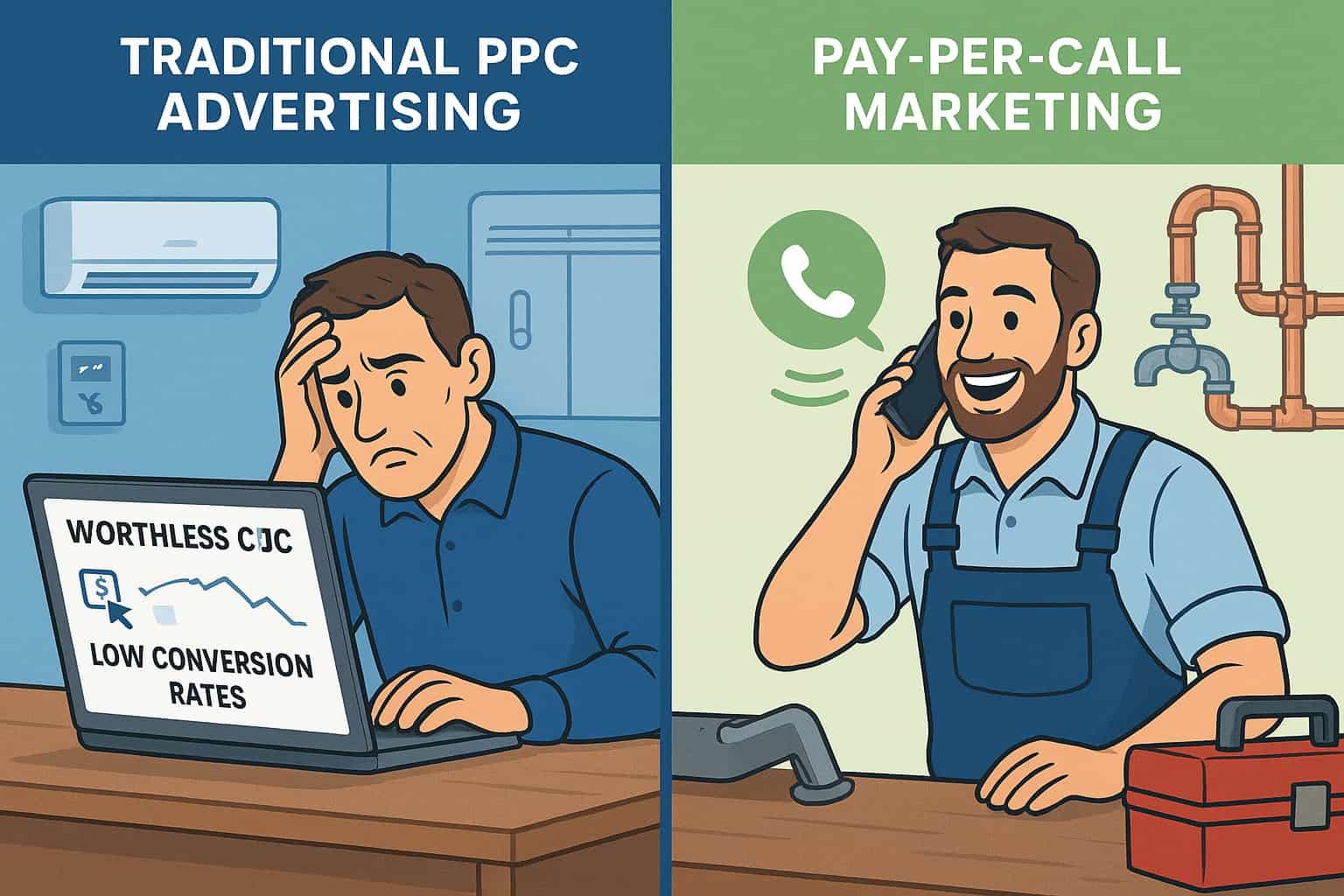
Your Google Ads costs keep climbing. Your leads keep dropping. Sound familiar?
You're not alone. Home service contractors across the country are watching their digital marketing budgets disappear into thin air. Click costs have skyrocketed while conversion rates have plummeted. Plus, you're probably losing thousands to click fraud without even knowing it.
The truth is, traditional pay-per-click advertising is broken for home service businesses. But there's a performance-based alternative that's changing the game: pay per call marketing.
In this guide, you'll discover why pay per call could be your secret weapon. We'll show you how to assess if your business is ready. Plus, you'll get a simple 5-minute self-assessment to determine if this strategy will work for you.
Why Traditional Digital Marketing is Failing
Why Pay Per Call Marketing
The 5-Point Pay Per Call Readiness Test
Essential Technology for Call Success
Your Pay Per Call Action Plan
The home services industry is drowning in competition. In 2024 alone, over 55,000 new janitorial companies opened their doors. That's just one trade. Every service category is seeing massive growth.
This explosion of competitors has created a perfect storm for your marketing budget.
Here's what's happening to advertising costs:
75% of home service businesses saw their cost per click increase
69% experienced higher cost per lead
Roofing contractors pay $10.70 per click on average
Plumbers spend $10.49 per click
Electricians get hit with $12.18 per click
But here's the kicker. Despite these rising costs, your conversion rates are dropping. The average conversion rate for home service businesses fell by 14.96% last year. That means you're paying more for leads that convert less often.
Want to know the real reason your Google Ads aren't working? Click fraud.
Studies show that 14% of all clicks on paid search campaigns are fraudulent. But for home service businesses, it's much worse:
Plumbers see fraud rates up to 46%
Locksmiths face 53% fraudulent clicks
Pest control companies deal with 62% fake clicks
Think about that for a second. If you're spending $10,000 per month on Google Ads, you could be losing $15,000 annually to fake clicks. That's money going straight to competitors and bots.
The competition isn't just hurting your ad costs. It's changing customer behavior too. Homeowners now request six or more bids for a single job. They used to ask for one or two.
This means even when you get a real lead, you're competing against five other contractors. Your close rate drops while your sales costs increase.
So what's the solution? Pay per call marketing changes the entire game.
Instead of paying for clicks that might be fake, you pay only for qualified phone calls. These aren't just any calls either. They're calls that last long enough to indicate real interest (usually 60-90 seconds).
Here's how pay per call stacks up against traditional digital marketing:
Cost Comparison:
Google Ads (Plumbing): $129 per lead average
Local Services Ads (Plumbing): $30-$60 per lead
Pay Per Call (Plumbing): $35-$100 per lead
Lead Quality:
People who call are ready to buy now
No fraud risk like with click-based advertising
Control:
Google Ads: Success depends on bidding wars
Local Services Ads: Google's algorithm controls your leads
Pay Per Call: Your phone skills determine success
Think about it from a customer's perspective. Someone with a burst pipe at 2 AM isn't going to fill out a web form. They're going to call.
Phone calls represent urgent need. Web clicks represent curiosity. That's why phone leads convert so much better.
When someone picks up the phone to call your business, they've already decided they need help. Your job is just to be the contractor they choose.
Pay per call isn't magic. It only works if your business can handle high-quality phone leads properly.
Here are the five areas that determine your success:
This is make-or-break for pay per call leads success. You have to answer the phone.
Sounds obvious, right? But here's the shocking truth. Business owners think they answer 97% of their calls. The reality? Most businesses only answer 66% of calls.
That means you're missing one out of every three potential customers. In the home services world, 85% of people won't call back if you don't answer. They'll just call the next contractor on their list.
The Real Cost of Missed Calls:
Let's say you're a roofing contractor. Your average job is worth $8,500. If you miss just three qualified calls per month, you're leaving $306,000 on the table annually.
Here's how other trades are affected:
Plumbing: Missing 5 calls daily = $1.1 million in lost annual revenue
HVAC: Missing 5 calls daily = $734,400 in lost annual revenue
Roofing: Missing 1.7 calls daily = $5.2 million in lost annual revenue
Professional answering services can solve this problem. They answer 99% of calls compared to 66% for in-house staff. Plus, they capture 86% of leads versus 75% for internal teams.
Not all jobs are created equal. Location matters more than you think.
Drive time kills profit. Every hour your technician spends driving is an hour they're not making money on a job site. Poor route planning can eat up 5% of your company's profits.
Smart contractors create "profit maps" of their service areas. They identify:
High-ticket neighborhoods with short drive times
Low-margin areas that waste resources
Sweet spots where they make the most money
Pay Per Call lets you target specific zip codes. You can focus your marketing budget on areas that generate the most profit. No more wasting money on leads from the wrong side of town.
Pay per call works best for high-value services. Emergency repairs, system replacements, and major installations are perfect fits.
You need to do the math on your business. Here's a simple formula:
Maximum Cost Per Lead = (Average Job Revenue × Profit Margin × Booking Rate) - Sales Costs
For example, if your average roofing job is $8,500 with a 30% profit margin and you book 30% of leads, you can afford to pay up to $765 per lead and still make money.
The key is shifting your mindset. Don't ask "Can I afford this lead?" Ask "Is my business ready to capitalize on this high-quality opportunity?"
Speed kills in home services lead generation. Respond to a lead within five minutes and you're 21 times more likely to qualify them. Wait 30 minutes and your chances plummet.
The first minute is everything. Respond within 60 seconds and your conversion rate jumps 391%. Wait two minutes and that boost drops to 160%.
Here's the beautiful thing about Pay Per Call. Response time isn't an issue. The lead generation and response happen simultaneously. When the phone rings, you're already responding.
But only if you answer the phone.
Answering the phone quickly isn't enough. You need to convert that conversation into a booked appointment.
Many contractors promote great technicians into customer-facing roles without sales training. That's a mistake. Handling inbound leads requires specific skills:
Following a consistent greeting script
Asking qualifying questions about timeline, budget, and decision-making authority
Guiding the conversation toward an in-person appointment
Setting proper expectations for the visit
The goal isn't to sell the entire job over the phone. It's to secure the face-to-face meeting where you can provide an accurate quote.
Pay per call lead generation platforms provide call recordings. This gives you direct insight into what's working and what isn't. You can coach your team based on real conversations with real leads.
To maximize your pay per call investment, you need the right technology stack.
This is non-negotiable. Call tracking platforms like CallRail use unique phone numbers to track which marketing efforts drive calls.
Essential features include:
Real-time analytics dashboards
Call recording and transcription
Spam call filtering
ROI tracking by marketing source
Don't manually enter lead data. That's a waste of time and creates errors.
Connect your call tracking to your CRM or field service management software. ServiceTitan is popular in the trades and integrates well with most call tracking platforms.
This connection lets you track a customer from initial phone call to final invoice. You get true end-to-end ROI measurement.
The latest technology analyzes your call content automatically. AI tools can:
Transcribe and summarize every conversation
Identify customer sentiment and keywords
Spot patterns in successful sales calls
Provide automated coaching after each call
This turns every inbound call into a training opportunity. Your team gets better with every conversation.
Take this 5-minute self-assessment to determine if Pay Per Call is right for your business:
Call Handling (25 points possible):
Call answer rate >95%: 10 points
Call answer rate 80-94%: 5 points
Call answer rate <80%: 0 points
Dedicated person/service for calls: 10 points
Live after-hours coverage: 5 points
Service Area Analysis (20 points possible):
Analyzed profitable zip codes: 10 points
Factor drive time into job costing: 10 points
Average Ticket Value (20 points possible):
Average job >$1,000: 10 points
Average job $400-$999: 5 points
Average job <$400: 0 points
Know conversion rates and acquisition costs: 10 points
Response Time (15 points possible):
Respond to web leads <5 minutes: 15 points
Respond <1 hour: 5 points
Respond >1 hour: 0 points
Sales Skills (20 points possible):
Use consistent call scripts: 10 points
Provide regular sales training: 10 points
80-100 Points: Pay Per Call Ready Your business is primed for success. Start vetting Pay Per Call networks and implement advanced call tracking technology.
50-79 Points: Proceed with Caution You have a solid foundation but critical gaps. Address call handling and sales process issues before scaling a campaign.
Under 50 Points: Not Ready Yet Focus on internal operations first. Fix your phone answering, analyze job profitability, and create basic sales processes.
For the Ready (80-100 points):
Research Pay Per Call networks specializing in home services
Implement call tracking with AI capabilities
Integrate with your CRM/FSM system
Start with a small test budget
For the Cautious (50-79 points):
Install call tracking to measure current performance
Consider professional answering service
Develop inbound call scripts
Train your team on lead qualification
For the Not Ready (Under 50 points):
Establish reliable phone coverage during business hours
Analyze job profitability by location
Create basic sales processes
Master fundamentals before investing in premium leads
Traditional digital marketing is getting more expensive and less effective. Click fraud is stealing your budget. Competition is fierce.
Pay Per Call offers a performance-based alternative. You pay only for qualified conversations with motivated customers. No more wasted clicks. No more fraud. Just real people with real problems who need your services.
But success requires operational excellence. If you can't answer the phone, qualify leads, and convert calls into appointments, Pay Per Call won't help.
Use the assessment above to determine your readiness. Address any gaps before investing. When you're ready, Pay Per Call can transform your lead generation and put you back in control of your marketing ROI.
The question isn't whether Pay Per Call works. It's whether your business is ready to make it work.
Once you're ready to start your first pay per call campaign, sign up for free with ResultCalls!

Hello everyone! My name is Alex and I write these blogs to help educate small business owners on different ways to grow their business. My goal is to make lead generation as easy as possible for you. After reading these blogs, I hope you leave with some actionable steps that will get you closer to growing your business :)