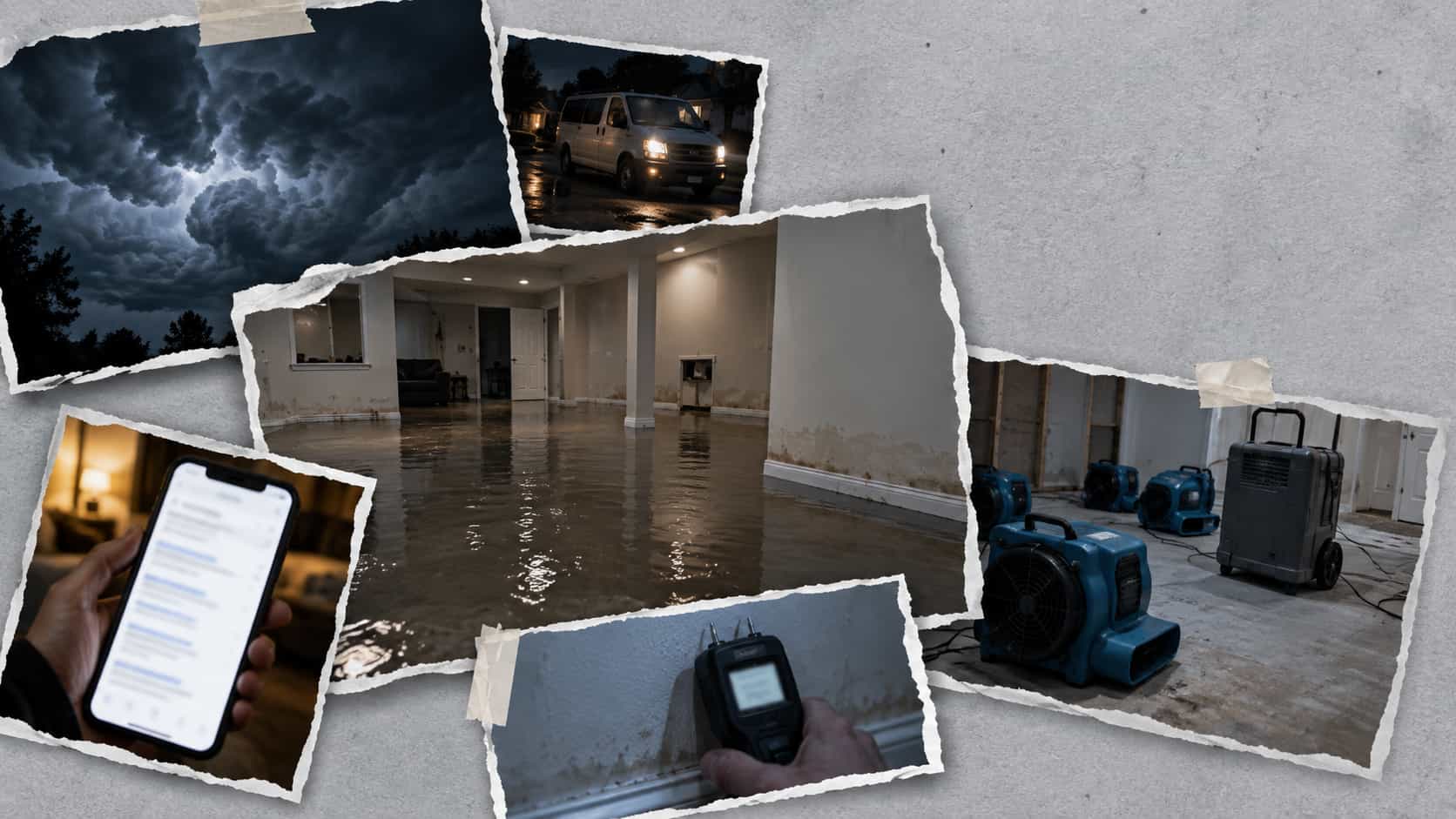
Water damage restoration has the most expensive clicks in home services. Keywords run $50 to $250 per click, and top-market terms exceed $250.
Google Ads lead costs reached a median of $676 in 2026, measured across more than $1.9 million in tracked spend. Highly competitive markets regularly exceed $1,400 per lead.
Google Local Services Ads sit far below that at an average of $154.29 per charged lead. Same homeowner, same emergency, one quarter the cost.
That gap is the whole argument for ranking channels rather than running all of them. Roughly 47% of restoration companies do not track cost per lead by channel, which means half the industry is buying blind.
This guide ranks seven channels from best to worst on cost per booked job, with 2026 benchmarks for each. If you want the version where you pay per call instead of per click, that is what ResultCalls sells.
Ranking Water Damage Restoration Internet Marketing Channels
Google Business Profile and Local SEO
Google Local Services Ads: The Workhorse
Pay Per Call and Exclusive Leads
Google Search Ads: Expensive but Effective
Insurance and TPA Vendor Programs
Meta Ads for Brand and Reactivation
Shared Lead Marketplaces: Last Resort
Building Your 2026 Strategy
Frequently Asked Questions
These seven channels are ranked from best to worst on cost per booked job. Cost per lead is a secondary metric, and cost per click is almost irrelevant in a category where a single click can cost $250.
The ranking uses four criteria, weighted in this order: cost per booked job, speed to first lead, whether the channel compounds, and fit with emergency demand.
The ResultCalls Restoration Channel Tiers group those seven channels into four bands by when a restoration company should buy them:
Tier 1, buy first: Google Business Profile and local SEO, then Google Local Services Ads
Tier 2, buy next: pay per call and exclusive leads, then Google Search Ads
Tier 3, situational: insurance and TPA vendor programs, then Meta Ads
Tier 4, last resort: shared lead marketplaces
About 80% of restoration demand is reactive, which compresses the homeowner decision window to hours. A channel that takes six months to produce a lead ranks differently here than in a trade with planned purchases.
The industry context supports heavy investment. U.S. property restoration is roughly $7.2 billion across 62,582 firms, with 5.6% of insured homes filing a claim in an average year.
Independent restoration companies typically spend 6% to 10% of gross revenue on marketing. Franchises average 3% to 5%. Growth-mode companies push past 15%.
Healthy return on ad spend in restoration runs $8 to $12 per dollar invested. Any channel consistently below $5 needs reallocation.
Google Business Profile and local SEO rank first because they cost nothing per lead and compound over time. SEO delivers a reported 5.3x return in restoration and reduces cost per lead to $75 to $150 once organic rankings establish.
No paid channel in this category comes close to that number.
Complete your Google Business Profile with correct categories, service areas, and hours showing 24/7 availability
Post real job photos monthly, since before-and-after creative generates 2.3x more engagement than stock imagery
Build a review generation habit into every completed job
Create separate service pages for water damage, mold, fire, and storm work
Build city pages only for areas you genuinely serve
SEO takes four to twelve months to produce meaningful volume. It cannot fill an empty schedule next week.
That is why it ranks first on economics and still needs a paid channel running alongside it from day one.
Verdict: the highest-return channel in restoration and the slowest, which is why it belongs first in your plan and never alone.
If your profile is complete and your phone is covered, the constraint becomes call volume rather than visibility. ResultCalls sends exclusive water damage calls where each lead goes to only one company and the homeowner calls your number directly in real time, with no contract and no sign-up fee. Details are on the water damage restoration leads page.
Google Local Services Ads rank second because they charge per lead rather than per click. Water damage LSA leads average $154.29 with a median of $147.62 and a typical range of $89.20 to $315.32.
That pricing model matters more in restoration than in any other trade. At $250 clicks, every wasted click is real money. LSA only charges when a homeowner actually calls or messages.

On a $6,000 average ticket, a $150 LSA lead closing at 25% to 35% produces a customer acquisition cost of roughly $450 to $600. Against a job grossing $1,800 to $2,400, that works.
Budget accordingly:
Start at $1,500 to $3,000 per month to establish volume
Scale to $3,000 to $5,000 once close rate holds
Expect $35 to $100 per lead in smaller markets and $200 to $500 in competitive metros
Answer 24/7 before spending anything, since Google weights responsiveness in placement
A homeowner searching at 2 AM with water spreading across a floor makes a fast, high-stakes decision. The badge is the strongest trust signal available in that moment.
Verdict: the best paid channel in restoration, and the first dollar most companies should spend.
Pay per call ranks third because it delivers a live homeowner on the phone with no ad account to manage. Exclusive restoration leads from lead generation services run $400 to $750 or more, and premium exclusive calls in top markets reach $2,250.
Those prices look high next to a $154 LSA lead. They sit well below a $676 median Google Ads lead.
Filling capacity during slow weeks without raising a fixed ad budget
Covering storm surges when your own campaigns cannot scale fast enough
Entering a new service area before your SEO or LSA presence exists there
Testing a market before committing to a $15,000 monthly ad program
Pay per call builds no asset. Google Business Profile and SEO keep producing after you stop paying. Bought calls stop the day you pause.
Treat it as the volume layer rather than the foundation. That is the correct role for it, and any vendor telling you otherwise is selling.
Verdict: the fastest way to add restoration volume without an agency retainer, and the wrong choice as your only channel.
Google Search Ads rank fourth because they produce the most expensive leads in the category and still convert well enough to justify themselves. Median lead cost hit $676 in 2026, up from $557 in 2025 and $504 in 2024. Google Search Ads in competitive markets run $300 to $500 per lead.
Cost per click averages $18 to $45, among the highest of any service category, and near-me water damage terms run $60 to $85.

Water damage PPC ads convert above 18%, which is exceptional for paid search. Emergency water removal keywords outperform general restoration keywords by 42% on conversion rate.
At a $3,500 to $8,000 average job ticket, a $300 lead cost still returns roughly 10x. The math works when the campaign is structured properly.
Running emergency and research keywords in the same campaign, so budget drains on information seekers
Optimizing for form fills when most emergency contacts arrive by phone
Failing to feed booked job revenue back into Google's algorithm
Bidding in competitive metros without the $15,000 monthly budget those markets require
Best-performing campaigns rarely produce leads below $300. If a vendor promises $80 restoration leads on Google Ads, ask what they mean by lead.
Verdict: necessary in most markets and punishing on small budgets, so run it only with proper campaign separation and call tracking.
Insurance carrier and third-party administrator vendor programs rank fifth because they produce high-value claim work with no per-lead cost and take months or years to access. You cannot buy your way onto these lists.
They are relationship channels wearing a marketing label.
IICRC certification and documented crew credentials
Consistent Xactimate estimating and documentation standards
Response time commitments, often measured in hours
Insurance, bonding, and capacity thresholds that exclude small operators
A track record the program can verify before adding you
The work is valuable and the acquisition cost approaches zero once you are on a list. The barrier is time, and the volume is not yours to control.
Programs also set pricing and documentation terms you accept rather than negotiate. That trade is reasonable for steady volume and wrong if it becomes your only source.
Verdict: build toward these deliberately while paid channels carry you, and never let one program become more than a third of your revenue.
Meta Ads rank sixth because the cost per lead is genuinely low and the intent is genuinely wrong for emergency work. Meta produces home service leads at $32 to $58, roughly half what Google Ads costs in the same vertical.
A homeowner scrolling Instagram is not standing in six inches of water. That intent gap is why the low cost per lead does not translate into booked emergency work.
Brand presence in your service area before the emergency happens
Reactivation campaigns to past customers and their neighborhoods
Storm response targeting after a regional weather event
Recruiting technicians, which is a real constraint in restoration
Judging Meta on cost per booked job against LSA will always make it look bad. Judge it on assisted conversions and brand search lift instead.
Verdict: a supporting channel that works for awareness and reactivation, and a poor primary source for emergency demand.
Shared lead marketplaces rank last because the same homeowner goes to several restoration companies at once. Shared restoration leads cost $200 to $350, against $400 to $750 for exclusive leads from the same category of vendor.
The gap looks like a discount. It is a close rate reduction.

A shared lead at $275 closing at 10% costs $2,750 per booked job. An exclusive lead at $550 closing at 30% costs $1,833.
The cheaper lead produced the more expensive customer, which is the same pattern that holds across every home service vertical.
Shared marketplaces can fill a genuinely empty week if you answer within minutes every time. Emergency leads disappear quickly, and every missed call raises your effective cost per lead.
Verdict: a stopgap for an empty schedule, never a foundation, and only worth it if your answer rate is close to perfect.
Three actions turn this ranking into a budget. Complete them in this order.
Emergency leads disappear within minutes, and 80% of restoration demand is reactive. No channel on this list survives a phone that rolls to voicemail at 2 AM.

Complete your Google Business Profile, then turn on Local Services Ads at $1,500 to $3,000 monthly. At $154 per lead against a $676 Google Ads median, nothing else competes on cost per booked job.
Roughly 47% of restoration companies do not. Split your spend 40% to 50% on immediate lead generation, 25% to 30% on relationships and referrals, and 20% to 25% on SEO and content.
Google Business Profile and local SEO produce the lowest cost per lead at $75 to $150 once established, with a reported 5.3x return. Google Local Services Ads are the best paid channel at an average $154.29 per lead. SEO takes four to twelve months, so most companies should run both from the start.
It depends entirely on channel. Google Local Services Ads average $154.29 per charged lead with a range of $89.20 to $315.32. Google Ads median lead cost reached $676, with competitive markets exceeding $1,400. Shared marketplace leads run $200 to $350 and exclusive leads $400 to $750 or more.
Independent restoration companies typically spend 6% to 10% of gross revenue, while franchises average 3% to 5% and growth-mode companies exceed 15%. Competitive metros generally need a minimum of $15,000 monthly for consistent lead flow, while smaller markets can work with $5,000 to $10,000.
Yes, with proper campaign structure and a real budget. Water damage PPC converts above 18% and a $300 lead still returns roughly 10x on a $3,500 to $8,000 ticket. The failure mode is mixing emergency and research keywords in one campaign, which drains budget on people who are not calling anyone.
Because demand is emergency-driven and every competitor bids on the same few terms at the same moment. Keywords run $50 to $250 per click, among the highest in home services, and Google Ads CPC has risen more than 35% since 2022. Pay-per-lead channels like Local Services Ads exist specifically to protect you from that click cost.
Water damage restoration internet marketing gets expensive fast because everyone bids on the same emergency at the same time. The ranking above is not about finding a cheap channel. It is about buying in the right order.
Fix the phone, finish the profile, turn on Local Services Ads, then add volume on top. Most companies invert that sequence and pay $676 a lead to learn it.
When you need volume the owned channels cannot produce yet, buying calls one at a time carries no retainer and no contract. Start with a small batch of pay per call water damage leads and measure cost per booked job against your LSA numbers.

Hello everyone! My name is Alex and I write these blogs to help educate small business owners on different ways to grow their business. My goal is to make lead generation as easy as possible for you. After reading these blogs, I hope you leave with some actionable steps that will get you closer to growing your business :)