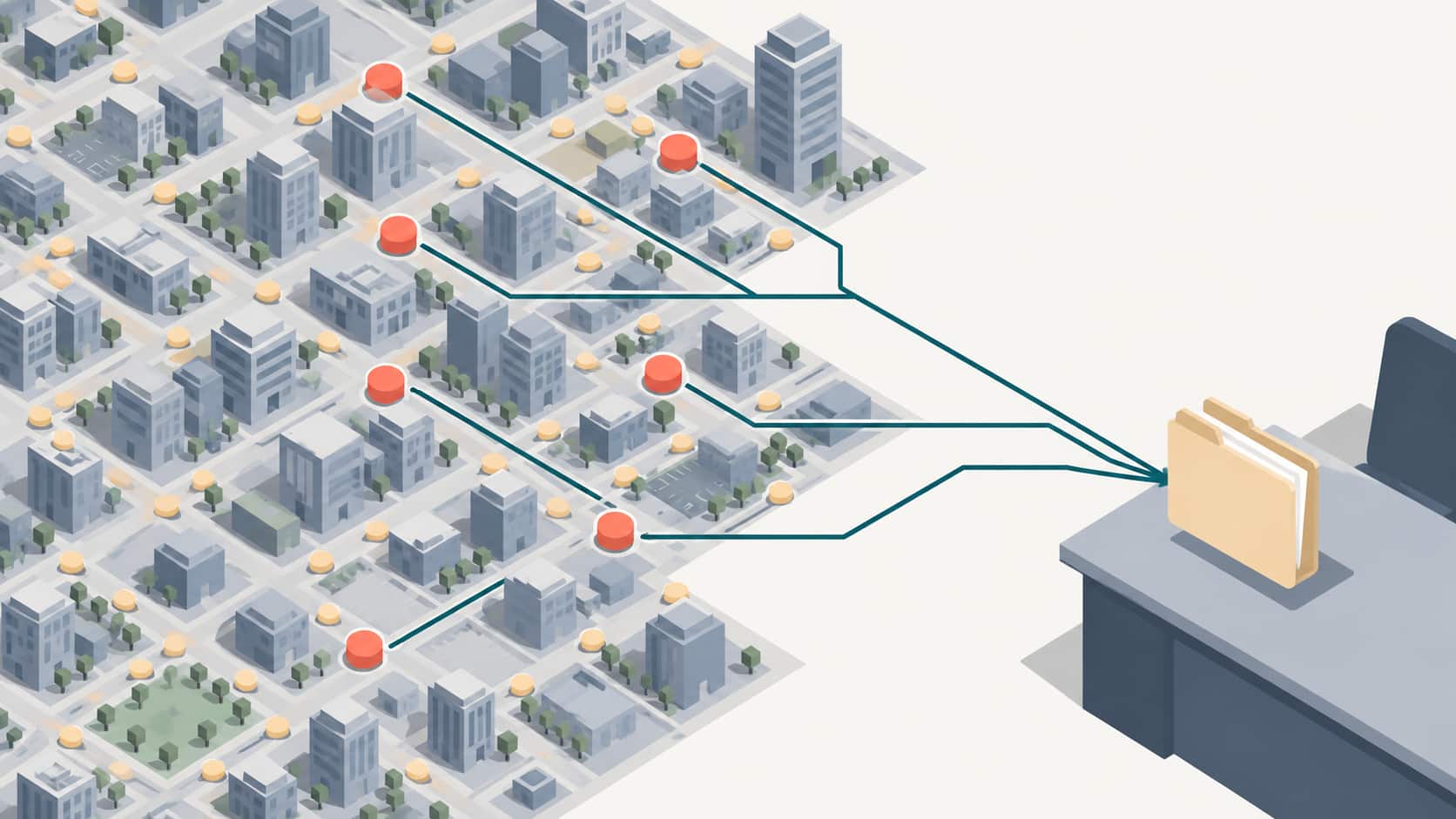
Franchise auto insurance leads fail for a reason that has nothing to do with lead quality. The call routes to a location that cannot legally write the policy.
A non-resident license is not the same as a carrier appointment. Three conditions must all be true before a producer can sell in a state: the non-resident license is issued, the carrier is licensed in that state, and the carrier has appointed the producer in that state.
Multi-location operations build territory maps first and discover the licensing gaps afterward. By then they have paid for calls they cannot convert.
The stakes scale with the network. Goosehead operates roughly 1,115 locations with average yearly gross sales near $248,707 per unit. Brightway runs 350 agencies against $1.7 billion in premium.
This guide lays out a four-layer framework for routing auto insurance calls across locations, built in the order that prevents the failure above. Nothing here is legal or compliance advice. If you want exclusive inbound calls to route, ResultCalls sells them.
What Franchise Auto Insurance Leads Require
The ResultCalls Location Stack Explained
Layer 1: Authority Before Anything Else
Layer 2: Mapping Territory to Locations
Layer 3: Franchise Call Routing Rules
Layer 4: Location-Level Reporting That Works
How to Allocate Budget Across Locations
Where Multi-Location Lead Programs Break
Building Your 2026 Strategy
Frequently Asked Questions
Franchise auto insurance leads require four things a single-location agency does not need: verified authority per state, a territory map, routing rules, and location-level attribution. Miss any one and the program leaks money at a specific, identifiable point.
Single-location agencies skip all four. One office, one state, one phone number, one report.
Calls must reach a specific office rather than a general queue
Each office may hold different carrier appointments and different lines of authority
Overflow between offices becomes a compliance question, not just an operational one
Budget has to be split, and franchisees will ask why their split is what it is
Reporting must attribute a policy to both a source and a location
Franchise networks introduce ownership boundaries that captive or corporate multi-location operations do not have. A franchisee owns their book, pays royalties, and has a contractual territory.
Goosehead franchisees share commissions at 20% of gross revenues on new business and 50% on renewals. Brightway franchisees keep 80% of new business commission. Those economics determine who will tolerate which routing rules.
The ResultCalls Location Stack is a four-layer framework for running auto insurance leads across multiple locations. Each layer depends on the one below it, so you build from the bottom.
The layers are Authority, Territory, Routing, and Proof.
Layer 1, Authority: what each location is legally permitted to write, by state, line, and carrier
Layer 2, Territory: which zip codes and states map to which location
Layer 3, Routing: how an inbound call reaches the correct office, including overflow and after-hours
Layer 4, Proof: location-level reporting that attributes each bound policy to a source and an office
Authority sits at the bottom because it is the only layer with legal consequences. A routing rule that sends a Nevada caller to an office without Nevada authority is not an inefficiency. It is a compliance exposure.
Territory sits above authority because you cannot assign a state you are not authorized to write. Routing sits above territory because rules need a map. Proof sits on top because attribution requires all three below it to be stable.
Most operations build layers 2 and 3 first, then retrofit 1 and 4. That sequence produces the failure this guide exists to prevent.
ResultCalls delivers exclusive auto insurance calls where each lead goes to only one agency, and the caller reaches your number directly in real time. Pricing runs on pay per call with no contract and no sign-up fee. Details are on the auto insurance leads page.
Authority is the combination of producer license and carrier appointment that permits a specific office to write a specific policy in a specific state. Build an authority matrix before you buy a single lead.
Licensing is the easier half. Carrier appointments are the half that blocks you.

All 50 states and the District of Columbia certify as reciprocal under NAIC Uniform Licensing Standards, adopted after the 1999 Gramm-Leach-Bliley Act. A producer with an active resident license typically skips the exam in a new state.
The practical numbers:
Applications file through NIPR with a 2 to 7 day turnaround for clean applicants
State fees run roughly $30 to $60 in low-fee states, $60 to $150 in most of the country, and $150 to $200 or more in California, Florida, and parts of the Northeast
NIPR adds a transaction fee of roughly $5 to $6 per application
Per-license cost lands near $80 to $150 in fees plus 0.6 to 1.2 hours of admin per year
Continuing education, not state fees, is the largest ongoing cost driver in multi-state licensure
A license grants the legal right to sell. An appointment grants something to sell. They are separate steps with separate timelines.
Appointments typically take 2 to 8 weeks per carrier, and each carrier requires its own. Appointment fees run $10 to $100 per carrier per state, though many insurers cover them.
For an agency with a national client base, 10 to 20 non-resident licenses is not unusual. Multiply that by your carrier count and the matrix gets large quickly.
California, New York, and Hawaii operate under different rules that require extra steps. New York in particular requires an entity license alongside the individual non-resident license when business is placed through a brokerage entity.
Confirm every requirement with your compliance team and the relevant state department of insurance. NARAB II was authorized by federal law in 2015 to create a single national producer license and has never launched, so per-state work remains the reality.
The territory map assigns every zip code in your footprint to exactly one primary location. Build it only for states where Layer 1 confirms authority.
Every zip needs a primary owner and a named backup. Ambiguity here becomes a routing failure later.
Primary location for each zip code, with no gaps and no overlaps
Backup location for overflow, verified as holding the same authority
State boundary flags, since a metro can span two states with different authority
Franchise contractual territory boundaries, where they exist
An exclusion list for zips where no location holds authority

Kansas City, St. Louis, Philadelphia, Charlotte, and Memphis all span state lines. A caller two miles from your office may sit in a state you cannot write.
Map by state first, then by zip inside each state. Reversing that order is how multi state auto insurance leads end up routed to offices without authority.
Franchise agreements often define protected territories. Routing a call across that boundary can breach the agreement even when both offices hold the same authority.
Read the franchise disclosure document before you design the map. Territory rules override operational convenience.
Franchise call routing sends each inbound call to the location that owns its zip code and holds authority for its state. Routing rules sit on top of the territory map and add time, capacity, and overflow logic.
Write the rules down. Routing that lives in one person's head fails the week they take vacation.
Primary routing by zip code to the owning location
Business hours routing, adjusted per location for time zone
Overflow routing to a backup location holding matching authority
After-hours routing to a central desk, an answering service, or an AI receptionist
A hard block on any state where no location holds authority
A network spanning Eastern and Pacific offices has a six-hour spread between the first office opening and the last one closing. A 7:30 AM Eastern call has no open office. A 5:30 PM Pacific call has only one.
Use that spread deliberately. Route early Eastern calls to a West Coast office only if authority permits, and cover the tails with a central desk.
Overflow between locations looks like an operations choice. In insurance it is an authority question first.
Before you enable any overflow path, confirm the backup location holds the license and appointment for the caller's state. Build the block into the routing logic rather than relying on the receiving producer to catch it.
Location level reporting attributes every inbound call and every bound policy to both a marketing source and a specific office. Without both dimensions you cannot tell a weak location from a weak source.
This is where most multi-location programs stay blind.
Location ID on every call record, assigned at routing time
Source or campaign ID, carried from the tracking number
Caller state, which validates the routing decision after the fact
Quoted or not quoted, set by the producer
Bound or not bound, with premium and carrier
Time from call to first contact, measured in minutes
Build a source-by-location matrix and a routing exception report. Nothing else matters until those two exist.
The source-by-location matrix shows cost per bound policy for every combination. A source performing at $112 per policy in Phoenix and $340 in Tampa is a location problem, not a source problem.
The routing exception report lists every call where the caller state did not match the receiving location's authority. That number should be zero. It rarely is on first audit.
Shared auto leads at $12 converting at 10% cost about $120 per bound policy. Exclusive leads at $28 converting at 25% cost about $112. Connected calls commonly price at $45 to $65.
Use those as a reference band. Any location running far outside it deserves a conversation before you change the budget.
Allocate budget by capacity and close rate, not by location count or by seniority. Equal splits feel fair and produce worse results than performance-weighted splits.
Franchise networks complicate this, because franchisees own their books and will notice any allocation they consider unfair.

Equal split: simple, politically easy, ignores capacity and performance entirely
Territory-weighted: allocates by population or licensed driver count in each location's zips
Performance-weighted: allocates by cost per bound policy, moving budget toward locations that convert
Run territory-weighted allocation for 60 to 90 days while you collect location-level data. Then shift toward performance weighting with a floor, so no location drops to zero while it improves.
Publish the formula to every location before you apply it. A transparent rule creates less friction than a fair outcome nobody can predict.
Average yearly gross sales per Goosehead unit sit near $248,707. Brightway franchisees retain 80% of new business commission.
Those figures set what a location can afford. A unit doing $250,000 in gross sales cannot absorb the lead budget of one doing $900,000, regardless of how the territory looks on a map.
Multi-location lead programs break at five predictable points. Four of them trace back to skipping Layer 1.
Calls route to offices without authority for the caller's state, producing unconvertible leads and compliance exposure
A license lapses and nobody notices, because renewal tracking sits in a spreadsheet
Overflow paths ignore authority, so backup routing quietly creates the same problem
Location ID never reaches the CRM, so reporting cannot separate location from source
Budget stays on an equal split for years because changing it is politically harder than losing money
Pull 100 recent calls. For each, check the caller state against the receiving location's authority matrix and confirm a location ID reached your CRM.
Run it quarterly. Licenses lapse, appointments change, and franchisees open and close locations without the routing table being updated.
TCPA and state mini-TCPA statutes govern how purchased leads are generated and contacted, and post-January 2025 one-to-one consent rules apply to data leads. Attorney and insurance advertising rules vary by state.
Work these questions with your own compliance counsel. This guide describes operational structure, not legal requirements.
Three actions build the Location Stack from the bottom. Complete them in this order.
List every location down one axis and every state and carrier across the other. Mark each cell as licensed, appointed, both, or neither. Buy no leads for any state that is not fully marked.

Assign it at routing time and carry it into your CRM. Without location ID you cannot build the source-by-location matrix, and without that matrix every budget conversation is guesswork.
Check caller state against receiving location authority on 100 recent calls. Any exception count above zero is a routing rule to fix this week, not this quarter.
Franchise auto insurance leads need authority verification, a territory map, routing rules, and location-level attribution that single-location agencies skip entirely. The core difference is that a call can route to an office that cannot legally write the policy. Franchise agreements also define protected territories that override operational convenience.
Only where three conditions are met: the producer holds a non-resident license in that state, the carrier is licensed there, and the carrier has appointed the producer there. All 50 states and DC grant reciprocal non-resident licensing through NIPR with a 2 to 7 day turnaround, but appointments take 2 to 8 weeks per carrier and are the real gate.
State fees run roughly $30 to $60 in low-fee states, $60 to $150 in most of the country, and $150 to $200 or more in California, Florida, and parts of the Northeast, plus a NIPR transaction fee near $5. Appointment fees add $10 to $100 per carrier per state, though many insurers cover them. Continuing education, not state fees, is the largest ongoing cost.
Start territory-weighted by population in each location's assigned zips, then move to performance-weighted by cost per bound policy after 60 to 90 days of data. Keep a floor so no location drops to zero while it improves. Publish the formula before applying it, since a predictable rule creates less friction than an unexplained outcome.
Two reports. A source-by-location matrix showing cost per bound policy for every combination, and a routing exception report listing every call where caller state did not match the receiving location's authority. The second number should be zero and rarely is on first audit.
Franchise auto insurance leads work when the stack is built in order. Authority, then territory, then routing, then proof.
Most networks reverse it, and the cost shows up as unconvertible calls and reports nobody trusts. Fixing the order is cheaper than fixing the symptoms.
Build the authority matrix this month, add location ID to every call record, and run the 100-call audit. Then route a small batch of exclusive auto insurance calls through the stack and measure cost per bound policy by location.

Hello everyone! My name is Alex and I write these blogs to help educate small business owners on different ways to grow their business. My goal is to make lead generation as easy as possible for you. After reading these blogs, I hope you leave with some actionable steps that will get you closer to growing your business :)