You're tired of wasting money on clicks that never convert. You're frustrated with paying for leads that five other contractors also bought. And you're sick of click fraud eating up your advertising budget.
What is pay per call marketing? It's a performance-based model where you pay only when a qualified customer actually calls your business. That's exactly what this pay per call advertising approach offers home service contractors.
This marketing approach flips the script on traditional advertising. Instead of paying for website visits or shared leads, you invest only in actual phone conversations with homeowners who need your services right now.
You'll discover how to set up profitable Pay Per Call campaigns, handle high-converting phone calls, and measure real ROI from your marketing spend.
Why Pay Per Call Lead Generation Beats Clicks
How Pay Per Call Works for Home Services
Home Services Lead Generation Setup
Converting Calls Into Paying Jobs
Measuring and Improving Your Results
Here's the reality of how customers find contractors today. 70% of all home service searches now happen on mobile devices. When someone's water heater breaks or their AC stops working, they grab their phone and search for help.
These aren't casual browsers. They're homeowners with urgent problems who want immediate solutions. Phone call leads represent the highest intent possible.
65% of people prefer calling a business directly instead of filling out web forms. This preference is even stronger for home services because these jobs require trust and quick action. When a pipe bursts, homeowners want the confidence of talking to a real person, not the uncertainty of waiting for an email response.
The mobile-first reality makes phone calls the natural conversion point. Click-to-call functionality puts customers one tap away from reaching your business.
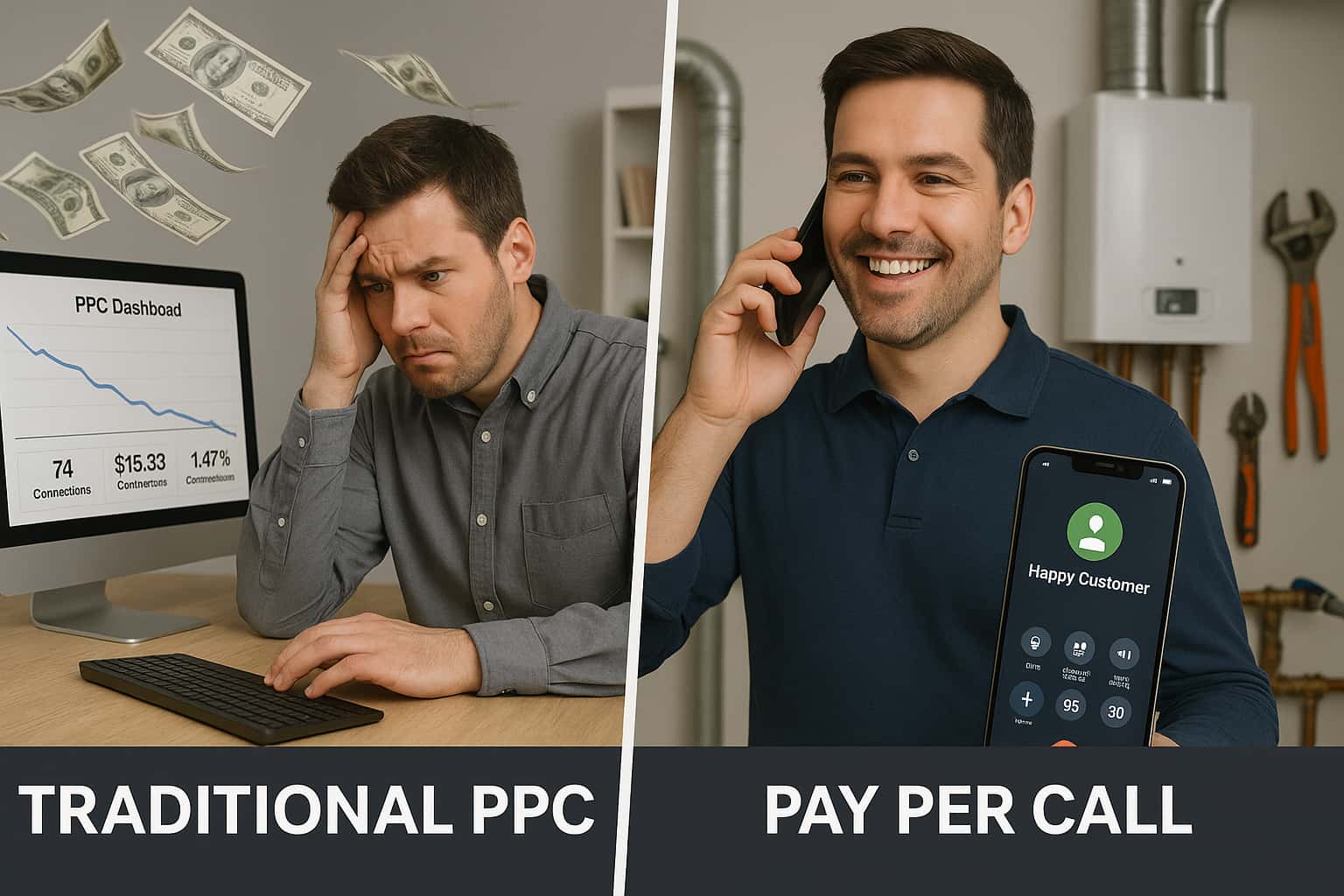
Pay-per-click advertising forces you to pay for every website visitor, regardless of their intent or quality. This creates massive waste in your marketing budget compared to pay per lead services that focus on actual customer contact.
Click fraud affects up to 60% of all paid ads in home service industries. Plumbing businesses see 46% fraud rates, while pest control companies face 62% fake clicks. You're literally paying for bots and competitors to visit your website.
The costs are getting ridiculous too. Emergency plumber clicks cost $15-30 each. In competitive markets, a single "plumber near me" click can cost $120. You could pay hundreds of dollars just to get someone to your website, with no guarantee they'll ever contact you.
Plus, you're competing against every other contractor bidding on the same keywords. This Google Ads vs pay per call comparison shows why traditional PPC creates higher costs, lower quality traffic, and zero exclusivity for most home service businesses.
Lead aggregators like Angi and HomeAdvisor sell the same lead to multiple contractors. You're competing against 5-7 other businesses for every single lead. The first contractor to call usually wins, creating a frantic competition that benefits no one except the platform.
This model frustrates homeowners too. They get bombarded with calls from multiple companies, which makes them less likely to hire anyone. Only 5-15% of shared leads ever convert into paying jobs.
Contractors report spending around $1,430 to acquire each customer through these platforms. The combination of low conversion rates, high competition, and frustrated customers makes shared leads a poor investment for most businesses.
Pay per call flips the entire model. You only pay when a qualified customer actually calls your business. No wasted clicks, no shared leads, no competition for the same prospect.
Phone calls convert 10-15 times better than web form submissions. When someone takes time to call, they're not just browsing. They have a real problem and they're ready to hire someone to fix it.
You get exclusive phone leads with no competition. There's no race against other contractors because you're the only business they're talking to. This lets you have a real conversation, build trust, and close more jobs.
Pay per call networks partner with marketing specialists called publishers. These aren't your employees - they're independent marketers who get paid only when they deliver qualified calls to your business.
Publishers use proven traffic sources to reach homeowners at the moment of need. This local business advertising approach targets customers exactly when they need your services.
Search engine marketing targets high-intent keywords like "emergency plumber near me" and "AC repair today." Search engine optimization captures homeowners searching for your services organically. Social media advertising reaches homeowners on Facebook and Instagram with prominent "Call Now" buttons.
Publishers also use home service directories and local advertising to connect with customers actively looking for contractors.
When a homeowner sees an ad and decides to call, sophisticated technology kicks in to qualify and route that call. Here's what happens in seconds:
Unique tracking numbers let the system know exactly which ad generated each call. Dynamic number insertion even tracks which specific keyword someone searched before calling.
Interactive voice response (IVR) systems answer the call first. The automated system asks callers to select their service needs, filtering out non-serious inquiries and gathering important information.
Intelligent routing uses the caller's location and service needs to instantly connect them with the right contractor. A homeowner calling about water heater installation gets routed to contractors who handle that service in their area.
Real-time bidding lets multiple contractors compete for the best calls. When a qualified call comes in, contractors' systems automatically bid based on their target criteria and budget.
You don't pay for every call - only the ones that meet specific quality standards. Calls must last 60-120 seconds minimum to qualify as billable leads. This simple filter eliminates wrong numbers, spam calls, and uninterested callers.
The caller must be located in your service area and requesting services you actually provide. Geographic and service matching ensures you only pay for leads you can actually convert.
If you receive an invalid call - like a sales pitch or wrong number - you can dispute the charge. Reputable networks provide call recordings so you can verify lead quality and get credits for invalid calls.
Start by identifying your highest-margin services. A complete HVAC system replacement generates more profit than a simple drain cleaning. Emergency repairs often command premium pricing compared to routine maintenance. Lead generation for HVAC and roofing contractors should focus on these high-value opportunities.
Work with your pay per call partner to define specific business categories for your campaign. This focus ensures your marketing budget targets the jobs that contribute most to your bottom line.
This strategic thinking forces a valuable business analysis. You'll evaluate the profitability of your entire service menu and concentrate growth efforts on the most lucrative opportunities.
Excessive drive time kills profit margins through higher fuel costs and non-billable labor hours. Define your service area strategically to maximize efficiency. Lead generation for plumbers works best when focused on profitable geographic zones.
Pay per call offers precise geographic targeting. You can specify exact zip codes, cities, counties, or set a radius around your location. Every call you pay for comes from your operational sweet spot - close enough to serve profitably but far enough to represent new business opportunities.
This prevents wasted spending on leads that are too far away to service cost-effectively.
Control when you receive leads by establishing specific business hours during campaign setup. Your network will only route calls when you're available to answer them live.
85% of callers who reach voicemail won't call back. There's no value paying for high-intent calls that arrive after hours and go unanswered.
Businesses offering 24/7 emergency services can run campaigns around the clock. However, this requires proper infrastructure like overnight staff or professional answering services to capture every lead.
Before setting bid prices, determine what a new customer is worth to your business. Calculate your Maximum Allowable Cost Per Lead (Max CPL) using this simple framework:
Determine your Average Profit Per Deal: If an average HVAC repair costs $400 and your profit margin is 50%, your profit is $200 per job.
Calculate your Leads Per Deal: If you book one job for every four qualified calls, your leads-per-deal ratio is 4.
Decide your trade amount: How much profit are you willing to invest to acquire a new customer? From $200 profit, you might trade $80 to secure the job.
Calculate Max CPL: Divide your trade amount by leads per deal. $80 ÷ 4 = $20 maximum cost per lead.
This gives you a clear, defensible benchmark for all marketing investments.
Your Pay Per Call network acts as the engine connecting you with qualified calls. Evaluate partners based on dynamic campaign management, transparent reporting, reliable call volume, and strong fraud prevention.
Watch for red flags like long-term contracts, unusually cheap leads, or charging for every call regardless of quality. Reputable providers structure pricing around performance with no setup fees or cancellation penalties.
Look for partners who provide real-time dashboards, detailed analytics, and the ability to easily adjust campaign parameters as your business needs change.
Speed is everything in lead conversion. Responding within five minutes makes leads 21 times more likely to convert compared to waiting 30 minutes. Conversion rates drop 8X after just five minutes.
Pay Per Call eliminates response time delays by delivering live callers directly to your phone. 35-50% of sales go to the vendor who responds first. By simply answering immediately, you become the first responder.
A one-minute response time can boost conversions by 391%. Waiting just one additional minute cuts that improvement in half to 160%. The lesson is clear: answer your phone immediately.
Business owners think they answer 97% of calls, but actually answer only 66%. This means one-third of high-intent leads go to voicemail or remain unanswered entirely.
85% of unanswered callers won't call back, and 80% would rather contact a competitor than leave voicemail. For a roofing contractor, missing just three qualified calls monthly could mean $25,000-45,000 in lost annual revenue.
Improving answer rates from 66% to 100% could increase new business revenue by 54% without spending additional marketing dollars. The biggest growth opportunity for most contractors isn't getting more leads - it's capturing the ones they already receive.
64% of homeowners say a business's ability to answer the phone influences their hiring decision. Your phone script can make or break lead conversion.
Start with a professional greeting that immediately identifies your company: "Thank you for calling [Company Name]. This is [Name]. How can I help you today?"
Ask qualifying questions to understand their needs: "Could you tell me more about the problem you're experiencing?" and "How long has this been happening?" Always confirm they're the property owner and decision-maker.
Communicate your value proposition by acknowledging their frustration and positioning your expertise: "I understand how stressful a broken AC can be in this heat. Our certified technicians specialize in quick diagnosis and repair to get your home comfortable again."
Close with a clear call to action: "We can definitely help with that. I have an opening this afternoon at 2 PM, or would tomorrow morning work better?"
Modern Pay Per Call platforms record every conversation for training and optimization purposes. These recordings provide objective insights into your team's performance.
Review recordings regularly to identify strengths and weaknesses in your call handling. Look for patterns in pricing objections, competitor mentions, and common customer concerns.
AI-powered conversation intelligence can automatically analyze calls, flag important keywords, measure customer sentiment, and provide personalized coaching feedback. This technology enables scalable, data-driven training that systematically improves your entire team's booking rate.
Reputable Pay Per Call platforms provide real-time dashboards showing campaign performance transparently. Key metrics to monitor on your dashboard include:
Total calls shows your campaign's reach and volume. Billable calls represents qualified leads meeting your criteria that you actually pay for. Cost per lead (CPL) divides total spend by billable calls to show your true lead acquisition cost.
Conversion rate measures the percentage of qualified calls your team books into appointments. This metric directly reflects your internal sales process effectiveness.
Call recordings and transcripts offer qualitative insights beyond dashboard numbers. Regular review provides an unfiltered window into customer thinking.
Identify common pain points, frequently asked questions, and recurring objections. Note competitive mentions and pricing concerns that come up repeatedly., frequently asked questions, and recurring objections. Note competitive mentions and pricing concerns that come up repeatedly.
Use these insights to refine ad copy, update website FAQ sections, and train staff on handling objections. Your call center becomes a powerful market research tool providing real-time customer feedback.
Pay Per Call's power lies in continuous optimization using real performance data. Work with your network partner to make strategic improvements:
Adjust bids dynamically based on conversion data. If weekend morning calls convert better, increase bids for those time periods. Refine keyword targeting by allocating more budget to terms driving the most valuable calls.
Control lead flow by pausing campaigns when you're fully booked. This prevents paying for leads you can't service while giving you complete pipeline control.
Track leads from source through closed jobs to measure real ROI. The basic formula: Revenue from jobs minus campaign cost, divided by campaign cost, times 100.
For deeper insights, consider Customer Lifetime Value (CLV) beyond the initial service call. A single plumbing repair could lead to annual maintenance contracts, future installations, and valuable referrals.
Calculate CLV using: Average purchase value × Average purchase frequency × Average customer lifespan.
Long-term customer value often justifies higher initial lead costs when measured against years of potential revenue rather than single transactions.
The data from Pay Per Call campaigns provides real-time business intelligence beyond marketing metrics. Analyze call patterns, service requests, and geographic trends to make informed decisions about staffing, inventory, pricing, and expansion opportunities.
Pay Per Call marketing transforms how home service contractors acquire customers. You pay only for qualified phone conversations with homeowners who need your services right now. No more wasted clicks, no more shared leads, no more frustrated customers.
The biggest opportunity isn't getting more leads - it's properly handling the high-intent calls you receive. Answer every call immediately, use proven scripts, and track your results to maximize ROI from this powerful marketing channel.
Start by calculating your maximum cost per lead and defining your most profitable services. Then partner with a reputable Pay Per Call network that provides transparent reporting and quality controls.
Your phone is your most valuable business tool. Make sure you're using it to capture every possible customer opportunity.
Once you're ready to start your first pay per call campaign, sign up for free with ResultCalls!

Hello everyone! My name is Alex and I write these blogs to help educate small business owners on different ways to grow their business. My goal is to make lead generation as easy as possible for you. After reading these blogs, I hope you leave with some actionable steps that will get you closer to growing your business :)