Your clients expect personal attention. But you're drowning in paperwork, missed follow-ups, and policy renewals. Sound familiar?
The truth is simple. Insurance agent automation isn't about replacing personal relationships. It's about freeing up time to build them. 96% retention becomes achievable when you stop chasing spreadsheets.
This guide reveals how leading insurance agencies use automation to handle routine tasks while focusing on what matters most - building client loyalty. You'll discover proven SMS strategies, renewal automation systems, and CRM workflows that transform scattered processes into predictable revenue.
Ready to reclaim your day and boost client retention? Let's dive into the automation systems that work.
Table of Contents
Why Insurance Agent Automation Matters
Auto Insurance SMS Marketing That Works
Insurance Policy Renewal Reminders Systems
Insurance Agent CRM Best Practices
Automated Insurance Follow-up Strategies
Measuring Your Automation Success
Your biggest competitor isn't another agency down the street. It's client indifference.
The average insurance agency has a client retention rate of approximately 84%. This means they must increase new business sales by 16% annually just to break even. The main reason clients leave? Lack of meaningful communication.
Here's what happens when communication fails. Policy renewal dates pass unnoticed. Clients feel forgotten. They shop around and find better prices. Your agency loses a trusted relationship plus all future revenue.
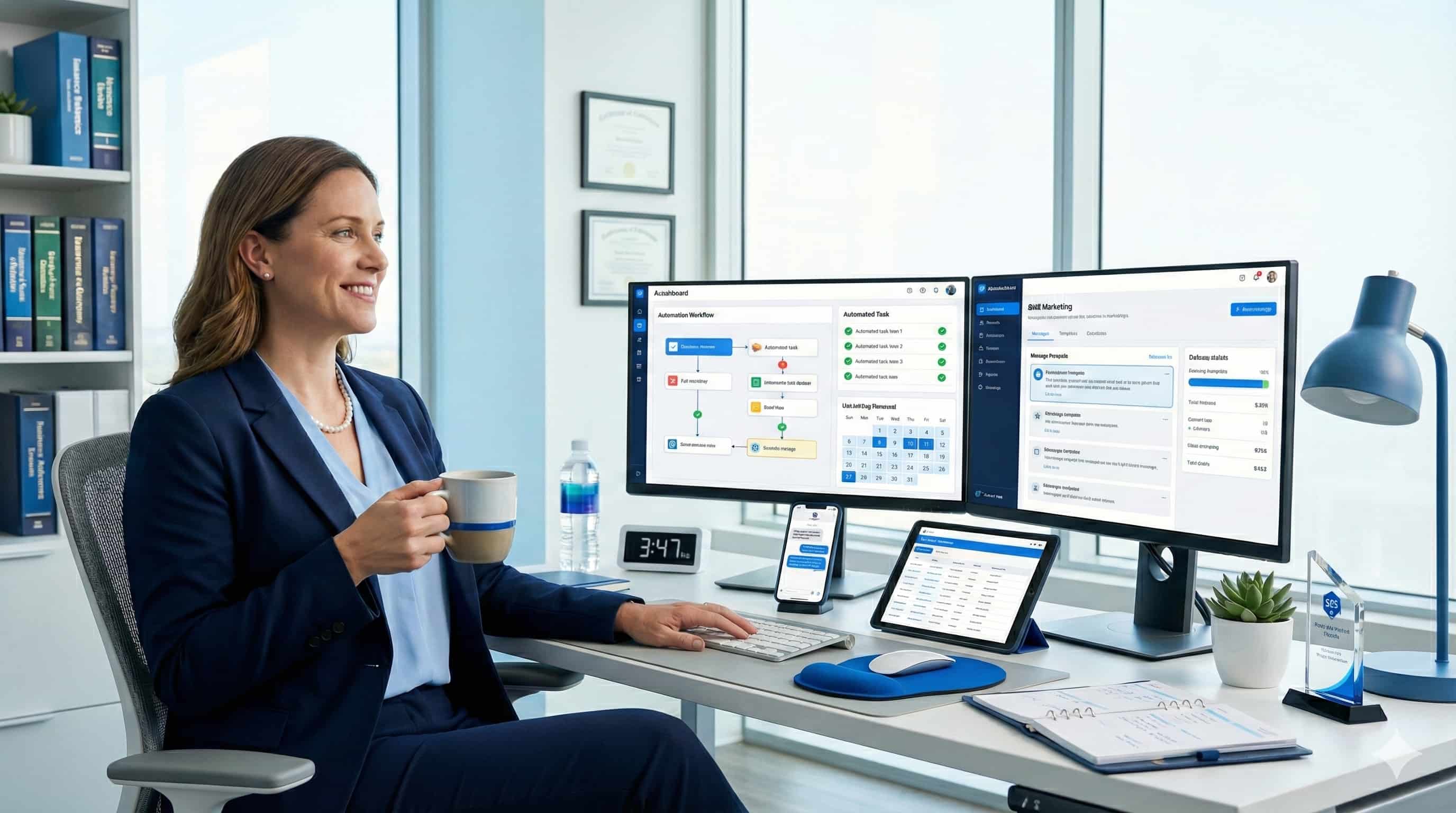
Automation fixes this problem. Insurance agent automation creates systematic touchpoints that keep clients engaged. It sends timely reminders about renewals. It follows up on quotes consistently. Most importantly, it frees you to focus on relationship building.
A sustained 5% improvement in customer retention doubles agency profit in five years. The insurance industry has one of the highest customer acquisition costs. It costs seven to nine times more to gain a customer than to keep one.
Consider this reality. 80% of sales take 5+ touch points before they become clients. Yet the average salesperson calls a lead 1.5 times before giving up. Automation bridges this gap.
Many agencies resist automation because they fear losing personal touch. This thinking is backwards. Automation handles routine tasks so you can spend more time on personal interactions that matter.
Technology underutilization remains common. Agents wear multiple hats and don't have time to dig into available data.
Email marketing gets a 28.6% open rate. SMS marketing achieves 90% to 98% open rates. Which would you rather use for time-sensitive policy updates?
Auto insurance SMS marketing works because it reaches clients where they already spend their attention. 98% of SMS messages are opened within minutes of being received. Compare that to emails sitting unread in inboxes.
Start with renewal reminders. Send SMS notifications about upcoming policy renewals, premium due dates, or expirations. This ensures timely payments and continuous coverage.
Use SMS for claim status updates. Clients want to know what's happening with their claims. Text messages provide immediate updates without phone tag or email delays.
Businesses generate an average of $71 for every $1 spent on SMS marketing. This ROI makes SMS one of the most effective automation tools available.
Keep messages short and actionable. "Your auto policy renews in 30 days. Reply YES to continue current coverage or CALL to discuss changes." This gives clients clear next steps.
Time your messages strategically. Send renewal reminders 30 days, 14 days, and 3 days before expiration. This creates multiple touchpoints without overwhelming clients.
Always include opt-out options. Compliance matters in insurance. Make it easy for clients to stop receiving messages if they prefer other communication methods.
Policy renewal automation is where most agencies see immediate results. Renewals represent predictable revenue that shouldn't require manual tracking.
When a long-term client misses their policy renewal because the agent forgot to follow up, the agency loses revenue and a trusted customer relationship. Agencies that under-use technology make the renewal process cumbersome. You can't survive doing everything manually.
Set up automated email and SMS reminders for policy renewals at multiple stages. Trigger personalized messages based on renewal dates to ensure clients never miss deadlines while freeing agents to focus on relationship-building.
For example, automated systems send calls, SMS, and emails automatically when policies are due. Customers receive reminders without staff needing to schedule them. Agents don't waste time tracking dates or chasing last-minute renewals.
Reminders should be personalized. Every policyholder gets the right message at the right moment by phone, SMS, or email. Voice AI can handle basic renewal confirmations automatically.
Renewal conversations create natural cross-selling opportunities. Data shows that increasing average policies per customer to more than 1.8 policies per client reduces annual churn rates to 5% (95% retention).
Use renewal automation to identify gaps in coverage. If a client only has auto insurance, automated workflows can flag them for life insurance or homeowner's coverage discussions.
Your insurance agent CRM should organize client data, automate reminders for renewals, track claims in real time, and manage the sales pipeline. Most agents use their CRM as a glorified contact list. This wastes massive potential.
Leading agents use CRM automation to organize and prioritize leads in the sales pipeline. They track client communications, store important documents, automate follow-ups, and manage client details all in one centralized platform.
Connect your CRM to SMS platforms, email marketing tools, and renewal management systems. This creates seamless workflows where information flows automatically between systems.
For instance, when a renewal date approaches, your CRM triggers automatic reminders across multiple channels. It updates client records when they respond. It schedules follow-up tasks for agents when needed.
EZLynx enables proactive renewal management via automated communication and marketing campaigns. The platform manages every stage of the insurance policy lifecycle automatically.
When agents manually track conversion rates, they can overlook details. CRM automation captures every interaction and measures performance objectively.
Track these key metrics automatically: lead response times, conversion rates by source, client retention rates, and average policies per customer. This data reveals which automation strategies work best for your agency.
Survey customers regularly and ask clients what you can improve. Know that your team is serving clients well. Don't assume.
The average prospect needs six to seven touches before they make contact. Yet most salespeople stop after 1.5 attempts. Automated insurance follow-up bridges this gap systematically.
Set a cadence for team members so leads are called as soon as possible. Build future automatic follow-ups into the workflow. After you quote, you need the same salesperson to follow up consistently until you get a firm yes or no.
One click can set up 18 phone calls over the next 30 days, plus two auto texts and eight emails, all sent at different preset times. This sounds like overkill but statistics show 80% of sales take 5+ touch points before conversion.
Vary your communication methods. Use phone calls for complex discussions. Send SMS for quick updates. Email detailed policy information. Each channel serves different purposes in the follow-up sequence.
Timing matters. Call leads within minutes of their initial inquiry. Send the first follow-up email within 24 hours. Space subsequent touches strategically to maintain engagement without annoyance.
Automation doesn't mean generic messages. Use client data to personalize communications. Reference their specific coverage needs, previous conversations, or policy details.
For example, instead of "Following up on your quote," try "Your homeowner's policy quote includes the flood coverage you requested. Let's review the details when convenient."
InsuredMine sets up automated workflows that keep clients engaged at various milestones. The system looks daily for accounts matching workflow criteria and sends personalized emails automatically.
When asked about retention rates, agents answer "HIGH!" When asked about customer service, they respond "GOOD!" These are feelings, not metrics. Successful automation requires measurable data.
Track client retention rates monthly. Measure lead response times. Monitor conversion rates by communication channel. Calculate the ROI of your automation investments.
Client retention rate should be your primary metric. Aim for 95% annual retention or higher. Track this monthly to identify trends early.
Lead response time measures how quickly you contact new prospects. Automated systems should respond within minutes of inquiry. Manual follow-up should happen within hours.
Conversion rate by channel reveals which automation tools work best. SMS might convert better for renewals while email works better for quotes. Adjust your strategy based on data.
Calculate time savings from automation. If automated renewals save 10 hours per week, multiply by your hourly rate to find value. Factor in reduced client churn from consistent communication.
McKinsey estimates that automation can boost productivity and reduce operational expenses by up to 40% over the next decade. Your agency should see measurable improvements within months.
Swiss Re achieved 80% improvement in reconciliation times through automation, reducing processing from 15 business days to just three. Similar efficiency gains are possible in client communication and policy management.
How much does insurance agent automation cost?
Basic CRM automation starts around $42 per user per month for platforms like Nutshell. SMS marketing platforms like Textla offer plans starting at $29 monthly. Most agencies see positive ROI within 3-6 months through improved retention and time savings.
Will automation make my agency feel impersonal?
No. Automation handles routine tasks like renewal reminders and follow-up scheduling, freeing you to spend more time on personal interactions that build relationships. Clients appreciate consistent communication more than sporadic personal touches.
What's the best SMS strategy for insurance policy renewal reminders?
Send renewal reminders at 30 days, 14 days, and 3 days before expiration. Keep messages short and actionable with clear next steps. Always include opt-out options for compliance. SMS achieves 90-98% open rates compared to 28% for email.
How many follow-up attempts should automated insurance follow-up include?
Plan for 6-7 touchpoints minimum since 80% of sales require 5+ contacts before conversion. Use multiple channels - phone, SMS, email - with strategic timing between attempts. Most agents stop after 1.5 attempts, missing significant opportunities.
Which insurance agent CRM offers the best automation features?
EZLynx specializes in insurance with comprehensive renewal automation and marketing campaigns. Nutshell offers strong SMS integration and policy renewal reminders. Choose based on your specific needs - policy management versus general sales automation.
Ready to get auto insurance marketing leads? Sign up for free with ResultCalls today!

Hello everyone! My name is Alex and I write these blogs to help educate small business owners on different ways to grow their business. My goal is to make lead generation as easy as possible for you. After reading these blogs, I hope you leave with some actionable steps that will get you closer to growing your business :)