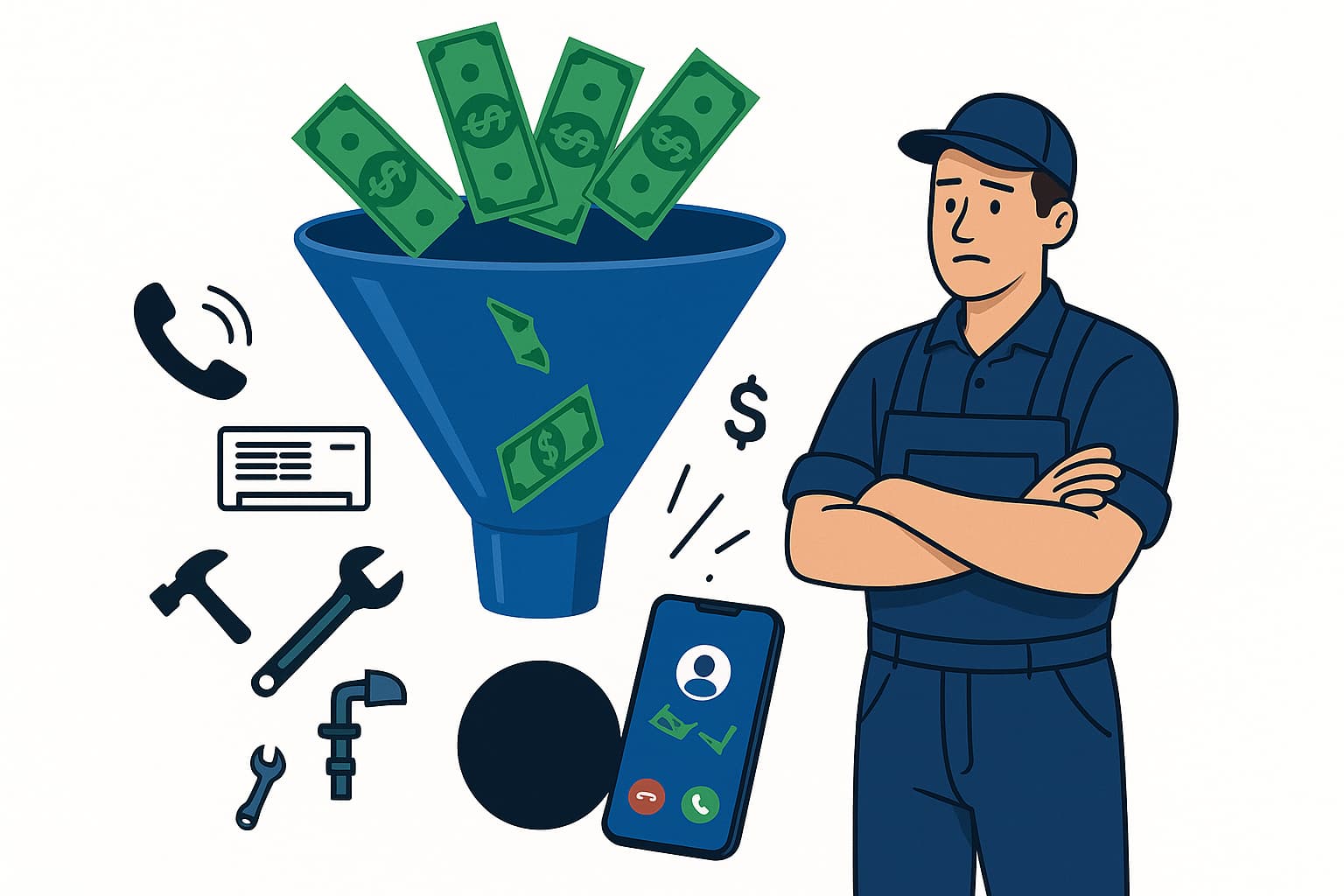
You spend thousands on marketing every month. Your phone rings. But somehow, you're still not getting enough jobs to keep your crews busy.
Sound familiar? You're not alone. Most home service contractors struggle with lead generation. Many report feeling like they're "throwing money into a black hole with little return." Todays market is more competitive than ever, and keeping your business profitable requires a steady flow of quality leads.
Pay per call marketing offers a solution. When someone calls your business, they're not browsing—they're buying. Phone call leads convert 10 to 15 times better than web form leads. Each call is incredibly valuable.
But here's the problem. That high value means every mistake costs you big money. Many contractors accidentally sabotage their own pay per call advertising campaigns. They fall into common traps that waste their budget and kill their ROI.
This guide reveals the seven most costly pay-per-call mistakes plaguing plumbers, HVAC techs, and roofers. Plus, you'll get a step-by-step blueprint to turn your local business advertising spend into predictable revenue.
Mistake #1: Why Pay Per Call Handling Makes or Breaks Your ROI
Mistake #2: How Shared Leads Kill Your Pay Per Call Profits
Mistake #3: Getting the Right Calls from Right Customers
Mistake #4: Understanding True ROI and Customer Value
Mistake #5: Building a Strong Digital Foundation
Mistake #6: Choosing the Right Pay Per Call Provider
Mistake #7: Protecting Your Budget from Click Fraud
The moment someone dials your number is make-or-break time. How you handle that first call determines whether you convert a lead or waste your money.
Pay per call lead generation works because callers have high intent. But poor call handling destroys that advantage faster than anything else.
Here's a shocking fact: responding to a lead within one minute improves conversions by 391%. Wait just five minutes? Your conversion rate drops by 8X. Wait 30 minutes? You're 21 times less likely to close the deal.
Modern customers expect fast responses. 82% want you to answer within 10 minutes. For home services, where problems are often urgent, this expectation is even stronger.
Most business owners think they're doing great at answering calls. They estimate they answer 97% of incoming calls. The reality? The average is only 66%.
That means one-third of your paid leads vanish before you even talk to them. 85% of people whose calls go unanswered won't call back. They move on to your competitor.
Let's look at what this costs you:
Just by answering more calls, the average contractor could see a 54% increase in new business. No extra marketing spend needed.
Answering the phone is just step one. An untrained employee can easily waste a high-value lead. 64% of homeowners say the initial phone call experience matters when booking service. 35% say it's the most important factor.
Good call handling is trainable. Use structured scripts for greetings, gathering information, and booking appointments. Record calls to coach your team. Turn your front desk from a liability into a profit center.
Not all leads are equal. The business model behind your lead source changes everything about its value.
Pay per lead services come in two main types: shared and exclusive. Understanding this difference is crucial for your home services lead generation success.
Shared leads get sold to multiple contractors—often three to seven companies. You're competing directly for the same job. Exclusive phone leads go to only your business. You get a one-on-one conversation with the customer.
Shared leads cost less upfront ($25-$50 each). Exclusive leads cost more ($75-$200+). But here's what really matters: your final cost per customer and ROI.
Because there's no competition, exclusive leads convert much better. Your true cost to acquire a customer is actually lower with exclusive leads. This is why smart contractors focus on Google Ads vs pay per call when comparing lead sources—the conversion rates tell the real story.
The complaints about platforms like Angi and HomeAdvisor are everywhere:
Low-quality and fake leads. Contractors pay for disconnected numbers, wrong service requests, and people just browsing with no intent to buy.
Predatory business practices. Aggressive sales tactics lock contractors into expensive contracts with huge cancellation fees. The FTC fined HomeAdvisor $7.2 million for these practices.
Poor customer service. When you get bad leads, good luck getting credits or refunds. Most contractors report unhelpful, rude support.
Shared leads create a pricing war. Multiple contractors compete for the same job. The fastest to call and lowest bidder usually wins. This kills your profit margins.
Plus, it damages your brand. The homeowner's relationship is with the lead platform, not you. They get overwhelmed by calls from multiple companies. You become a nameless commodity competing only on price.
Here's how the numbers work out:
Exclusive leads deliver higher ROI despite the higher upfront cost.
Even with exclusive leads, your campaign can fail if you're targeting wrong. Effective targeting means finding the right customers in the right locations for the right services.
Home service is local business. Profitability depends on operational efficiency. Excessive drive time kills profits.
When campaigns deliver leads 50+ miles away, your techs spend hours on the road. They burn fuel and lose time for other jobs. One case study showed a plumbing contractor's previous agency sending techs over 50 miles for jobs, severely hurting their bottom line.
This creates a death spiral. You pay for a distant lead for low-margin work. Your tech spends two hours driving, making the job unprofitable. Meanwhile, you miss a high-margin emergency call five miles from your shop.
Use precise geographic targeting. Define your service area by zip code, city, or radius. Every paid call should be from someone you can serve profitably.
The search query that triggers your ad matters hugely. Broad keywords like "plumbing" attract tire-kickers and researchers. High-intent keywords like "emergency plumber near me" attract ready buyers.
Use aggressive negative keywords too. Filter out searches for "jobs," "free," "DIY," "parts," and "how to." These protect your budget from non-revenue searches.
Don't lump all services into one campaign. Emergency repairs, maintenance, and new installations have different customer profiles and profit margins. Lead generation for plumbers requires different targeting than HVAC or roofing. They need separate strategies.
A $10,000 roof replacement lead routed to voicemail is money wasted. Use smart call routing. Set up an IVR system to pre-qualify callers: "Press 1 for New Installation, Press 2 for Emergency Repair."
Direct high-value leads to your best salespeople or senior techs. Make sure the right person handles each type of call.
Many contractors focus on the wrong metric: cost per lead. This narrow focus leads to poor decisions and leaves money on the table.
Cheap, unqualified leads that never convert cost more than expensive leads that close. A $25 lead with 5% conversion rate costs $500 per customer. A $100 lead with 30% conversion rate costs $333 per customer.
Providers promising extremely cheap leads should worry you. This often signals low-quality, shared, recycled, or fake calls.
Instead of guessing, calculate what you can afford to pay for leads.
Step 1: Find your maximum cost per lead. Know your Average Profit Per Deal and how many Leads Per Deal you need to close one job. If a job yields $2,000 profit and you need 10 leads to close one job, you can spend up to $200 per lead and break even.
Step 2: Calculate Customer Lifetime Value. New customers are worth more than their first job. They return for maintenance, repairs, and replacements. The average lifetime value for a plumbing customer is $8,023.
Step 3: Calculate ROI. The formula is simple: ROI = (Revenue from Calls - Cost of Calls) / Cost of Calls × 100.
Here's what good performance looks like:
Use this framework to calculate your ROI:
Pay-per-call campaigns don't work in isolation. They're part of your digital marketing ecosystem. Driving calls to a business with a weak online presence is like inviting guests to a messy house.
An optimized Google Business Profile is mandatory in 2025. Google's algorithm now weighs GBP signals heavily for Local Services Ads. Poor profiles hurt your campaign performance.
Your GBP needs:
Correct categories. Use specific primary categories like "Plumber" and relevant secondary categories.
Complete service listings. List all services with keyword-rich descriptions.
Optimized business description. Write compelling copy that naturally includes key services and service areas.
Regular posts. Update frequently with offers, projects, and company news. This signals activity to Google.
High-quality photos and videos. Professional images of your team, vehicles, and work build trust.
Don't send ad traffic to your homepage. Create dedicated landing pages for each ad group. These pages must load fast, work on mobile, and feature prominent phone numbers with clear calls-to-action.
Include trust signals like customer testimonials, certifications, and service guarantees. These reassure visitors and encourage them to call.
Online reviews are modern word-of-mouth. 93% of consumers say reviews influence their buying decisions. Top-ranking businesses average 47 reviews.
Even small improvements matter. A 0.1-star rating increase boosts conversion rates by 4.4%. Plus, 89% of consumers prefer businesses that respond to all reviews.
This creates a "Digital Trust Flywheel." Good pay-per-call campaigns generate satisfied customers. When they leave positive reviews, it strengthens your GBP. This boosts organic rankings and improves paid campaign performance. Your initial investment accelerates growth of your most valuable asset: your reputation.
The pay-per-call industry has many providers. Some are great strategic partners. Others are predatory vendors who exploit contractors' need for leads. Choosing wrong can waste budgets and create contractual nightmares.
Before partnering with anyone, get clear answers to these questions:
Lead quality and exclusivity: "Are leads exclusive to my business or shared with competitors?"
Call qualification: "What defines a billable call? What's your policy for crediting invalid calls?"
Transparency and tracking: "Do I get real-time dashboard access? Can I listen to call recordings?"
Targeting and control: "How do you ensure calls come from my service area? Can I set business hours?"
Pricing and contracts: "What's your complete pricing model? Are there setup fees or long-term contracts?"
Watch out for these warning signs:
Long-term contracts. Confident providers don't need to lock you in. Long-term requirements are major red flags.
Vague pricing. Trustworthy partners are transparent about costs. Hidden fees signal trouble.
Unrealistic guarantees. "Guaranteed results" promises are impossible to deliver and used to close deals.
No transparency. Without real-time dashboards and call recordings, you can't verify performance.
Suspiciously cheap leads. Very low costs almost always mean low-quality, shared, or fake leads.
The best providers align their success with yours. They only profit when they deliver valid leads you accept.
A huge chunk of digital ad spend gets consumed by fraud. This is especially bad in competitive local industries where rivals use dirty tactics and bots generate fake traffic.
Click and call fraud isn't a small problem. On-demand service industries can see fraud rates up to 60%. Plumbing specifically averages 46% fraud rates.
A business spending $10,000 monthly on Google Ads could lose $12,000-$15,000 annually to fraud. That's money with zero chance of return.
Fraudulent activity comes from two main sources:
Competitor clicks. Unscrupulous competitors deliberately click your ads to deplete your daily budget. This forces your ads offline, removing you from competition.
Bot traffic. Automated scripts generate fake clicks and calls. These "bad bots" mimic human behavior to drain ad spend on non-human traffic.
Beyond direct costs, fraud corrupts your data. You see high clicks but low conversions. This leads to wrong conclusions about campaign effectiveness. You waste time "fixing" things when fraud is the real problem.
Reputable pay-per-call providers have systems to detect and filter fraudulent traffic. Look for platforms with robust fraud prevention measures.
Better yet, choose pay-for-performance models. When you only pay for qualified customer calls meeting specific criteria, you're protected from fraudulent clicks and spam calls.
These seven mistakes drain budgets and kill ROI for countless contractors. But now you know how to avoid them.
The solution isn't just buying leads. It's investing in a complete system. You need the right tools, transparency, and targeting to turn phone calls into predictable revenue.
Focus on exclusive leads, not shared ones. Answer every call quickly with trained staff. Target precisely and track true ROI. Build a strong digital foundation. Choose partners who align with your success. Protect against fraud.
Get these fundamentals right, and pay-per-call becomes your most powerful growth engine. Your phone rings with qualified prospects ready to buy. Your crews stay busy. Your business grows predictably.
The choice is yours. Keep throwing money into the marketing black hole. Or build a system that turns every dollar into measurable results.
Ready to transform your lead generation? Start by auditing your current approach against these seven mistakes. Fix the biggest problems first. Then systematically build a pay-per-call system that actually works.
Your competitors are making these mistakes right now. That's your opportunity to dominate your market with smarter marketing that delivers real results.
Once you're ready to start your first pay per call campaign, sign up for free with ResultCalls!

Hello everyone! My name is Alex and I write these blogs to help educate small business owners on different ways to grow their business. My goal is to make lead generation as easy as possible for you. After reading these blogs, I hope you leave with some actionable steps that will get you closer to growing your business :)