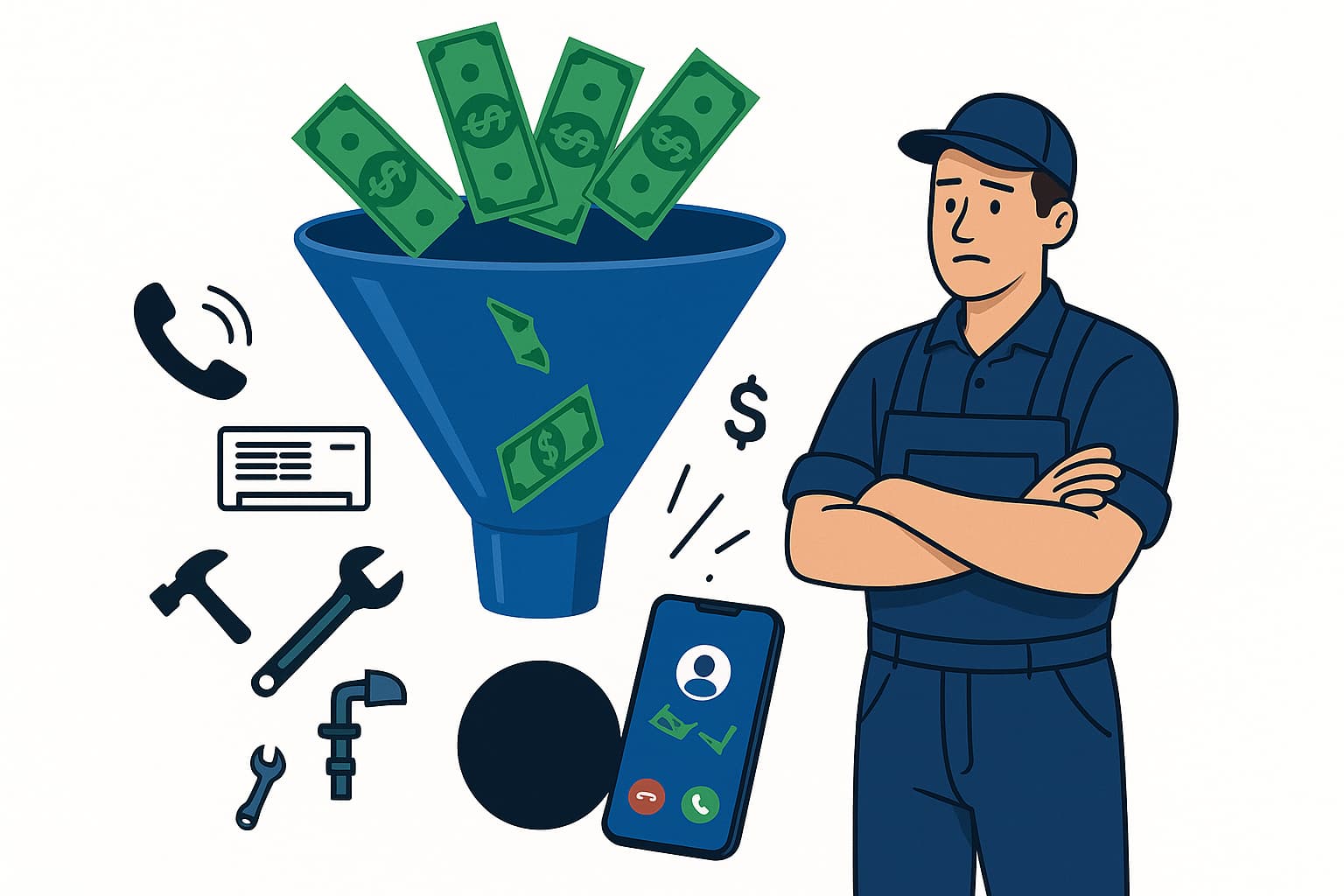
You're spending thousands on Google Ads. Your phone rings occasionally. But most of your budget disappears on clicks from people who never call, never book, and never become customers.
Sound familiar? You're not alone. Most plumbers struggle with the same problem. Traditional digital marketing forces you to pay for website visits and form submissions. But here's the truth: phone calls convert 10 to 15 times better than web leads.
Pay-per-call plumbing leads change everything. Instead of paying for clicks that might turn into leads, you pay only when qualified customers actually call your business. No more wasted spend on tire-kickers, DIY researchers, or people outside your service area.
This guide shows you exactly how pay per call works for plumbers. You'll learn why phone calls are your best lead source, how to set up campaigns that actually work, and real examples of plumbers who've grown their revenue by 500% using these strategies.
Why Pay-Per-Call Plumbing Leads Beat PPC
How Pay-Per-Call Marketing Works
Setting Up Your Pay-Per-Call Strategy
Best Phone Scripts for Booking Jobs
Calculating Your True Marketing ROI
Real Case Studies and Results
Top Tools and Platforms
Traditional Google Ads cost plumbers a fortune. Keywords like "plumber near me" cost $30 to $120 per click. Emergency plumbing services? You're looking at $82 per click.
But here's the problem. You're paying for clicks, not customers. Pay per call advertising focuses on actual conversations instead of website visits.
Most plumbing businesses need $1,500 to $10,000 monthly just to stay competitive on Google Ads. The average cost per lead is $129. That's $129 for someone to fill out a form on your website.
But only 2% of web form leads become paying customers. Phone call leads convert at 25-40%. This shows why local business advertising should focus on generating calls, not clicks.
HomeAdvisor and Angi seem like easy solutions. But they sell your lead to up to 10 other plumbers. You're immediately in a price war. The cheapest quote wins.
Plus, you pay for terrible leads. Fake phone numbers. People just browsing for prices. Angry customers who didn't know their info would be shared. Pay per lead services like these create more problems than solutions.
When someone calls your business, they're ready to hire. They have a problem right now. They want to talk to a human who can solve it.
Phone calls signal high intent. Web forms are just information gathering. That's why 64% of local marketers say phone calls are their most valuable lead source.
Pay per call lead generation is simple. You only pay when a qualified customer calls your business.
First, targeted ads run across Google, Facebook, and local directories. These ads are designed to make people call, not click through to a website.
Each campaign uses unique tracking numbers. This lets you see exactly which ads generate calls.
The key difference? You only pay for qualified calls. These typically need to last 90-120 seconds. This filters out wrong numbers, spam calls, and non-serious inquiries.
Your pay-per-call partner helps define qualified calls based on:
Call duration: Usually 90-120 seconds minimum
Geographic location: Callers within your service area
Service type: Focus on higher-value jobs if you want
Time of day: Filter out calls during closed hours
Unlike shared lead platforms, pay-per-call leads are exclusive. The customer calls only you. No competition. No price wars. Just a direct conversation with someone who needs your services.
Exclusive phone leads eliminate the bidding wars that destroy profit margins. This is what separates quality home services lead generation from shared lead platforms.
Most plumbers work with pay-per-call networks rather than managing campaigns themselves. These networks handle the advertising complexity while you focus on answering phones and booking jobs.
Lead generation for plumbers works best when specialists manage the technical aspects of campaign optimization.
Look for networks that specialize in home services. They understand plumbing keywords, seasonal trends, and what makes customers call.
Key features to evaluate:
Transparent pricing: Know exactly what you pay per call
Quality filters: Strong systems to block spam and irrelevant calls
Real-time tracking: See campaign performance instantly
Local expertise: Understanding of your market area
Work with your network to define your ideal customer:
Service area boundaries: How far will you travel?
Service types: Focus on high-margin work like water heater replacement
Call hour preferences: When can you actually answer and book?
Minimum job values: Filter out small repairs if needed
Smart targeting prevents wasted spend:
Geo-fencing: Calls only from your service radius
Service-specific campaigns: Separate campaigns for emergency vs. scheduled work
Seasonal adjustments: Higher bids during peak demand periods
Your phone answer determines if a qualified lead becomes a paying customer. Every call is a $129+ marketing investment. Don't waste it with poor phone skills.
Keep it simple: "Thank you for calling [Company Name], this is [Name]. How can I help you today?"
This immediately identifies your business, personalizes the interaction, and focuses on their problem.
The most common question: "How much will this cost?"
Never give prices over the phone. Use this four-step framework:
Acknowledge: "I understand you want to know the cost upfront."
Explain: "To give you an accurate price, our technician needs to see the situation."
Pivot to value: "I can have a certified technician come out today for an exact, upfront quote."
Reinforce logic: "This way you know the exact cost with no surprises."
Avoid open-ended scheduling questions like "What time works for you?"
Instead, offer two specific options: "I have an opening at 11 AM or 3 PM today. Which works better?"
This makes decisions easier for stressed customers and keeps you in control of the booking process.
For urgent issues, emphasize speed and availability:
Acknowledge their stress: "I can hear this is urgent."
Confirm availability: "We have a technician who can be there within two hours."
Explain the process: "He'll assess the situation and give you options before starting any work."
Measuring pay-per-call success requires understanding two key metrics: Cost Per Lead (CPL) and Customer Acquisition Cost (CPA).
This measures what you pay for each qualified call:
CPL = Total Marketing Spend ÷ Total Qualified Calls
Example: $2,500 spend ÷ 50 calls = $50 CPL
This is your most important metric. It shows what you actually pay for each new customer:
CPA = Total Marketing Spend ÷ New Customers Acquired
Here's how it works:
Monthly spend: $3,000
Qualified calls: 100 calls (CPL = $30)
Appointments booked: 40 (40% booking rate)
Jobs completed: 30 (75% close rate)
Final CPA: $3,000 ÷ 30 customers = $100
If your average job value is $600, a $100 CPA delivers excellent ROI.
Don't forget repeat business and referrals. A customer acquired for $100 might generate:
Initial job: $600
Annual maintenance: $200
Future repairs: $800
Referrals: $1,200 additional revenue
Total lifetime value: $2,800 from a $100 acquisition cost.
A Phoenix plumber was burning through budget on poorly managed Google Ads. High costs, wrong geographic targeting, and generic landing pages created terrible ROI.
The solution: Call-focused landing pages, proper geographic targeting, and conversion tracking. This shows the difference between Google Ads vs pay per call approaches.
Results: 102% increase in website traffic, doubled impression share, and significant reduction in cost per conversion within three months.
One Call Plumbing spent $2,500 monthly on Google Ads with poor results. Wrong keywords meant irrelevant clicks. Their website ranked on page three of Google.
The strategy: Reallocated the same $2,500 budget to targeted ads plus aggressive local SEO.
Results: 500% revenue increase within 12 months. Moved from a shed to a commercial location. Reached #1 Google ranking in seven months.
A plumber with just $3,500 monthly budget competed against larger companies spending much more.
The approach: Maximum efficiency through precise targeting and optimized landing pages.
Results: Generated 68 leads for $4,800 spend. $71 cost per lead vs. $129 industry average. 21% conversion rate.
Case Study 4: 600% More Call Volume in 60 Days
911 Rooter and Plumbing hit a growth ceiling they couldn't break through. Traditional marketing wasn't scaling their business effectively.
After partnering with ResultCalls for pay per call campaigns, everything changed. Their call volume doubled quickly, then continued climbing.
Within just 2 months, 911 Rooter and Plumbing grew their call volume by 600%. This massive increase in qualified leads allowed them to finally scale past their previous limitations.
CallRail: Comprehensive features with keyword-level attribution and AI-powered conversation intelligence. Best for detailed analytics but can get expensive with high call volumes.
Nimbata: Pay-per-answered-call pricing model with built-in AI tools. More predictable costs and seamless CRM integration.
ResultCalls: Specializes in home services with pure performance pricing. No setup fees or monthly retainers. Pay only for qualified calls.
ServiceTitan: Enterprise-level platform for larger plumbing businesses. Advanced scheduling, financial reporting, and marketing attribution.
Jobber: Perfect for small to medium businesses. User-friendly scheduling, quoting, and mobile app. Excellent customer support.
Housecall Pro: Simple, mobile-first design for smaller companies and solo operators. Basic but effective core features.
Pay-per-call marketing works because it aligns your costs with actual results. You pay for qualified conversations, not random website visitors.
Start by evaluating your current marketing spend. If you're paying $129 per lead for 2% conversion rates, pay-per-call offers immediate improvement.
Most successful plumbers begin with a modest test budget. Work with a specialized network to define qualified calls for your business. Track your CPA closely and scale what works.
The plumbing industry is perfect for phone-first marketing. Your customers need immediate help. They want to talk to an expert. Pay-per-call connects you directly with people ready to hire.
Focus on what matters: qualified conversations that turn into profitable jobs. That's how you build a sustainable, growing plumbing business.
Ready to try pay-per-call marketing for your plumbing business? Start with clear qualification criteria and strong phone processes. The leads are out there – make sure you're positioned to capture them.
If you want to skip the technical headaches, sign up for free with ResultCalls and get pay per call plumbing lead today!

Hello everyone! My name is Alex and I write these blogs to help educate small business owners on different ways to grow their business. My goal is to make lead generation as easy as possible for you. After reading these blogs, I hope you leave with some actionable steps that will get you closer to growing your business :)