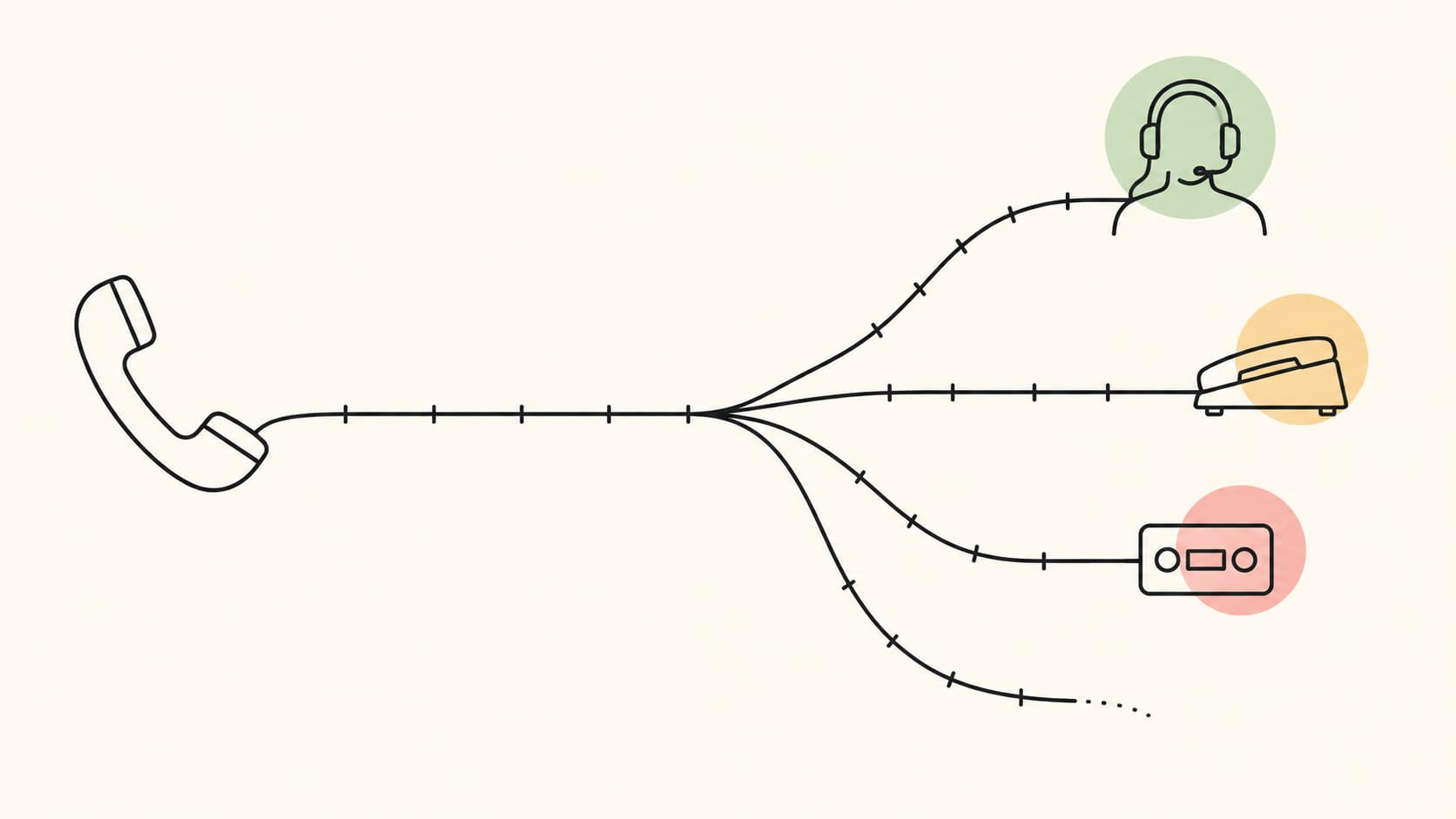
An unanswered electrician call goes to voicemail in most shops. Voicemail captures about 17% of those callers. The other 83% dial the next electrician on their list.
That is the short answer. Callers who reach voicemail are 100 times less likely to convert than callers who reach a live person within five minutes.
The volume is significant. Invoca's call tracking research puts the average missed-call rate across home services at 27%. Every missed after-hours electrical call represents a $400 to $1,800 job.
Electrical contractors feel this harder than other trades. A homeowner smelling something hot at the panel will not leave a message. They will call someone else within 90 seconds.
This guide traces the full overflow path in order. It covers ring groups, voicemail, answering services, after-hours routing, and what each option costs in 2026. If call volume is your constraint rather than call handling, ResultCalls covers that side.
What Electrician Call Overflow Actually Means
Where the Call Goes Right Now
Why Voicemail Is the Worst Option
Ring Groups and Backup Call Routing
Answering Services: Human, AI, and Hybrid
After-Hours Is Different for Electricians
What a Missed Call Costs You Twice
How to Build the ResultCalls Overflow Ladder
Building Your 2026 Strategy
Frequently Asked Questions
Electrician call overflow is the routing path an inbound call takes when the first phone does not answer. Every phone system has one. Most electrical contractors never configured theirs.
The default overflow path is voicemail. Voicemail books no appointments and captures roughly 17% of callers.
Call overflow determines three outcomes for an electrical contractor:
Whether the caller reaches a human, a machine, or nothing
How long the caller waits before deciding you are unavailable
Whether the call appears in Jobber, Housecall Pro, ServiceTitan, or FieldEdge afterward
That third item hides the problem. A call that hits voicemail and gets deleted never reaches your dispatch tool. The loss never appears in a report.
Electrical faults escalate faster than plumbing faults. A burning smell at a panel produces urgency that a dripping tap does not.
Ticket values reflect that urgency. Residential electrical work averages $200 to $500. Emergency electrical call-outs bill $400 to $1,200.
An unanswered electrician call ends in one of five places. Four of them are configurable. Most electrical contractors have never tested which one theirs uses.
The five destinations are a live human, a rollover number, voicemail, an answering service, or no destination at all.
The ResultCalls Four-Call Phone Audit takes 20 minutes and requires a stopwatch. Call your own business number from a phone that is not in your contacts. Let it ring out completely.
Run the test four times:
During business hours on a weekday
At lunchtime, when your office may be uncovered
At 7:00 PM, after your office closes
On Saturday morning, when homeowners notice problems
Record three data points on each call. Count the rings before anything changed. Write down what the caller heard. Check whether a record appeared in your dispatch tool afterward.
Most electrical contractors find at least one broken rung. Common findings include a rollover number that rings a phone nobody carries anymore, and an after-hours greeting recorded by a person who left the company.
The stakes are high on a single call. About 75% of customers say they would take their business elsewhere after one bad phone experience. Not a pattern. One.
If the audit shows your handling is solid and your phone simply does not ring enough, the constraint is volume rather than routing. ResultCalls sends exclusive electrical calls. Each lead goes to only one company. The homeowner calls your number directly in real time. Pricing runs on pay per call with no contract and no sign-up fee. Details are on the electrical leads page.
Voicemail captures about 17% of calls that reach it. It books zero appointments. It is free, which is its only advantage over every alternative.
Basic live answering captures 55%. AI answering captures 89%. Voicemail loses to both by a wide margin.

A homeowner with a breaker that will not reset behaves predictably. They are working down a list of three electricians.
The sequence runs like this:
The caller hears a recorded greeting
The caller learns you are unavailable
Most callers hang up without leaving a message
The caller dials the next electrician immediately
Your callback arrives after someone else booked the job
Response speed decides the outcome. Businesses responding within five minutes are roughly 10 times more likely to win the job than businesses responding five hours later.
Automated SMS text-back fires within 60 seconds of a missed call. It is the highest-return single change in the entire overflow stack for electrical contractors.
A text message gets read. A voicemail notification gets ignored. That asymmetry explains why the fix works.
Set it up before you evaluate any paid answering service. It costs almost nothing and recovers calls the same day.
Backup call routing sends an unanswered electrician call to a second destination before voicemail. It is a configuration change, not a purchase. That makes it the cheapest improvement available to an electrical contractor.
Two routing patterns exist. They behave very differently.
Simultaneous ring hits every phone at once. It is fastest. It also means three people grab for their phones on every call
Sequential ring hits phones in order with a timeout on each. It is orderly. It burns seconds
A four-ring timeout equals roughly 20 seconds. A three-stage sequential chain can take 60 seconds to catch a call
Most electrical shops perform better with simultaneous ring at stage one and a hard handoff at stage two
The contractor benchmark is answering 80% of calls within 20 seconds. Build your routing chain to hit a human voice or a competent AI inside that window.
Test the chain with a stopwatch, not by feel. Most electrical contractors discover their chain takes 45 to 70 seconds to reach its final destination. Callers start dialing competitors well before that.
An electrician answering service costs $100 to $749 per month and captures 55% to 89% of calls. The price depends on the model. Three models exist in 2026: basic live answering, virtual receptionist, and AI receptionist.
The choice depends less on quality than on how many minutes your calls consume.

A contractor answering service plan runs $200 to $450 per month for 50 to 100 minutes. Overage costs $1.50 to $2.50 per minute beyond the allowance.
Electrical calls run long and cluster after hours. Most contractors exceed those allowances quickly. Ambs Call Center data puts typical plans at $135 to $400 monthly, with per-minute rates of $0.75 to $1.50.
Premium live coverage reaches $235 to $1,640 per month depending on volume.
AI voice agents run roughly $50 to $500 per month. Entry-level options start at $29 to $99. There is no per-minute overage.
Reported returns average $3.50 for every $1 invested in AI customer service.
An answering service that does not write into your dispatch tool is expensive voicemail. Ask whether it integrates with Jobber, Housecall Pro, ServiceTitan, FieldEdge, or Profit Rhino before you compare prices.
Good integration creates the job record automatically. It populates severity, panel age, and a residential or commercial flag. It assigns the on-call tech and sends an SMS. If someone has to retype the details from an email, most of the return evaporates.
After-hours electrical calls are worth two to three times daytime calls. An emergency electrical call-out bills $400 to $1,200. A daytime residential electrical job bills $200 to $500.
Electrical contractors also underestimate their after-hours volume. Calls that hit voicemail at 8:00 PM never enter the CRM. They never enter the report either.
Electrical faults frighten homeowners. A dead nursery circuit at 9:00 PM produces an immediate call. A dripping tap waits until Tuesday.
Commercial work adds a second evening wave. Property managers and facilities staff call after their own tenants leave. Shops with heavy commercial books see weekday-evening volume that residential-only shops do not.
An in-house on-call rotation costs nothing in fees and everything in crew goodwill
A live answering service with an emergency escalation rule routes true emergencies to a named on-call number
An AI receptionist forwards genuine emergencies and books everything else into your calendar
Define what counts as an emergency in writing before you launch any of the three. An escalation rule that wakes your on-call tech for a quote request will not survive two weeks.
A missed electrician call costs three things at once. It costs the job. It costs the lead fee you already paid. It costs future Google Local Services Ads placement.
Electricians pay the highest cost per click in home services at $12.18. Google Search leads for electrical contractors cost $93.69 each. Sending one to voicemail discards a lead you already bought.
The job itself, worth $200 to $1,200 depending on time of day
The acquisition cost, from $39 on Google Local Services Ads up to $93.69 on paid search
Future placement, because Google factors responsiveness into LSA ranking and pricing
Google Local Services Ads rank electrical contractors partly on responsiveness. Missed calls lower your placement. Lower placement raises what you pay per lead.
That matters because LSA is the cheapest channel electrical contractors have. It books at a 43.4% rate on a $1,434 average electrical ticket. Degrading it to avoid a $149 answering service fee is poor arithmetic.
The ResultCalls Overflow Ladder is a four-rung routing sequence for electrical contractors. Each rung has a defined timeout in seconds. The final rung captures anything the first three missed.
Write the ladder down once. Stop improvising on every call.

Simultaneous ring to office and intake staff, 15 to 20 seconds
Rollover to a second internal number or shared line, 15 seconds
Answering service or AI receptionist, which books or qualifies the caller
Automated SMS text-back within 60 seconds on anything that still fell through
A timeout defined in seconds, not in "a few rings"
A named owner, so it is clear whose phone rings at stage two
A write-path into Jobber, Housecall Pro, ServiceTitan, or FieldEdge
A separate rule set for after-hours and weekends
A monthly end-to-end test
Phone systems drift. Staff change. A rung that broke quietly in March will not announce itself. Test the full ladder once a month with the same stopwatch you used for the Four-Call Phone Audit.
Three actions fix most electrician call overflow problems. Complete them in this order.
Call your business number four times this week: business hours, lunch, 7:00 PM, and Saturday morning. Time each call with a stopwatch. Write down where each one ended.
Automated SMS within 60 seconds is the highest-return fix in the stack. It costs almost nothing. Complete this before shopping for an answering service.
A single recovered emergency electrical call-out is worth $400 to $1,200. AI answering costs $149 to $749 monthly. Live answering costs $200 to $450. One recovered call per month covers nearly every option on the list.

Electrician call overflow is the routing path an inbound call takes when the first phone does not answer. Every phone system has one, and the default is usually voicemail. The path determines whether the caller reaches a human, how long they wait, and whether the call reaches Jobber, Housecall Pro, or ServiceTitan.
Invoca's call tracking research puts the average missed-call rate across home services at roughly 27%. The electrical figure is likely higher after hours, because those calls hit voicemail and never enter the CRM. Callers reaching voicemail convert about 100 times less often than callers reaching a live person within five minutes.
Yes, on the arithmetic of a single recovered job. Basic live answering costs $100 to $300 monthly at roughly 55% capture. AI receptionists cost $149 to $749 at around 89% capture. One recovered emergency electrical call-out at $400 to $1,200 covers most plans for the month.
It depends on call minutes. Live services sell 50 to 100 minutes for $200 to $450, with overage at $1.50 to $2.50 per minute, and electrical calls run long. Flat-rate AI at $50 to $500 removes per-minute exposure. Either option only pays if it writes into Jobber, Housecall Pro, ServiceTitan, or FieldEdge.
Yes. Google factors responsiveness into Local Services Ads placement for electrical contractors. Missed calls lower future visibility and raise cost per lead. LSA averages $39 per lead at a 43.4% book rate on a $1,434 average electrical ticket, so degrading that channel is expensive.
Fixing electrician call overflow starts with four test calls and a stopwatch. It does not start with a purchase. The ResultCalls Four-Call Phone Audit will tell you more about your sales process than a month of reports.
Then add the two cheapest rungs. Configure a second ring destination. Turn on automated text-back within 60 seconds. Most electrical shops recover more calls from those two changes than from anything they buy afterward.
Once your phone is genuinely covered, more volume produces more booked work instead of more voicemails. That is the moment to add exclusive electrical calls and let your close rate set the pace.

Hello everyone! My name is Alex and I write these blogs to help educate small business owners on different ways to grow their business. My goal is to make lead generation as easy as possible for you. After reading these blogs, I hope you leave with some actionable steps that will get you closer to growing your business :)