
The solar industry reached record growth in 2025. Installations hit nearly 50 GWdc this year. That's a 21% jump from 2023. Solar now accounts for 66% of all new generating capacity.
Here's the challenge: 44% of homeowners struggle to find trustworthy solar installers. They want proof your company delivers results. They need clear answers before they reach out.
Smart installers use current statistics to build trust. Data helps answer customer questions. It shows market growth and real savings. This approach cuts through skepticism and speeds up sales.
You'll learn the most powerful statistics for 2026. We'll show you how to use data in your marketing. Plus, discover tools that help you track results and grow your business.
Table of Contents
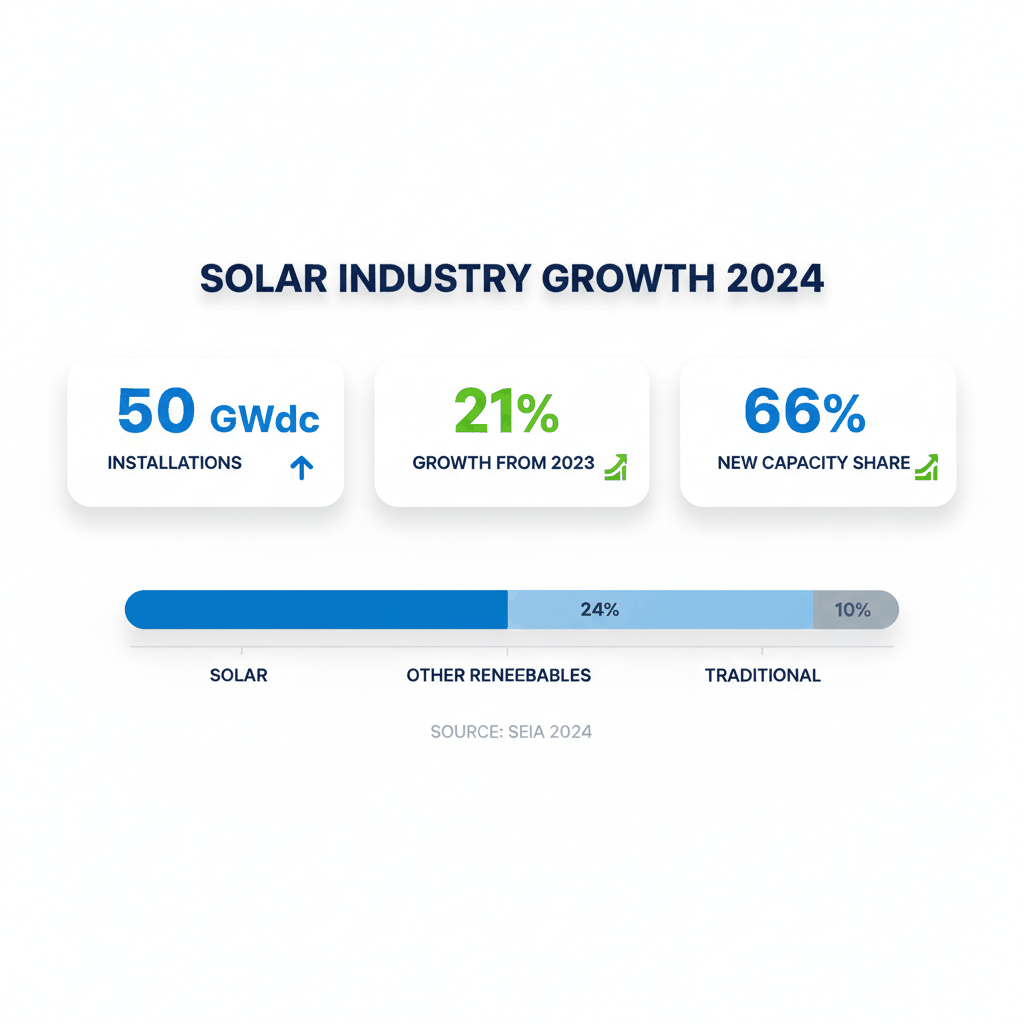
The solar market is exploding in 2026. Solar installations reached nearly 50 GWdc this year. This represents a massive 21% increase from 2023.
Solar now dominates new energy capacity. The industry accounts for 66% of all new generating capacity added in 2024. This shows the incredible momentum behind solar adoption.
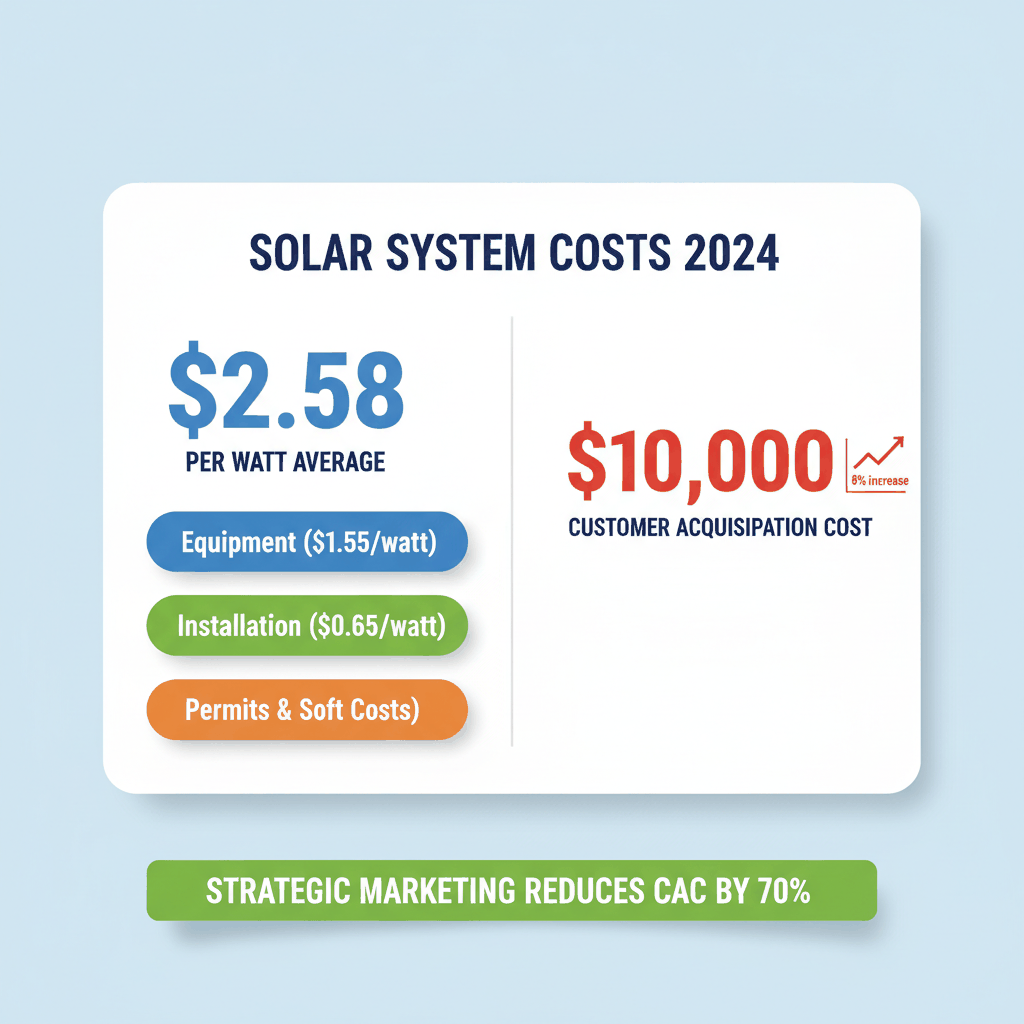
Solar costs remain competitive in 2026. Systems average about $2.58 per watt before incentives. The typical range falls between $2 and $3 per watt. The current average sits at $2.79 per watt.
Customer acquisition costs tell a different story. These costs increased 8% year-over-year to $0.87/Wdc in Q4 2024. This forces installers to spend more on marketing to find customers.
The global solar market shows incredible growth potential. Analysts project 20.5% annual growth for the solar industry. This creates massive opportunities for installers who position themselves correctly.
Solar will continue dominating new capacity additions. The industry accounted for 54% of all new electricity-generating capacity in 2025. This trend shows no signs of slowing down.
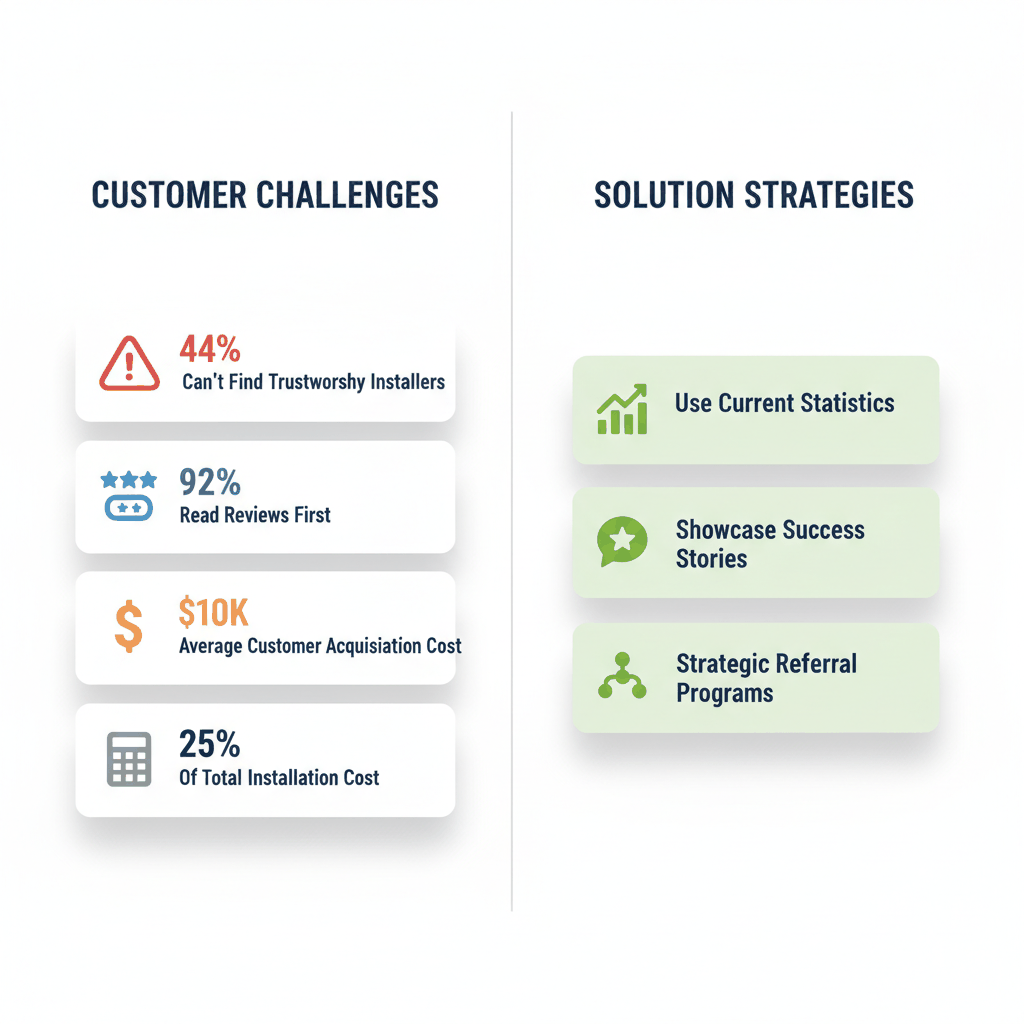
Trust remains the biggest barrier for solar installers. Nearly half of homeowners can't identify legitimate solar companies. They worry about scams and poor installation quality.
Customer acquisition costs represent a major challenge. The average cost per customer reaches $10,000 per sale. This consumes 25% of total installation expenses. However, strategic marketing can reduce these costs by 70%.
Homeowners ask tough questions before buying. They want to know if they can trust your company. They question whether they'll really save money. Concerns about financing and compatibility add to their uncertainty.
Solar lacks trialability compared to other products. Customers can't test drive solar panels. There's no 30-day money back guarantee. This makes past customer experiences more important than ever.
Customers have huge knowledge gaps about solar. They don't understand costs, benefits, or installation procedures. Complex proposals can lose their interest quickly.
Crafting clear proposals becomes critical. Installers must present financing options simply. They need accurate, compelling proposals without errors. Poor communication kills sales before they start.
Smart installers leverage data to build credibility. Current statistics answer customer questions before they ask. This approach reduces skepticism and speeds up decisions.
Start with compelling cost data. Tell prospects that solar systems average $2.58 per watt before incentives. Explain how the federal tax credit reduces their costs significantly.
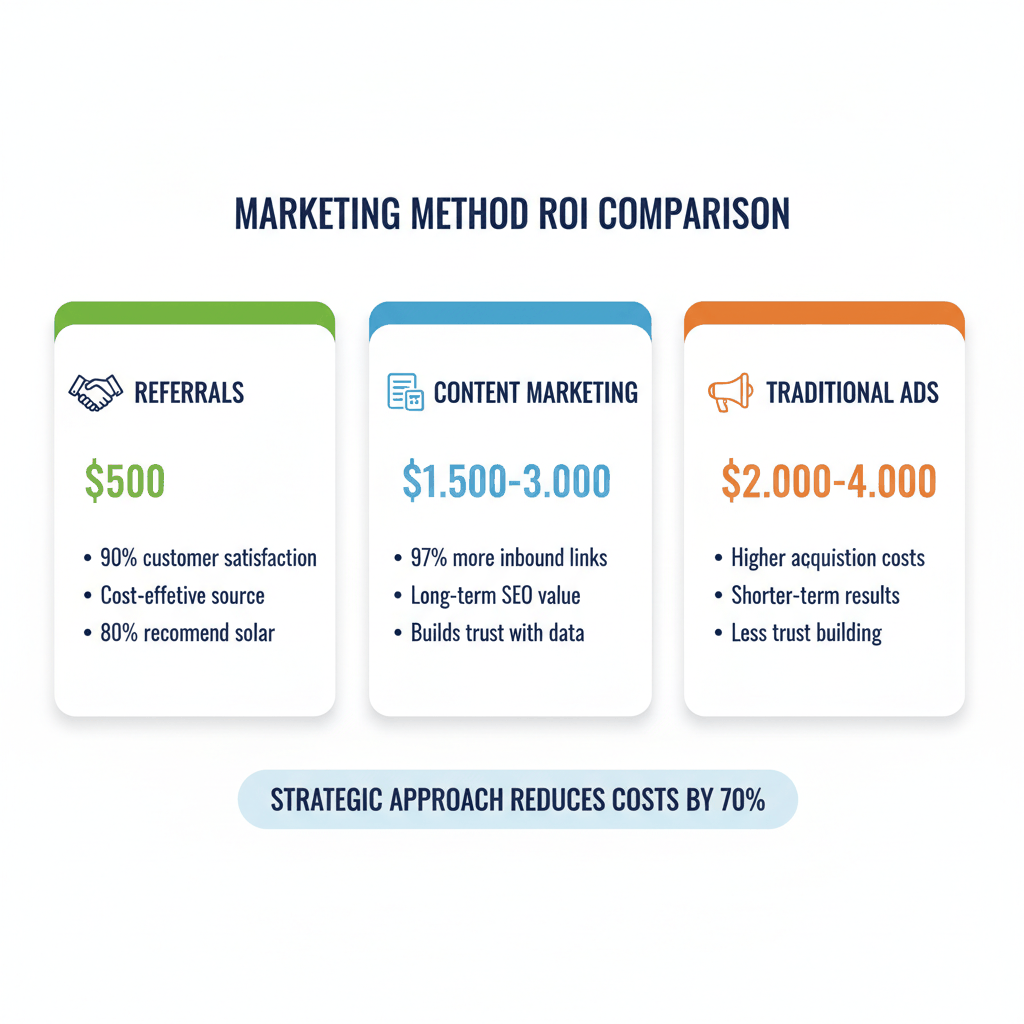
Create educational blogs using current statistics. Write about topics like "How Solar Panels Work" or "Financial Benefits of Solar Energy." Companies who blog generate 97% more inbound links than those that don't.
Showcase successful installations with real metrics. Include energy savings and cost reductions in your case studies. Make explainer videos about solar energy, financing, and installation processes.
Focus on high-intent keywords in your content. Target terms like "best solar panel installation" or "solar energy company near me." These phrases reach customers actively searching for your services.
Highlight market growth in your marketing. Solar accounted for 54% of all new electricity capacity in 2025. This shows customers they're making a smart, forward-thinking choice.
Use local search optimization effectively. 46% of searches are local. Younger homeowners average 5.83 words per search. About 44% of Gen Z queries are phrased as questions.
Customer success stories build more trust than any statistic. 92% of consumers look at reviews before making purchases. Your success stories are professionally written product reviews.
Showcase detailed customer testimonials. Highlight energy savings and environmental benefits. Include specific numbers and timeframes. Real data makes testimonials more believable.
Referrals remain the most cost-effective customer source. Solar companies pay about $500 for referrals compared to $2,000-$4,000 for other methods.
Current solar owners love their systems. About 90% are satisfied with their solar panels. Over 80% would recommend solar to others. This creates massive referral potential for smart installers.
Use video marketing for complex topics. Video drives deeper engagement because viewers process visuals faster than text. Produce short rooftop walkthroughs explaining panel orientation and safety protocols.
Create explainer videos for installation processes. Show financing benefits through real examples. Feature customer success stories across YouTube, social media, and your website.
Humans remember stories better than statistics. Start each story with a relatable customer. Highlight their challenges and show the turning point. Celebrate measurable victories and results.
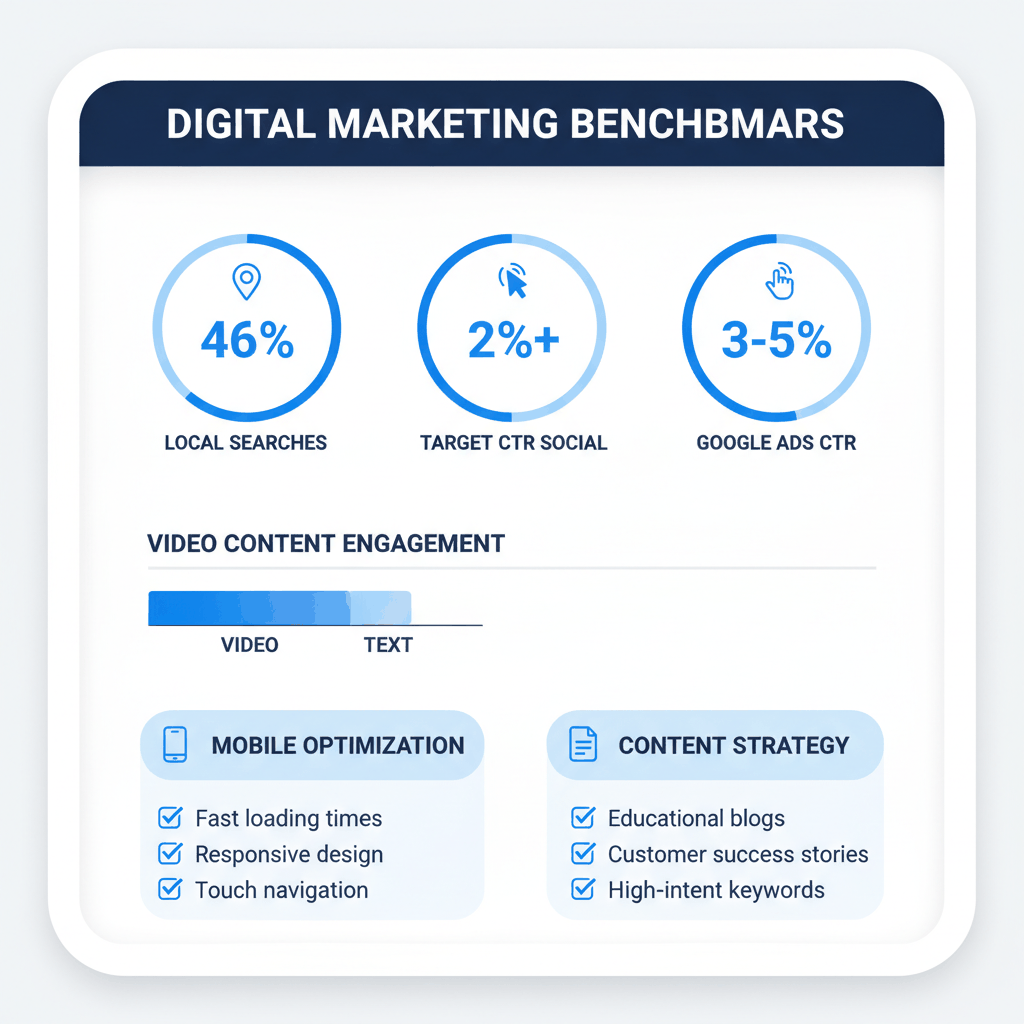
Content performance trends favor video and visual storytelling. Solar companies use video content more than ever. They showcase installations, testimonials, and real-world impact through engaging visuals.
Mobile optimization has become essential. Consumers rely on smartphones to research and make decisions. This means fast loading times, responsive design, and touch-friendly navigation.
Solar blog optimization extends beyond writing. Compress images and implement lazy loading. Remove render-blocking scripts to achieve sub-second load times. Interlink related posts and add structured data for FAQs.
Monitor key performance metrics carefully. Aim for click-through rates above 2% on social media. Target 0.9% average for Facebook Ads. Shoot for 3-5% on Google Ads campaigns.
Solar buying peaks around specific fiscal quarters. Marketing should integrate federal and state tax credit timelines. Include net metering updates and local rebate programs in your campaigns.
Understanding peak demand periods boosts lead generation. Government rebate seasons drive more interest. Energy conservation awareness months create additional opportunities for smart installers.
Solar-specific CRM platforms streamline your entire process. Sunbase Solar Software manages leads, site surveys, system design, proposals, contracts, permits, and installation workflows in one connected system.
Shape CRM offers powerful sales and marketing tools. It's known for modern design and functionality. Plans start at $119 per month per user for sales and marketing features.
HubSpot provides comprehensive marketing, sales, and customer service features. While not solar-specific, its flexibility and automation capabilities work well for solar businesses of all sizes.
Salesforce dominates the CRM market with 21.7% market share. It offers enterprise-level capabilities and extensive customization options. However, complexity and higher costs may not suit smaller operations.
Analytics tools help measure website traffic and lead conversions. Google Analytics, HubSpot, and SEMrush provide essential tracking capabilities. These platforms help you calculate overall ROI from your marketing efforts.
Readymode offers predictive dialer and CRM features. It's designed to maximize solar business revenue. The platform streamlines operations, generates appointments, and helps agents close deals more efficiently.
AI tools make content creation easier and faster. AI video creators help produce polished, engaging clips without full production setup. AI voice generators add smooth, professional narration to your videos.
All-in-one solar software brings your entire workflow together. Data flows from lead to layout to install without duplication. This connects CRM, design, proposals, and project management seamlessly.
Get professional solar lead generation support to maximize your marketing ROI and focus on what you do best - installing great solar systems.
What are the most important solar panel statistics for 2026?
Solar installations reached nearly 50 GWdc in 2026, up 21% from 2023. Solar accounts for 66% of new generating capacity. Systems average $2.58 per watt before incentives. Customer acquisition costs average $10,000 per sale but can be reduced by 70% with strategic marketing.
How much do solar panel installations cost in 2026?
Solar systems cost between $2-3 per watt on average. The current average is $2.79 per watt, with systems averaging $2.58 per watt before incentives. Federal tax credits and local rebates significantly reduce these costs for homeowners.
What solar industry trends should installers know about?
Mobile optimization is essential as consumers research on smartphones. Video marketing drives higher engagement than text. Referrals cost $500 versus $2,000-4,000 for other methods. About 90% of current solar owners are satisfied and 80% would recommend solar to others.
How can solar installers build trust with statistics?
Use current market data showing 21% industry growth. Share cost statistics like $2.58 per watt averages. Highlight that 92% of consumers read reviews before buying. Feature detailed customer testimonials with specific savings numbers and timeframes.
What tools help solar installers track marketing performance?
Solar-specific CRMs like Sunbase and Shape streamline operations. Google Analytics and HubSpot track website performance. SEMrush helps with SEO optimization. Target 2% click-through rates on social media and 3-5% on Google Ads for best results.
Ready to get exclusive solar leads? Sign up for free with ResultCalls today!

Hello everyone! My name is Alex and I write these blogs to help educate small business owners on different ways to grow their business. My goal is to make lead generation as easy as possible for you. After reading these blogs, I hope you leave with some actionable steps that will get you closer to growing your business :)