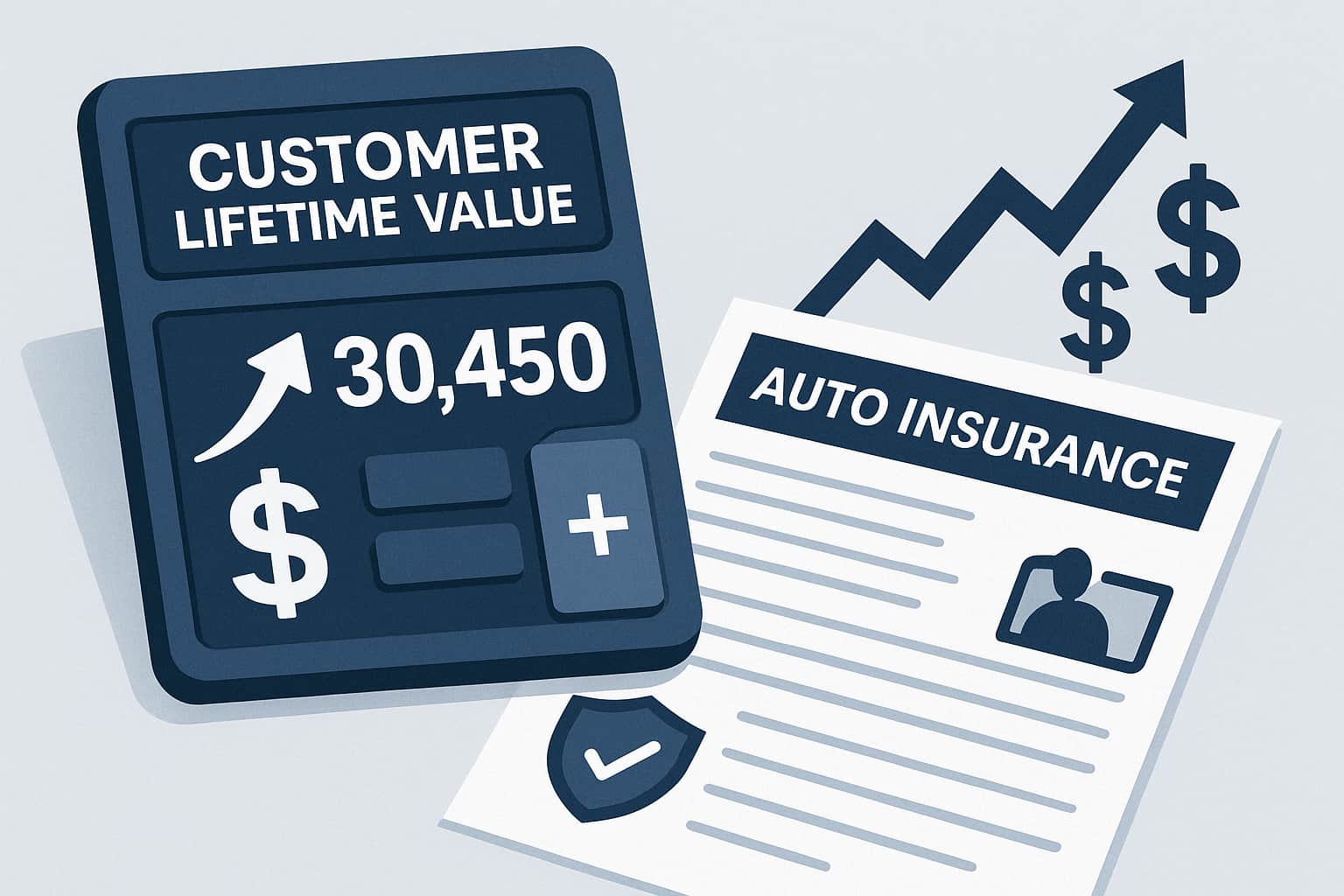
Want to know which car insurance customers are actually worth your digital marketing dollars? Most auto insurance agencies struggle with this question. They spend hundreds per lead without knowing if those customers will stick around or just disappear after six months.
Here's the problem: According to a McKinsey study, agencies that focus on customer lifetime value outperform competitors by 20%. But most agencies still make decisions based on upfront costs alone. This approach wastes money on customers who leave quickly while missing high-value prospects.
The solution is simpler than you think. Calculate customer lifetime value (LTV) the right way. Use that data to spend your digital marketing budget smarter. Focus on exclusive auto insurance leads for agents who bring real long-term profit.
You'll learn how to calculate LTV for auto insurance, avoid common mistakes that cost agencies thousands, and use LTV insights to improve your insurance lead conversion rates.
Understanding Customer Lifetime Value
Common LTV Calculation Mistakes
How to Calculate LTV Properly
Segmenting Customers for Better Analysis
Optimizing Lead Generation with LTV
Tools for Tracking LTV
Improving Retention to Maximize LTV
Real Agency Success Stories
Customer lifetime value measures total profit from one customer over your entire relationship. For auto insurance companies, this includes policy renewals, cross-selling opportunities, and all costs.
Think of it this way: if you spend $500 to get a customer through pay per call auto insurance leads, how much profit will they bring over time? If they're worth $1,500 over three years, that's a great investment. If they're only worth $400, you're losing money.
Auto insurance LTV is unique because of recurring revenue. Customers renew annually or semi-annually. Plus, they might add home insurance, life insurance, or more vehicles later.
Here's what LTV tells you:
How much you can spend on insurance leads to get new customers
Which lead generation sources bring the best customers
Where to put your digital marketing dollars for maximum return
Which customers need extra attention through email marketing to keep them happy
The goal is simple: earn at least $3 for every $1 spent on getting customers. Industry experts call this a 3:1 LTV to customer acquisition cost ratio.
For example, if a customer's lifetime value is $1,200, you can spend up to $400 to acquire them through SEO or content marketing and still maintain healthy profits.
Optimize your customer acquisition strategy to achieve this ratio by learning how to get more auto insurance leads & cut CAC methods that balance lead quality with acquisition costs.
Most agencies make critical errors that lead to bad digital marketing decisions. Here are the biggest mistakes to avoid:
Looking only at first-year revenue. Many agencies calculate LTV using just the initial policy term. This gives a dangerously limited view. Industry experts warn that 6 or 12-month calculations "provide a short-term view and rarely tell you how much you should spend" on getting customers.
Ignoring cross-selling opportunities. Treating each auto policy separately dramatically undervalues customers. Research shows customers with multiple policies have retention rates up to 95%. Agencies with more than 1.8 policies per client see annual churn drop to just 5%.
Using total premiums instead of actual profit. Some agencies use premium amounts rather than real profit margins. True LTV must include costs like claims, commissions, and service expenses. Most agencies see profit margins of 10-20% on auto policies.
Overlooking retention rates. Many assume all customers renew forever. Reality check: average auto insurance retention is around 84%. Getting this wrong leads to wildly inaccurate LTV estimates.
Not separating customer types. Using one average LTV for all customers hides huge value differences. A young driver with basic coverage has very different value than a middle-aged homeowner with multiple vehicles and bundled policies when you compare auto insurance rates online.
Overpricing loyal customers. Some agencies gradually raise premiums for long-term customers, assuming they won't shop around. One case study showed how a 17% premium increase lost both the $600 LTV and the original $480 acquisition cost when the customer decided to switch car insurance providers.
Calculating LTV for auto insurance requires a formula that handles insurance-specific factors. Here's the step-by-step approach:
Basic LTV Formula
LTV = (Annual Profit × Retention Rate) / (Discount Rate + Churn Rate)
Where:
Annual Profit = Average Annual Premium × Profit Margin
Retention Rate = Percentage who renew (like 84%)
Churn Rate = Percentage who leave (like 16%)
Discount Rate = Time value of money (typically 10%)
This formula aligns with standard LTV calculation methods used across financial analysis and insurance industries.
Real Example
Let's calculate LTV for a typical auto insurance customer:
Average Annual Premium: $1,200
Profit Margin: 15%
Retention Rate: 84%
Churn Rate: 16%
Discount Rate: 10%
Annual Profit = $1,200 × 0.15 = $180 LTV = ($180 × 0.84) / (0.10 + 0.16) = $151.20 / 0.26 = $581.54
This customer is worth about $582 over their lifetime. You could spend up to $194 to acquire them through cheap auto insurance leads while maintaining a 3:1 ratio. This approach to calculating LTV is supported by financial modeling best practices for customer valuation.
Adding Cross-Sell Value
To get more accurate numbers, include the chance of selling additional policies:
Calculate what percentage of auto customers add home insurance (maybe 25%)
Find the average annual profit from home policies (maybe $200)
Adjust your LTV formula
Enhanced LTV = Basic Auto LTV + (Cross-sell Rate × Home Policy LTV)
Using our example:
Basic Auto LTV: $581.54
Cross-sell Rate: 25%
Home Policy LTV: $700
Enhanced LTV = $581.54 + (0.25 × $700) = $756.54
This better calculation shows you could spend up to $252 to acquire a customer through auto insurance leads with high ROI while keeping your 3:1 ratio. This aligns with industry benchmarks where insurance companies typically target acquisition costs of 10-15% of expected lifetime premium.
One average LTV for all customers hides big differences in value. Smart agencies separate their customer base to find which types deliver the highest lifetime value through their digital marketing strategies.
Key Ways to Separate Customers
Vehicle type: Luxury, standard, multiple vehicles
Coverage level: Basic liability vs. what coverage does auto insurance include in full policies
Bundle potential: Home, renters, other vehicles
Demographics: Age, location, marital status, homeownership
Claim history: How often and how much
How they found you: Direct, referral, online, pay per call campaigns
Comparing Two Customer Types
Here's how dramatically LTV can vary:
Customer Type A: Young Renter with One Vehicle
Annual Premium: $1,000
Profit Margin: 12%
Retention Rate: 70%
Cross-sell Potential: Low (10% get renters insurance, often seeking car insurance discounts for students)
LTV: About $280
Customer Type B: Middle-aged Homeowner with Multiple Vehicles
Annual Premium: $1,600
Profit Margin: 18%
Retention Rate: 92%
Cross-sell Potential: High (80% already have home insurance, understand how to lower auto insurance premiums through bundling)
LTV: About $1,840
The difference is huge: $280 vs. $1,840. If you use only an average LTV, you might spend the same amount to get customers from both groups. This means dramatically overpaying for Type A while underinvesting in the much more valuable Type B customers.
Once you know the lifetime value of different customer segments, you can transform your approach to how to get car insurance leads.
Setting Smart Spending Limits
Use your LTV calculations to figure out maximum costs per lead by source:
Start with the LTV for each customer segment
Divide by your target ratio (typically 3:1)
Adjust for how many leads become customers
For example, if your high-value segment has an LTV of $1,840, your maximum cost should be around $613. If 20% of leads become customers, you could spend up to $122 per lead.
This approach lets you:
Bid more for exclusive auto insurance leads for agents with high-value potential
Spend less on channels that mostly bring low-value customers
Justify higher investments in quality lead sources and content marketing
Choosing Better Lead Channels
Different lead sources often attract different customer types when implementing local SEO strategies:
Internet leads might bring price-sensitive shoppers looking for first-time car insurance
Referral programs often deliver customers like your best existing clients
Real estate partnerships might bring high-value homeowner prospects
Pay-per-call campaigns might attract customers ready to buy now
Track LTV by where customers come from. This shows which sources deliver the highest long-term value, not just the lowest cost per lead.
Maximize the value of your high-LTV prospects by learning how to double your auto insurance leads conversion rate techniques that turn quality leads into loyal, profitable customers.
Real Example: Smart Bid Changes
Consider an agency buying auto insurance leads:
Before: They spent $50 per lead across all campaigns.
After LTV analysis, they found:
Channel A leads had average LTV of $400 (maximum bid: $40)
Channel B leads had average LTV of $1,200 (maximum bid: $120)
By reducing bids on Channel A and increasing bids on Channel B, they kept the same total marketing budget but increased overall LTV by 40%.
Successfully using an LTV-based approach requires the right tools and systems, including CRM for independent insurance agents.
Customer Management Systems
For insurance agencies, specialized systems can track policy details, premiums, and retention:
Salesforce with Financial Services Cloud
AgencyBloc
Applied Epic
Vertafore AMS360
InsuredMine
These systems store important data like:
Policy start and renewal dates
Premium amounts and coverage details
Cross-sold products
Customer interactions
Claims history
LTV Calculation Tools
Several options exist for calculating and tracking LTV:
Spreadsheet templates (Google Sheets, Excel)
HubSpot's free customer lifetime value calculator
Custom dashboards in your management system
Business intelligence tools like PowerBI or Google Data Studio
Your calculation tool should track:
Average premium by customer segment
Retention rates by segment
Profit margins
Cross-sell rates
Costs to get customers by channel
Lead Tracking and Attribution
For agencies focused on auto insurance lead generation, connecting leads to long-term value is crucial:
Call tracking platforms for pay per call auto insurance leads campaigns
Google Analytics for digital attribution and mobile-first website design
UTM parameters to track campaign sources and best keywords for SEO
Integration between lead platforms and your management system
The best agencies create complete reporting where they can trace each customer back to their original lead source and calculate the actual LTV delivered by different channels.
Enhance your lead source analysis by learning how to improve your auto insurance lead conversion rate using call scoring to identify which channels deliver not just leads, but high-converting, high-LTV prospects.
Since retention rate critically affects LTV calculations, customer retention in auto insurance directly increases lifetime value. Research by Bain & Company and Harvard Business School shows that increasing retention by just 5% can increase profits by 25-95%.
Systematically improve your retention rates by learning how to reduce churn and get better auto insurance leads strategies that focus on keeping your highest-LTV customers engaged long-term.
Proven Ways to Keep Customers
1. Create a systematic welcome process
Welcome calls or emails explaining what coverage does auto insurance include
Easy-to-understand policy summaries for first-time car insurance buyers
Early education about digital tools, payment options, and how to file a car insurance claim
2. Stay in regular contact using email campaigns
Annual policy reviews to find coverage gaps or new discounts
Birthday or policy anniversary messages through social media marketing
Seasonal driving tips or safety reminders
3. Make renewal easy
Renewal notifications 45, 30, and 15 days before expiration
Clear explanation of any premium changes
Highlight loyalty benefits or multi-policy discounts
4. Give special treatment to high-value customers
VIP service options for your most valuable segments
Special rate considerations for long-term customers
Priority claims handling
5. Smart cross-selling strategies for insurance agents
Time offers based on customer life events
Emphasize bundling discounts
Use data to find the most relevant additional products
For agencies dealing with consumer auto insurance, improving retention by just 3-5 percentage points can dramatically increase overall profits. This often delivers better return on investment than getting new customers.
Agency A: From Cold Calls to Smart Targeting
An independent agency with three producers was using cold-calling to get new business. After using an LTV-based approach with cost-effective insurance marketing strategies:
What they did:
Analyzed their customer base to find most profitable segments (mainly professional homeowners with multiple vehicles)
Shifted budget from general lead buying to targeted marketing focused on these segments using SEO for auto insurance companies
Set up a system to track prospects and customers
Created a structured follow-up process with insurance lead follow-up best practices
Results:
Increased policy count by 22% while spending 15% less on marketing
Improved retention rate from 82% to 89%
The agency reported they "closed more policies and increased customer lifetime value" by focusing on fewer, higher-quality leads rather than raw lead volume.
Agency B: Focus on Keeping New Customers
A mid-sized agency with 12 producers noticed their retention rate for first-year customers was much lower (70%) than for customers who renewed at least once (92%).
What they did:
Added touchpoints at 30, 90, and 180 days after policy start
Started cross-sell conversations at the six-month mark
Began early renewal outreach with personalized offers
Results:
First-year retention improved to 85% (consistent with industry research showing average retention of 84-85%)
Cross-selling rate increased by 15%
Overall LTV increased by about 30%
The agency found that investing in early retention delivered better return on investment than continuing to increase spending on auto insurance lead generation.
Understanding and using customer lifetime value can transform your auto insurance agency's marketing strategy and profits.
Here's how to start using an LTV-based approach:
1. Start with your data Analyze your existing customer base to establish baseline retention rates, profit margins, and cross-selling patterns.
2. Separate your customers Find the characteristics that distinguish high-value from low-value customers.
3. Calculate LTV by segment Use the formulas in this article to determine the lifetime value of each customer segment.
4. Evaluate your lead sources Track which channels deliver customers in your highest-value segments.
5. Adjust your marketing investments Put more budget toward sources that deliver high-LTV customers, even if their initial cost is higher.
6. Focus on keeping customers Especially work to keep your highest-value customers and increase cross-selling opportunities.
7. Monitor and improve Regularly update your LTV calculations as you gather more data and as market conditions change.
Building your auto insurance lead generation strategy around customer lifetime value rather than just acquisition cost creates a more sustainable, profitable agency that can thrive even in competitive markets.
If you want to get more pay per call auto insurance leads today, sign up for free with ResultCalls!

Hello everyone! My name is Alex and I write these blogs to help educate small business owners on different ways to grow their business. My goal is to make lead generation as easy as possible for you. After reading these blogs, I hope you leave with some actionable steps that will get you closer to growing your business :)