The U.S. roofing industry pulls in about $92.5 billion a year across roughly 109,000 businesses, and the three largest companies control under 4% of it. That means almost every roof in America gets sold by a small local crew. Yours included.
The problem is getting noticed. Roofing contractors pay an average of $10.25 per click and $126 per lead on Google Ads, and in storm markets like Dallas or Atlanta a single click can hit $65. Exclusive roofing leads run $60 to $120 in smaller metros and $120 to $220 in competitive cities. If you are a two-truck operation, those numbers are hard to swallow.
Here is the good news. The channels that produce the most roofing work are also the cheapest ones. Local search delivers a cost per lead about 61% lower than traditional outbound marketing, and reviews cost nothing but a follow-up text. This guide walks you through a four-phase system you can run for a few hundred dollars a month, plus a clear rule for when paid leads are worth adding.
What should you fix first when money is tight? How much should a small roofing company actually spend? And when does it make sense to buy calls instead of chasing them? ResultCalls works with roofing contractors across the country on exactly these questions, and you can see how the pay-per-call model works at ResultCalls.
How to Market a Roofing Company Cheaply
Phase L: Lock Down Your Google Listing
Phase E: Earn Reviews and Referrals on Purpose
Phase A: Answer Calls Within Five Minutes
Phase N: Nudge Your Neighborhood for Cheap
When to Add Paid Roofing Leads
What This Roofing Marketing Plan Costs Monthly
Building Your 2026 Strategy
Frequently Asked Questions
Learning how to market a roofing company on a small budget comes down to one rule: fix the free channels first, then pay only for results. Most home service contractors spend 5% to 10% of annual revenue on marketing, which is $50,000 to $100,000 a year at $1 million in sales. You do not need that to start. The first three phases below run for $300 to $800 a month.
The system has a name so you can keep it straight: the LEAN Roof Method. Listing. Earn. Answer. Neighborhood. Each phase builds on the one before it, and each one has to be working before you spend a dollar on ads.
Why that order? Because roughly 46% of all Google searches carry local intent, and a homeowner with a leak is not browsing. They search, they scan the top three map results, and they call. If your listing is thin and your phone rings out, paid traffic just sends more people to a dead end.
Plenty of roofing marketing strategies fail for that exact reason. The ads work fine. The business behind them does not. Run LEAN in order and you fix the leaks before you turn up the water.

Your Google Business Profile is free and it is the single highest-return asset you own. Listings with more than 100 photos receive 520% more calls than average listings, and businesses that respond to reviews within six hours see 38% more engagement. Setup takes about 3 to 4 hours. Upkeep takes 20 minutes a week.
Start with the basics and get them exactly right. Use your legal business name, one phone number, and the same address format everywhere online. Pick "Roofing Contractor" as your primary category. Add secondary categories like "Roof Repair" or "Gutter Service" only if you truly do that work.
Then set your service area. List the 5 to 10 cities and ZIP codes you actually drive to, not the whole state. Google shows you to people near the center of your service area, so a bloated radius makes you weaker everywhere.
Photos are where most roofers stop short. Post 10 to 15 new job photos every month: before shots, tear-off, underlayment, finished ridge, the crew, the truck. Real photos from real addresses beat stock images every time. Add job details in the caption, like "Architectural shingle replacement, 2,100 square feet, Tulsa."
Finally, use the Q&A section. Write out the 5 questions you get asked on every estimate, then answer them yourself. Things like "Do you work with insurance claims?" and "How long does a full replacement take?" That section is public, indexed, and almost always empty on your competitors' profiles.
Once your listing is complete and your phone is covered, adding call volume becomes a math problem instead of a gamble. ResultCalls sends roofing contractors exclusive inbound calls with no setup fee and no monthly minimum, so you can test 10 calls before committing to anything. See how it works on the roofing leads page.

Ask every single customer for a review within 24 hours of final walkthrough. Sites ranking in the top three local results average 561 Google reviews, and every 10 new reviews lifts profile conversions by about 3%. This costs you nothing except a text message and a habit.
Build the ask into your close-out process. When the crew loads up, the foreman hands the homeowner a card and says one line: "If you were happy with us, a quick Google review helps our small crew a lot." Then send a follow-up text with the direct review link that afternoon. About 1 in 4 people will do it if you ask this way.
Referrals deserve the same treatment. Word of mouth is still the top lead source for 74% of contractors, with repeat business at 62% and online search at 54%. Most roofers treat referrals as luck. Treat them as a process instead.
Here is a simple version. Every completed job gets a follow-up call at 30 days to check the roof and ask if a neighbor needs a look. Offer $150 to $250 for any referral that turns into a signed job. On a $9,500 average replacement, that is under 3% of the ticket for your cheapest possible lead.
Do not forget adjusters, real estate agents, and property managers. Five good relationships there can carry a slow month. Take three of them to lunch this quarter and ask what makes a roofer easy to work with.

Answer the phone or lose the job. Phone leads convert at 46% compared to 8% to 12% for form submissions, 78% of homeowners hire the first contractor who responds, and 85% will not leave a voicemail. Speed beats polish here, and it is free.
Track your missed calls for one week. Most small roofing companies find 20% to 40% of inbound calls go unanswered during work hours, usually because everyone is on a roof. That is real money. At a $9,500 average job and a 30% close rate, 10 missed calls a month is roughly $28,500 in lost revenue.
Fix it in the cheapest way that works for you. A shared cell phone with a rotating "phone duty" schedule costs nothing. A live answering service runs $100 to $250 a month. A part-time office person costs more but pays for itself at one extra job per month.
Set two rules and hold to them. Every call gets answered by a human or returned within 5 minutes. Every voicemail gets a text back immediately, because a text gets read when a callback goes ignored.
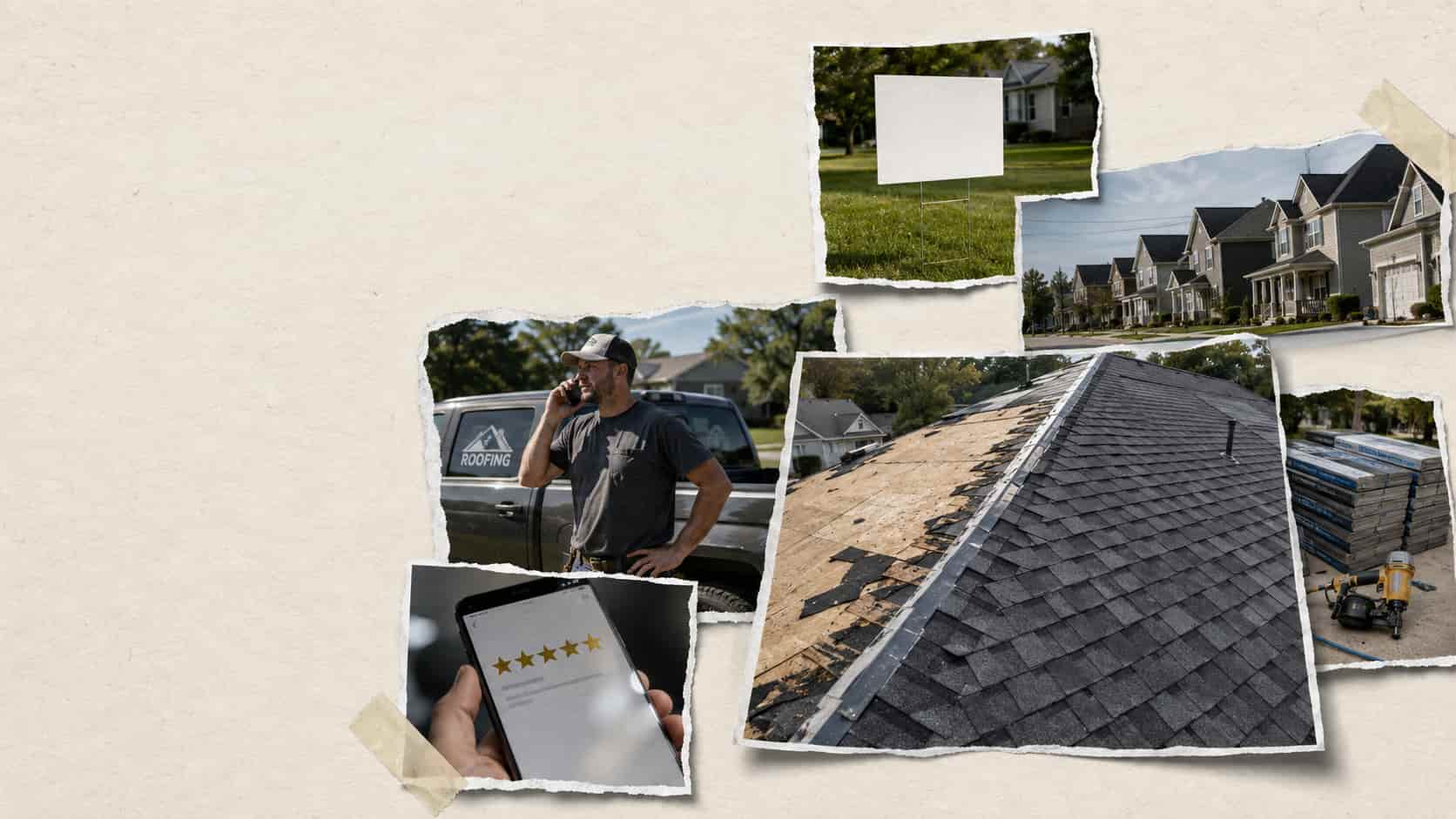
Work the streets you are already on. Wind and hail damage now account for 42.5% of claims filed on homeowners insurance, and roofs age in clusters, so the houses around your current job are the warmest prospects you will ever find. A yard sign costs $8 to $15 and stays up for a week.

These roofing marketing ideas all run under $200 a month and need no agency:
Yard signs on every job. Order 50 at $8 to $12 each and put one out on day one, not day three.
Door hangers on the 20 nearest homes. Printing runs $0.10 to $0.30 per piece, so 200 hangers costs about $40.
A truck wrap or magnet set. Full wraps run $2,500 to $4,000, but door magnets and a rear window decal cost under $300.
Free Nextdoor and local Facebook group posts. Post the finished job photo, not an ad.
A storm follow-up route. After a hail event, drive the affected ZIP codes within 72 hours and leave inspection offers.
Social media belongs here too, but keep expectations honest. Around 70% of contractors advertise on social, so it is a crowded room. One before-and-after post a week with a real address and a real price range does more than daily filler.
Track everything with one question: "How did you hear about us?" Write the answer on every estimate. After 90 days you will know which of these actually pays, and you can drop the rest.
Add paid channels once LEAN is running and you have capacity to sell more work. You have four realistic options, and they price out very differently. Google Ads averages $126 per lead for roofing, shared platforms like Angi run $15 to $85 per lead, SEO takes 4 to 12 months to mature, and agencies typically charge $500 to $2,500 a month on top of ad spend.
Google Ads gives you speed and control. It also punishes small budgets, since less than 9% of keywords in unmanaged roofing accounts produce leads while the rest burn most of the spend. If you go this route, start at $1,500 a month minimum, use exact-match terms only, and turn off display entirely.
SEO is the best long-term value and the worst short-term one. Expect 4 to 12 months before meaningful traffic, and $800 to $2,500 a month for real work. Do it when you can fund a year of it without flinching. Do not do it when payroll is tight.
Shared lead platforms look cheapest and usually are not. A $70 shared lead sold to four contractors, closing at 10%, works out to $700 per job. An exclusive lead at $180 closing at 40% comes to $450 per job. The sticker price fooled you; the booked-job cost tells the truth.
Pay per call sits in the middle on price and at the low end on risk. You pay for a qualified phone call from a homeowner in your area, not a shared form fill and not a click. There is no ad account to manage and no monthly retainer. For a roofing contractor marketing on a tight budget, that matters, because you can start at 10 calls, measure your close rate, and stop whenever you want. With ResultCalls, roofing calls are exclusive to you, with no setup fees, no monthly fees, and no cancellation fees, so a slow month costs you nothing.

The full LEAN Roof Method runs $350 to $900 a month plus about 4 hours a week of your time. Compare that to the $6,700 a month a $1 million roofing company would spend at an 8% marketing budget. You are getting the highest-return 20% of the work for roughly 10% of the cost.
Here is the thing about that table. Three of the four phases are free or nearly free, and the free ones are the ones that decide whether the paid ones work. A contractor doing $400,000 a year can run all four for under 2.5% of revenue.
Do these three things in this order over the next 30 days.
First, finish your Google Business Profile this week. Add 15 job photos, set a 10-city service area, and answer 5 questions in the Q&A section. It is free and it takes one afternoon.
Second, run a missed-call audit for 7 days. Count every unanswered call. If you are missing more than 15%, fix that before you spend a dollar on advertising, because at a $9,500 average job you are losing thousands a month.
Third, start asking for reviews on every job, starting with your next one. Aim for 10 new reviews in 90 days, which is roughly a 3% lift in profile conversions per 10 reviews.

Most home service contractors spend 5% to 10% of gross revenue, so a $500,000 roofing company lands around $2,000 to $4,200 a month. If you are established with a strong referral base, 3% to 5% is often enough to hold steady. New companies without a customer list usually need 8% to 12% to build any real presence.
Google Business Profile and reviews are the cheapest, since both are free and local search produces leads at roughly 61% below outbound costs. After that, referral payouts of $150 to $250 per closed job are the lowest-cost paid option. Pay per call comes next, because you only pay when a homeowner actually calls you.
Usually not, once you run the real math. Roofing leads on those platforms run $15 to $85 and get sold to three to five contractors at once, which pushes your true cost per booked job toward $700. Exclusive leads cost more per lead but often land near $450 per booked job because you are not racing anyone to the phone.
Your Google listing and review flow can produce calls within 2 to 4 weeks. Pay per call starts within days since the demand already exists. SEO is the slow one, at 4 to 12 months before it carries real volume, which is why it should never be your only plan when cash is tight.
Yes, but a simple one is fine. A 5-page site with your phone number above the fold, 10 job photos, and your service areas will do the job for $500 to $2,000. Google uses your site to verify your business, and 54% of homeowners find contractors through online search.
You do not need a big budget to figure out how to market a roofing company that stays busy. You need a complete listing, a steady review habit, a phone that gets answered, and a few blocks of the neighborhood working for you. That is the whole LEAN Roof Method, and it costs less than one shared lead package.
Once those four phases are running, extra call volume turns into extra jobs instead of extra chaos. That is the right moment to buy calls, and the right way to buy them is one at a time, with no contract holding you in place. Start with a handful of pay per call roofing leads and let your close rate tell you whether to scale.

Hello everyone! My name is Alex and I write these blogs to help educate small business owners on different ways to grow their business. My goal is to make lead generation as easy as possible for you. After reading these blogs, I hope you leave with some actionable steps that will get you closer to growing your business :)