
Does your dental website feel like a ghost town? You get website visitors but they don't book appointments. Here's the reality: most dental websites convert only 2-4% of visitors into patients.
The problem is that your website visitors leave without taking action. They browse your services, maybe read a review, then disappear forever. Your marketing brings traffic, but your website design doesn't turn that traffic into revenue.
Smart dental practices use conversion-focused design strategies to transform their websites into patient magnets. These practices consistently achieve 8-12% conversion rates through strategic design improvements and proven psychological triggers.
You'll discover the exact dental website design elements that convert browsers into booked patients. Plus specific optimization techniques that can double your appointment bookings within 90 days.
What You'll Learn
Over 60% of patients search for dental practices on mobile devices. Your website must work perfectly on smartphones or you lose patients instantly.
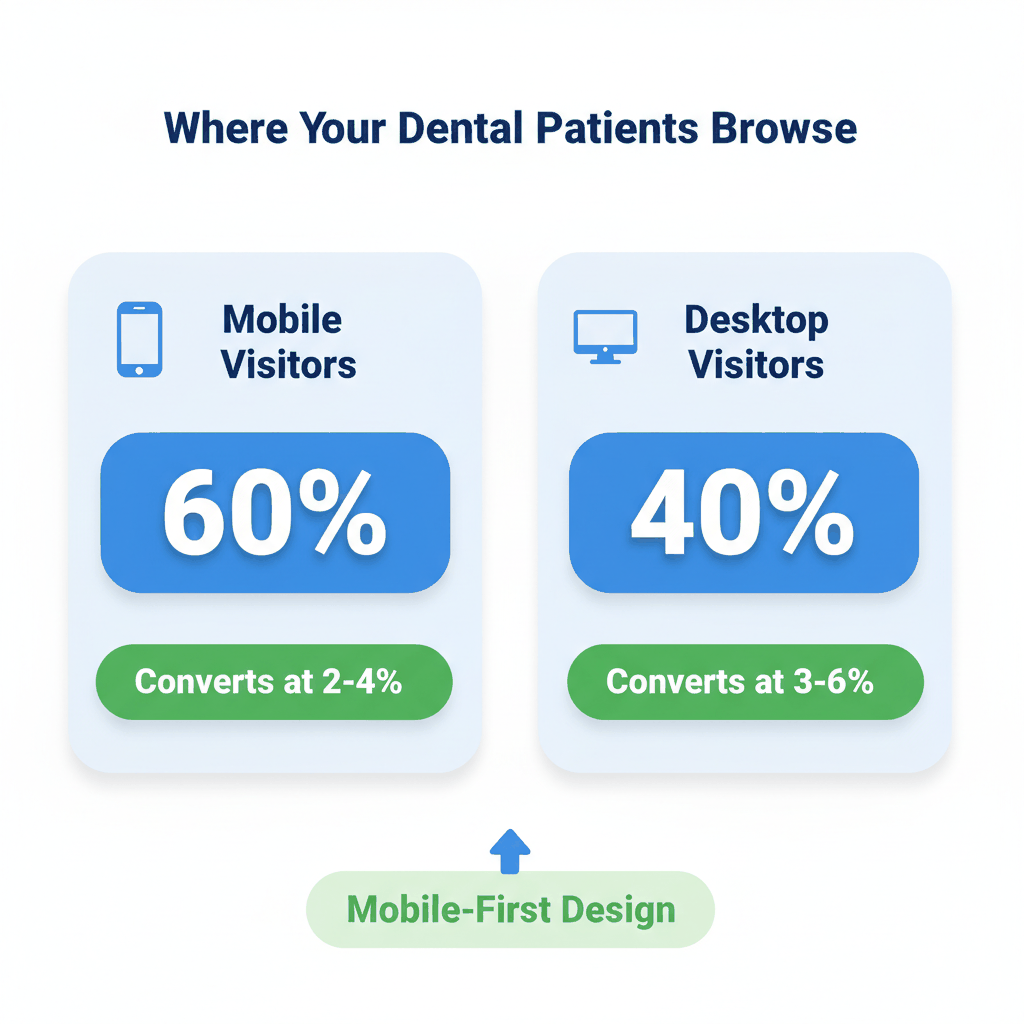
The best dental website designs in 2025 share seven traits. Mobile-first responsive layout, sub-3-second load speed, real-time appointment booking, dedicated pages for each service, embedded Google reviews, secure patient forms, and AI chat integration.
Your mobile dental website needs three critical elements. Large, tappable call buttons at the top of every page. Simplified navigation with no more than 5 menu items. Booking forms that work with one thumb.
For example: A dental practice in Portland redesigned their mobile site with these elements. Their mobile conversion rate jumped from 1.8% to 6.2% in 8 weeks. The key was making appointment booking possible in under 30 seconds on mobile.
Test your mobile experience right now. Pull out your phone and try booking an appointment on your website. If it takes more than 3 taps or requires zooming, you're losing patients every day.
Google uses mobile-first indexing for all websites. Your mobile version determines your search rankings. Poor mobile design doesn't just lose conversions - it kills your SEO.
Essential responsive design elements include touch-friendly buttons at least 44 pixels tall, readable text without zooming, and forms that don't require horizontal scrolling. Your contact information should be visible without scrolling on every page.
Your booking system is where conversions happen or die. Effective booking forms require only essential information and complete in under 2 minutes.
The biggest booking system mistake is asking for too much information upfront. Stick to the essentials: name, phone, email, and preferred time. You can gather insurance details and medical history later.
Reduce booking friction with these proven strategies:
Single-page booking forms with progress indicators
Calendar widgets showing available appointments
Text confirmation within 60 seconds of booking
Option to book emergency appointments separately
Multiple contact methods for booking-shy patients
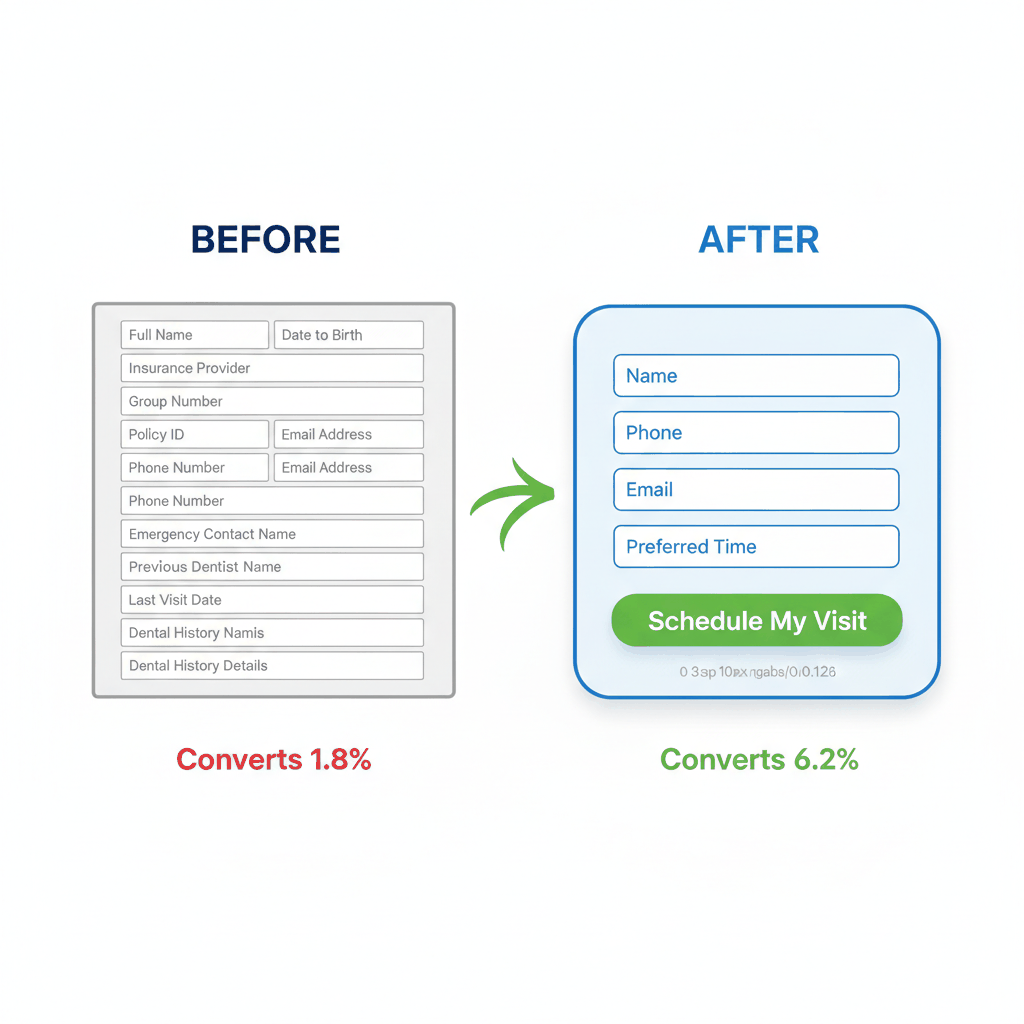
A Chicago dental practice reduced their booking form from 12 fields to 6 fields. Their conversion rate increased by 89%. The shorter form eliminated the biggest barrier to appointment booking.
Your "Book Now" button should appear at least 3 times on every page. Place buttons in the header, after service descriptions, and in the footer. Use action-oriented text like "Schedule Your Visit" instead of generic "Submit" buttons.
Color psychology matters for booking buttons. Orange and red create urgency. Blue builds trust. Green suggests "go" action. Test different colors to see what works best for your patients.
Dental anxiety affects 75% of adults. Your website must overcome fear and build trust before patients will book. Social proof and trust signals turn nervous visitors into confident patients.
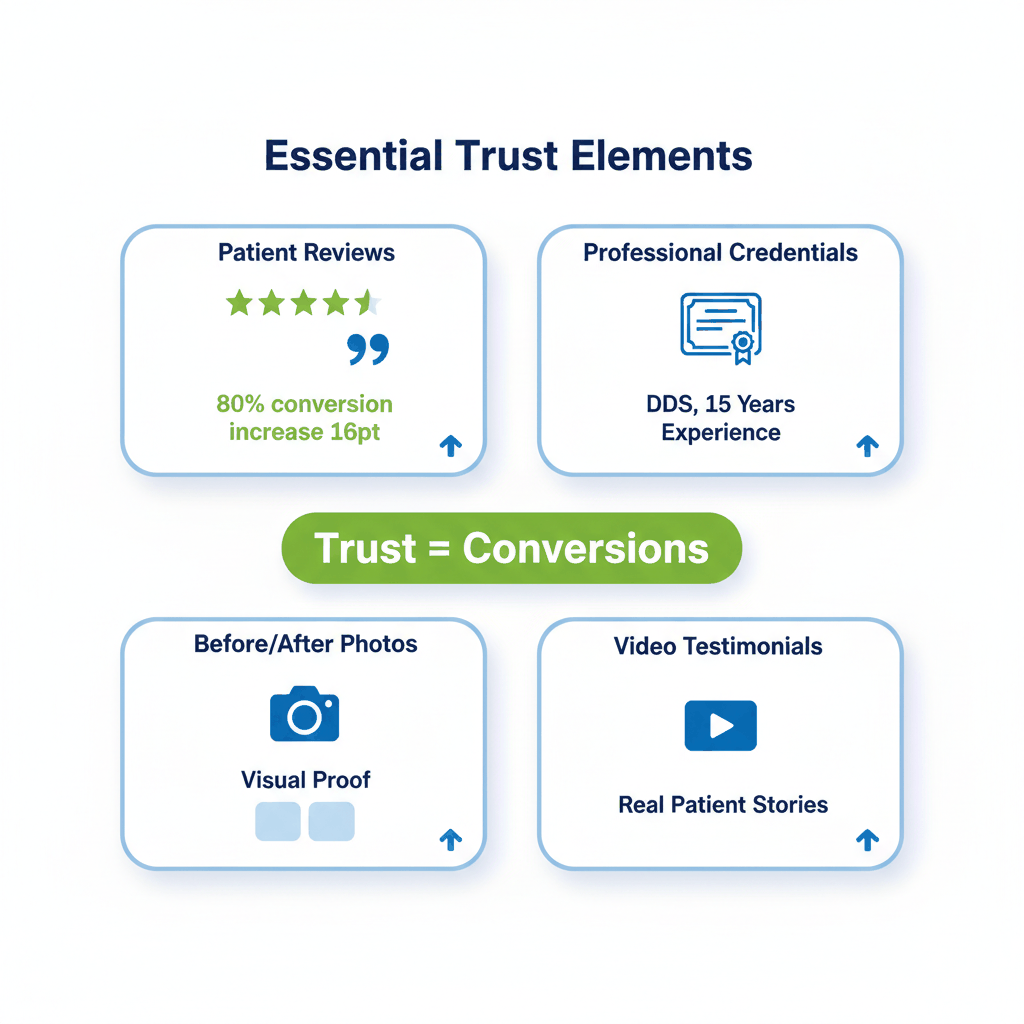
The most powerful trust signals include real patient photos, staff credentials, before/after treatment photos, and video testimonials. These elements address common patient concerns about pain, cost, and treatment quality.
Patient testimonials increase conversion rates by up to 80% compared to text-only descriptions. Video testimonials work even better because patients can see real emotions and results.
Display testimonials strategically throughout your site:
Homepage hero section with your best review
Service pages with treatment-specific testimonials
About page with staff-focused reviews
Contact page with location and convenience praise
Include patient names and photos when possible. Anonymous reviews feel fake to modern patients. Real names and faces build authentic trust.
Display your education, certifications, and professional memberships prominently. Patients want to know their dentist is qualified and current with modern techniques.
Create a dedicated "Meet the Team" section with professional photos and credentials for each staff member. Include years of experience, specializations, and personal touches that help patients connect.
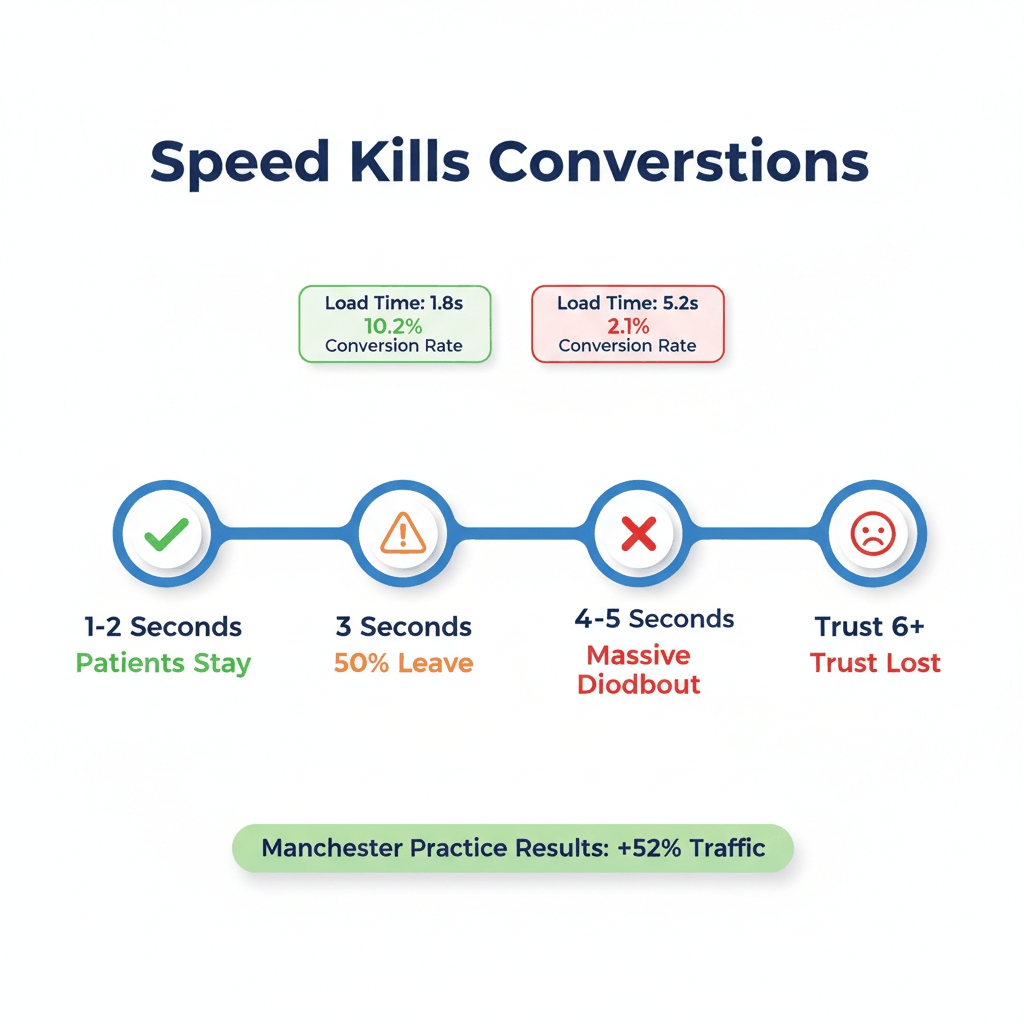
Website speed directly impacts conversions. If your site takes more than 3 seconds to load, over half your visitors leave before seeing anything. Fast loading builds trust and reduces bounce rates.
Google PageSpeed Insights should score your site at 90+ for mobile performance. Anything below 70 hurts both conversions and search rankings. Speed optimization is the foundation of effective dental website design.
High-quality dental photos are essential but can slow your site. Optimize images without losing quality using these methods:
WebP format reduces file sizes by 25-35%
Lazy loading for images below the fold
Proper image dimensions prevent browser resizing
Compressed images under 100KB when possible
A Manchester dental practice reduced loading time from 5.2 seconds to 1.8 seconds through image optimization. This resulted in 52% increased organic traffic and 28% higher consultation booking rates.
Your hosting choice affects site speed more than any other factor. Shared hosting for $5/month can't handle dental website traffic spikes. Invest in managed WordPress hosting or dental-specific platforms.
Essential performance features include content delivery networks (CDN), automatic backups, SSL certificates, and 24/7 uptime monitoring. Your hosting should handle appointment booking traffic without crashes.
A/B testing eliminates guesswork from dental website conversion decisions. Test one element at a time with statistically significant sample sizes. Effective testing requires minimum 1,000 visitors per variation and 2-4 week test durations.
The most impactful elements to test include call-to-action button colors and text, appointment booking form layouts, homepage hero sections, and service page information architecture.
Start with high-impact, easy-to-test elements:
Booking button text ("Schedule Now" vs "Book Appointment")
Homepage phone number placement and size
Contact form length and field requirements
Service page layout and information order
Homepage hero image and headline combination
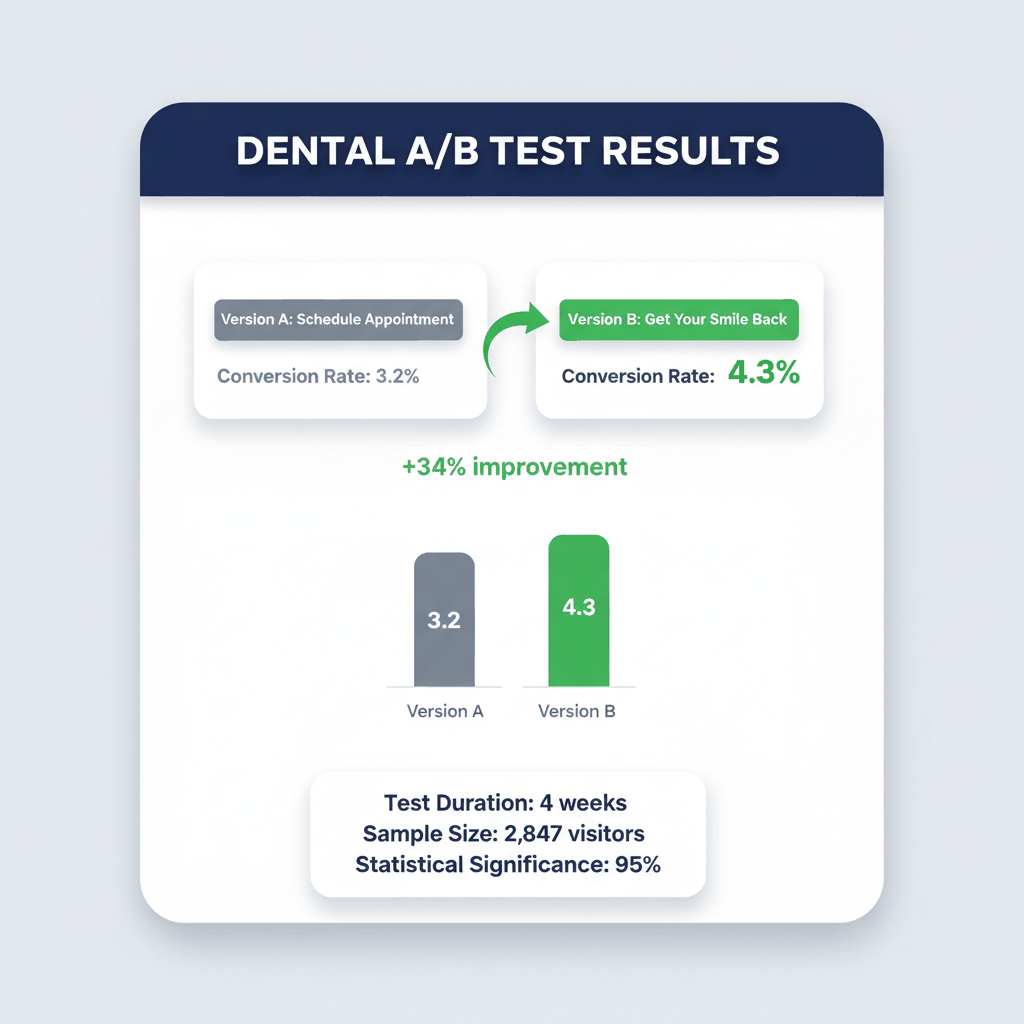
A Boston dental practice tested two different booking button texts. "Get Your Smile Back" converted 34% better than "Schedule Appointment." The emotional appeal resonated better with their patients.
Google Optimize provides free A/B testing for small dental practices. For more advanced testing, consider Optimizely or VWO. These platforms track conversions and provide statistical significance data.
Set up conversion tracking for phone calls, form submissions, and booking completions. Without proper tracking, you can't measure test results accurately.
Real dental practices achieve dramatic conversion improvements through systematic optimization. These case studies show specific strategies and measurable results from actual dental website redesigns.
Dr. Haddad launched a wellness-focused brand positioning his practice as Detroit's go-to provider for TMJ and sleep apnea care. The strategic website redesign drove 758% increased traffic, 1,159% lift in organic keywords, and 1,863% boost in conversions.
The key strategies included dedicated landing pages for TMJ and sleep apnea services, patient video testimonials, and streamlined booking forms. The practice focused on one specialty instead of general dentistry messaging.
A Chicago dental clinic gained 838 new patients and boosted conversions by 517% in 8 months. They cut cost per acquisition from $185 to $42 through targeted Google Ads and conversion optimization.
The optimization strategy included landing page redesigns, call tracking implementation, and booking form simplification. They tested different ad-to-page combinations to find the highest converting paths.
A general dentist in Holbrook, MA, boosted conversions by 74.5% and gained 45 new patients in 2 months. The practice reduced cost per acquisition from $185 to $42 through systematic testing.
They implemented heat mapping tools to identify where patients clicked and scrolled. This data revealed that patients wanted pricing information earlier in their browsing journey.
Professional dental website optimization requires the right tools for testing, measurement, and improvement. These platforms provide the data you need to make conversion-focused design decisions.
Google Analytics 4 tracks website visitors, page views, and conversion paths. Set up goal tracking for phone calls, form submissions, and appointment bookings. This data shows which pages drive appointments and which ones leak visitors.
Call tracking tools like CallRail or CallTrackingMetrics assign unique phone numbers to different marketing channels. You'll know exactly which website pages generate phone calls and appointments.
Heat mapping tools like Hotjar or Crazy Egg show where patients click, scroll, and spend time on your pages. This visual data reveals user experience problems that hurt conversions.
Online appointment scheduling tools include Acuity Scheduling, Zocdoc, and Square Appointments. The best systems send automatic confirmations and reminders, reducing no-shows by up to 30%.
Form optimization tools like Typeform or Gravity Forms create user-friendly contact forms. These platforms provide analytics on form abandonment and completion rates.
Google PageSpeed Insights provides free speed testing for your dental website. Test both mobile and desktop versions. Aim for scores above 90 for optimal performance.
GTmetrix offers detailed performance analysis with specific optimization recommendations. This tool identifies which images, scripts, or plugins slow your site.
What's a good conversion rate for dental websites?
Most dental websites convert between 2-5% of visitors into appointments. However, optimized dental websites consistently achieve 8-12% conversion rates through strategic design and user experience improvements. The difference between 3% and 10% conversion can mean 70 additional monthly appointments.
How long does dental website optimization take to show results?
Most dental practices see conversion improvements within 30-60 days of implementing optimization strategies. However, significant results typically require 90 days of consistent testing and refinement. Speed improvements and mobile optimization can impact conversions immediately.
Should I focus on dental website design or SEO first?
Prioritize conversion optimization before driving more traffic through SEO. There's no point attracting more visitors if your current website doesn't convert them into patients. Fix your dental website conversion issues first, then scale traffic through SEO and advertising.
What's the most important element of dental website design?
Mobile-first responsive design is the foundation of effective dental websites. Over 60% of patients search on mobile devices, and Google uses mobile-first indexing for rankings. Your mobile experience determines both conversions and search visibility.
How much should I invest in dental website optimization?
A conversion rate improvement from 3% to 8% on 1,000 monthly visitors generates 50 additional appointments worth $60,000-120,000 in annual revenue. Professional dental website optimization typically pays for itself within 90 days through increased patient bookings.
Ready to buy dental marketing leads? Sign up for free with ResultCalls today!

Hello everyone! My name is Alex and I write these blogs to help educate small business owners on different ways to grow their business. My goal is to make lead generation as easy as possible for you. After reading these blogs, I hope you leave with some actionable steps that will get you closer to growing your business :)