
Are you tired of watching your dental practice schedule stay empty while competitors book solid appointments? You're not alone. Most dental practices struggle with inconsistent patient flow and wasted advertising dollars on social media campaigns that don't deliver results.
The problem isn't lack of potential patients. Social media influences 41% of consumers' healthcare decisions. The real challenge is that most dental practices use outdated strategies that miss their target audience and fail to convert viewers into booked appointments.
This guide reveals proven Facebook and Instagram advertising strategies that consistently generate 50+ qualified consultations monthly. You'll discover how successful practices achieve 15% conversion rates from social media touchpoints while maintaining profitable ad spending.
By implementing these tested strategies, you'll transform your practice from feast-or-famine scheduling to predictable patient acquisition. Ready to fill your schedule with qualified patients who value quality dental care?
Table of Contents
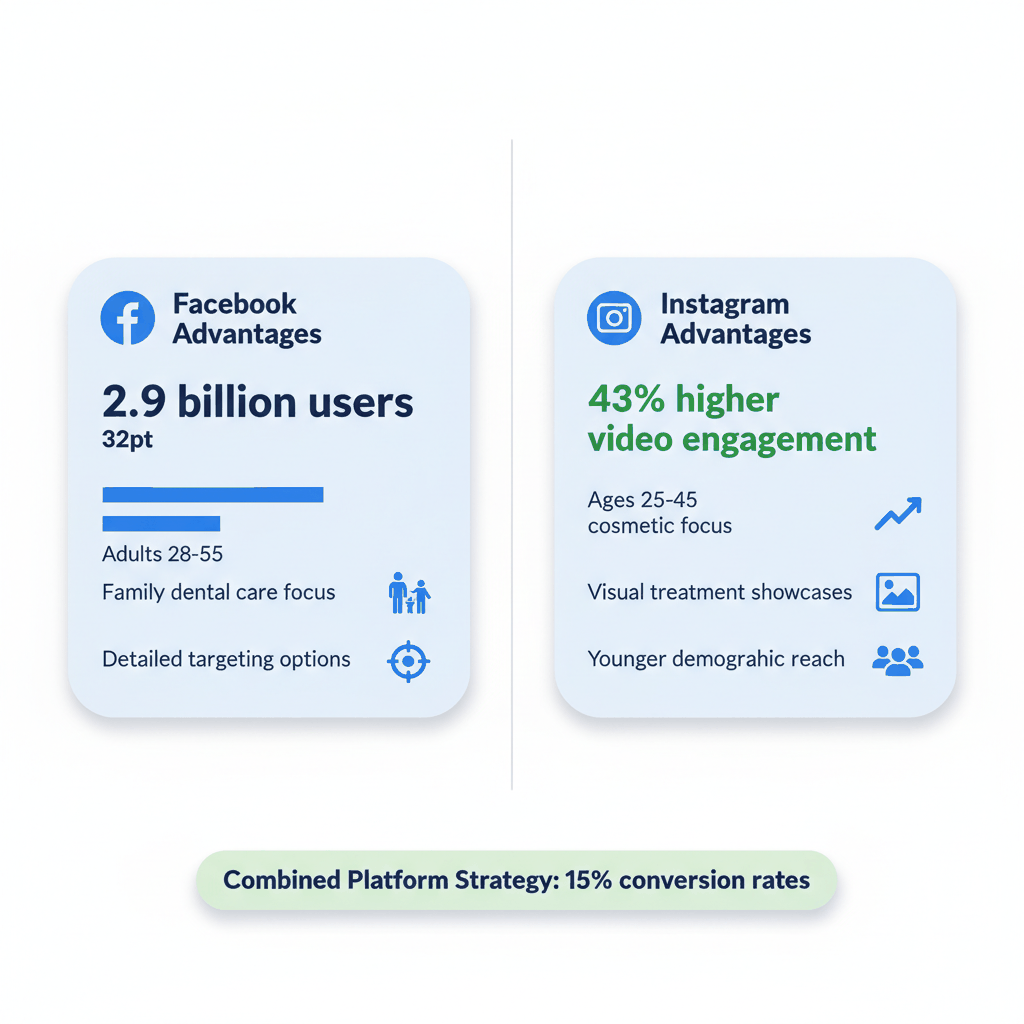
Facebook boasts over 2.9 billion monthly users. This massive reach includes your ideal patients across all age groups and income levels. Plus, 95% of dental offices already have a social media presence, but most aren't using strategic advertising to fill their schedules.
Healthcare Facebook Lead Ads achieve up to 11% conversion rates. Compare this to Google Search Ads at 6.8%. The visual nature of dental work makes these platforms perfect for showcasing your results and building patient trust.
Facebook excels at reaching established adults who need family dental care. The platform's detailed targeting options let you focus on households making over $50,000 annually within 10 miles of your practice.
Instagram dominates with younger demographics seeking cosmetic treatments. Video ads showcasing treatment processes achieve 43% higher engagement than static images.
Both platforms offer sophisticated analytics tools. You can track everything from initial ad views to completed appointments, making your marketing investment measurable and scalable.
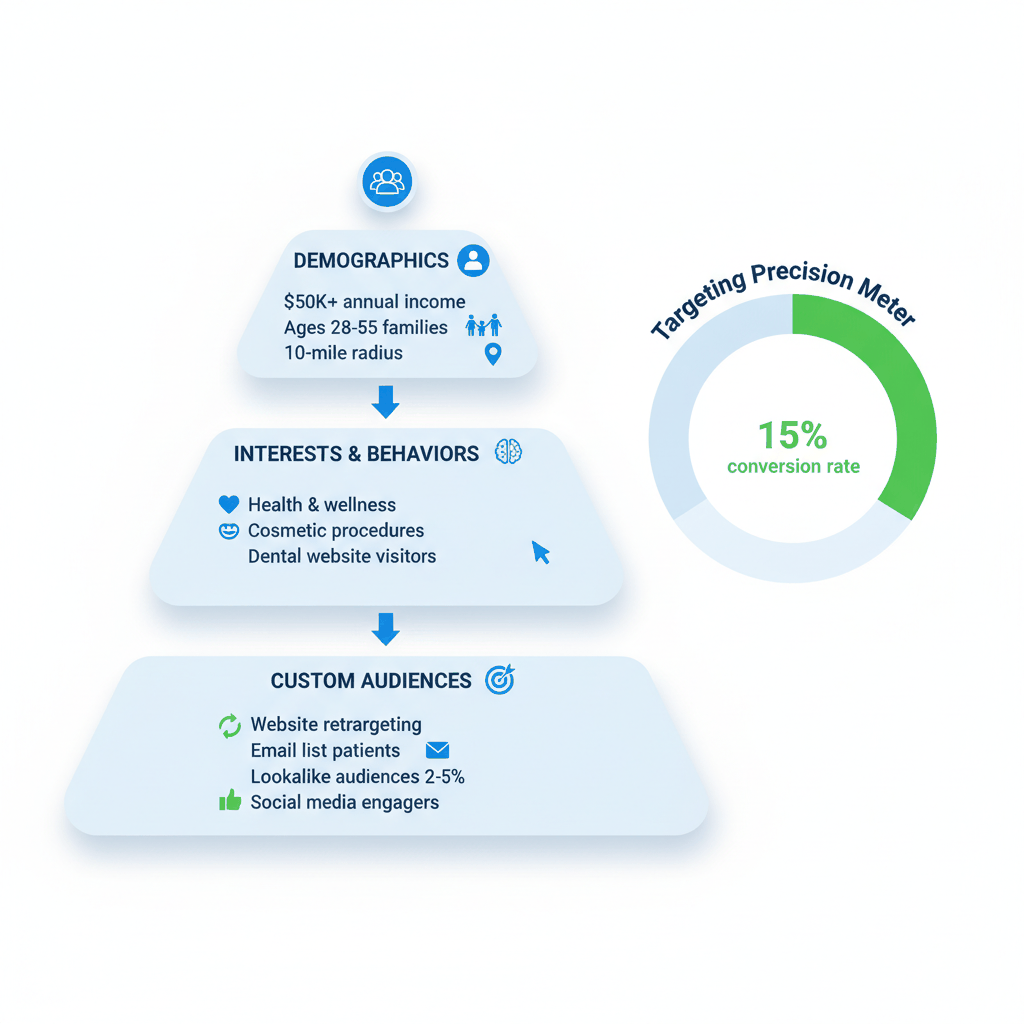
Stop wasting money on broad targeting. Successful dental practices focus on specific patient profiles that generate the highest lifetime value. This precision targeting approach cuts your cost per lead while improving appointment show rates.
Target people making over $50,000 annually with families within 10 miles of your office. This income threshold ensures patients can afford quality dental care without insurance limitations affecting treatment decisions.
Age targeting varies by service type. General family dentistry targets ages 28-55. Invisalign campaigns focus on adults 25-45 interested in cosmetic treatments.
Geographic targeting should stay tight. A 10-mile radius works for most practices. Extend to 15 miles only if you're in rural areas or offer specialized treatments like oral surgery.
Layer interest targeting over demographics for better results. Target people interested in health and wellness, cosmetic procedures, or dental care specifically.
Lookalike audiences work exceptionally well for dental practices. Facebook creates profiles matching your best existing patients. Upload your patient database to create lookalike audiences of 2-5% similarity for optimal performance.
Behavioral targeting captures people actively researching dental services. Target users who visited dental websites, searched for dental terms, or engaged with dental content recently.
Website retargeting captures visitors who didn't book appointments initially. Create custom audiences of people who visited your services pages or started appointment booking but didn't complete it.
Email list retargeting works for existing patients needing follow-up care. Upload patient email addresses to create custom audiences for cleaning reminders or specialty treatments.
Engagement retargeting targets people who interacted with your previous social media content. These warm audiences convert at higher rates because they already know your practice.
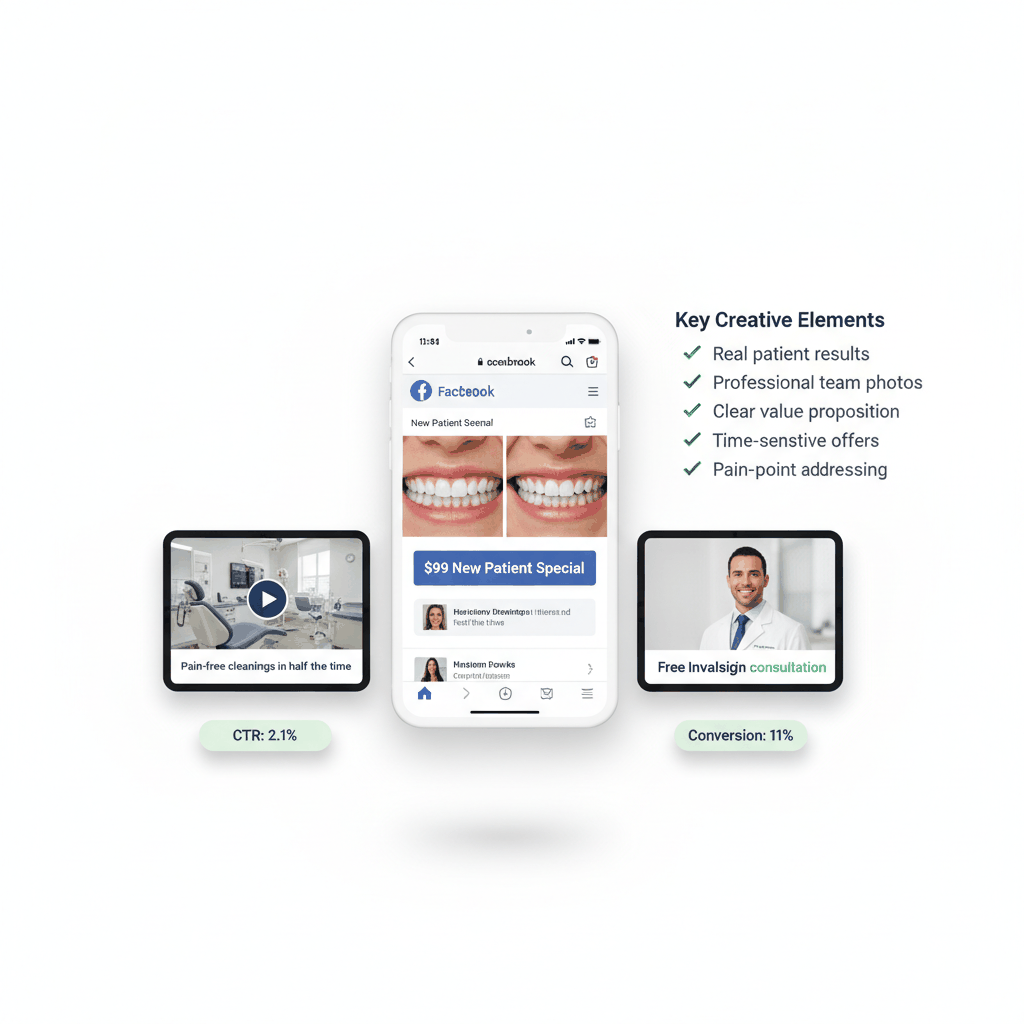
Your ad creative determines whether potential patients stop scrolling or keep browsing. The most successful dental ads combine compelling visuals with irresistible offers that make booking appointments feel urgent and valuable.
Before and after photos remain the highest-converting visual content for dental practices. Show real patient results with proper consent. These authentic transformations build trust and demonstrate your expertise.
Video content outperforms static images consistently. Create short videos showing your team, office tour, or treatment explanations. Keep videos under 30 seconds for optimal Facebook and Instagram performance.
Professional headshots of your team humanize your practice. Patients prefer seeing the actual dentist and staff they'll interact with during appointments.
Lead with patient benefits, not practice features. Instead of "State-of-the-art equipment," use "Pain-free cleanings in half the time." Focus on what matters most to patients: comfort, convenience, and results.
Create urgency with limited-time offers. "New patient special: $99 cleaning, exam, and X-rays (regularly $250). Available this month only." Time-sensitive offers increase conversion rates significantly.
Address common patient concerns directly. "Nervous about dental visits? Our gentle approach helps anxious patients feel comfortable." Acknowledging fears builds trust with hesitant prospects.
New patient specials generate the most leads. The classic "$99 cleaning, exam, and X-rays" offer (typically 60% off regular price) consistently produces 90+ leads monthly.
Free consultations work well for cosmetic services. "Free Invisalign consultation (normally $150)" attracts patients considering orthodontic treatment without the pressure of immediate payment.
Add-on incentives increase perceived value. "Free whitening kit with new patient cleaning" provides extra value without significantly impacting your costs.
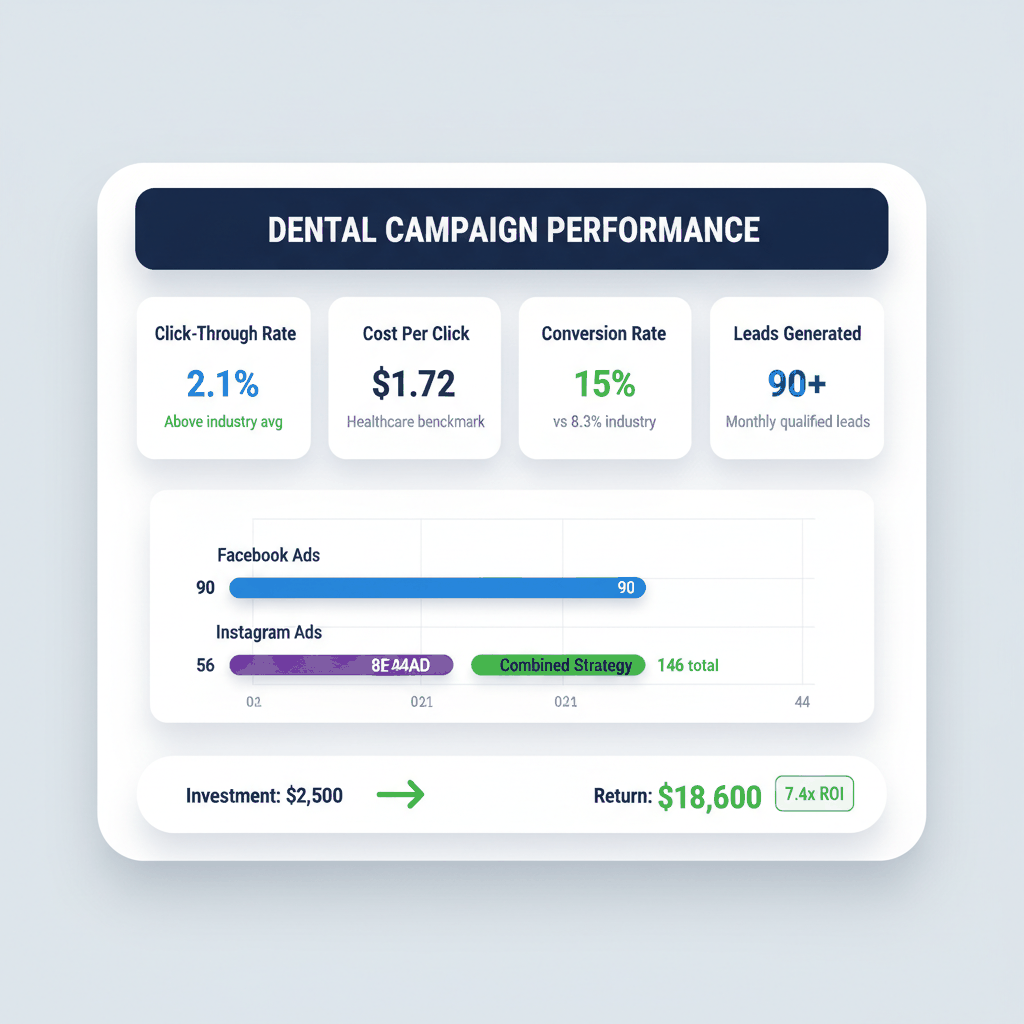
Campaign optimization separates profitable practices from those burning through ad budgets. Monitor key metrics daily and make data-driven adjustments to improve performance continuously.
Click-through rate (CTR) indicates ad relevance. Healthy CTRs for dental ads range from 1-2% or higher. Lower CTRs suggest your targeting or creative needs improvement.
Cost per click (CPC) in healthcare averages $1.32. Facebook dental ads typically cost $1.72 per click. Higher costs may indicate competitive targeting or poor ad relevance scores.
Conversion rate measures appointment bookings per website visitor. The industry benchmark for dental practices is approximately 8.3% from social media traffic.
Test ad creative elements systematically. Try different images, headlines, or offers with identical targeting. Run tests for at least 7 days to gather statistically significant data.
Test audience segments separately. Compare lookalike audiences against interest-based targeting. Geographic radius testing helps optimize your local reach.
Landing page testing improves conversion rates. Direct traffic to dedicated landing pages that match your ad messaging exactly. Generic website homepages convert poorly compared to focused landing pages.
Start with small daily budgets of $10-20 for testing. Successful campaigns can scale to $50+ daily while maintaining profitable cost per acquisition.
Use Facebook's Campaign Budget Optimization to distribute spending across ad sets automatically. This feature allocates more budget to your best-performing combinations.
Dayparting targets ads during peak engagement hours. Most dental appointment bookings happen Tuesday through Thursday, 9 AM to 3 PM.
Accurate tracking reveals which campaigns generate actual appointments versus just website clicks. Many dental appointments are booked by phone, making proper attribution crucial for measuring true ROI.
Facebook Pixel installation tracks website visitors and conversions. Install the pixel on all pages to build audience data and measure campaign effectiveness accurately.
UTM parameters help identify social media traffic in Google Analytics. Use specific codes for each campaign to track performance beyond Facebook's native analytics.
Call tracking solves the phone booking challenge. Assign unique phone numbers to different campaigns. When patients call after seeing your Facebook ad, you'll know which campaign generated that lead.
Set up multiple conversion events in Facebook Ads Manager. Track website form submissions, phone calls, and appointment bookings as separate conversion types.
Google Analytics goal tracking measures website actions. Set up goals for appointment request forms, phone number clicks, and key page visits.
CRM integration provides the most accurate ROI data. Connect your practice management software to track which leads become actual patients and their lifetime value.
Calculate cost per lead by dividing total ad spend by qualified leads generated. Quality leads are people who schedule consultations, not just website visitors.
Track lifetime patient value, not just initial appointments. The average lifetime value of a patient acquired via social media is approximately $1,240.
Factor in show rates when calculating true costs. If 70% of scheduled appointments actually show up, adjust your cost per patient calculations accordingly.
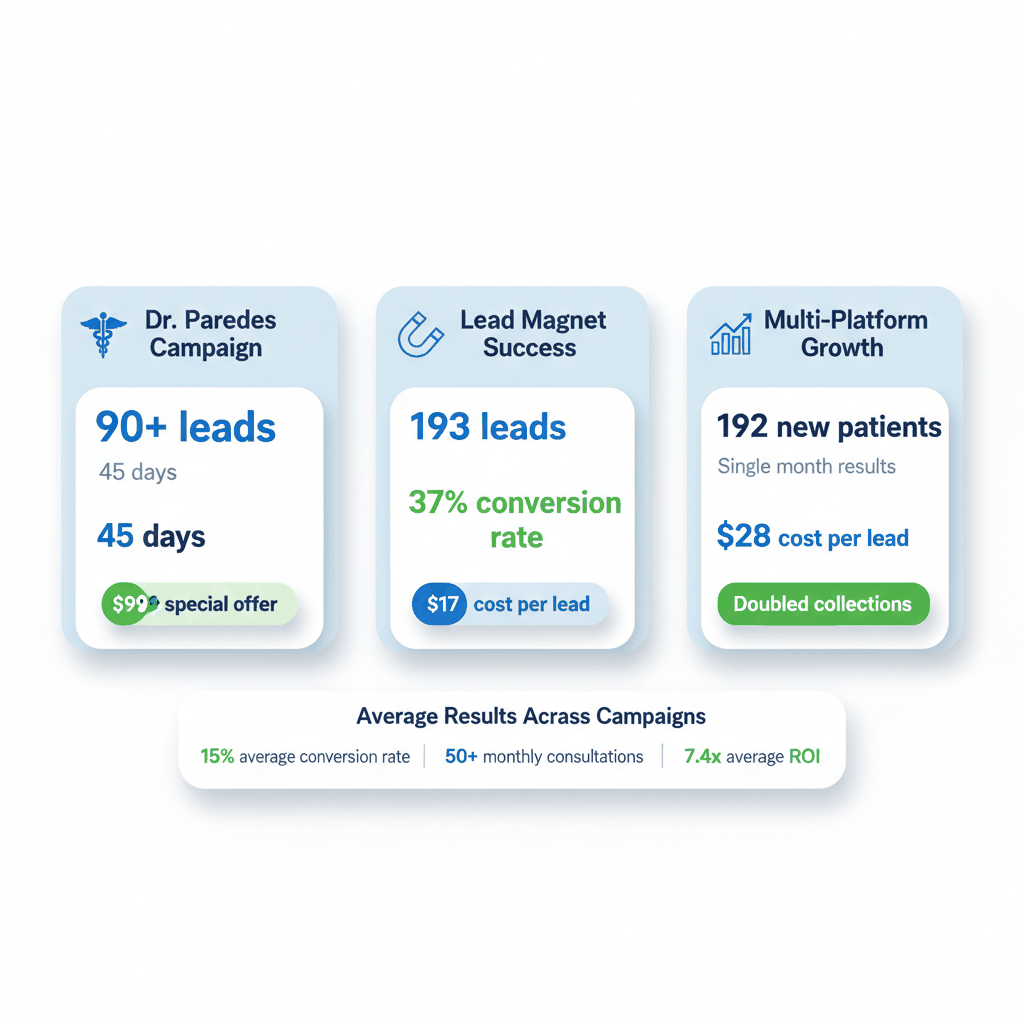
These real-world examples demonstrate how strategic social media advertising transforms dental practice growth. Each case study includes specific metrics and strategies you can adapt for your practice.
Dr. Paredes offered a $99 dental exam plus package (60% off regular price). The package included exam, cleaning, and X-rays for new patients.
The campaign generated over 90 new leads within 45 days. The before-and-after photos combined with the compelling discount offer created high engagement and conversions.
Key success factors included tight geographic targeting, professional visual content, and a clear value proposition that addressed cost concerns for new patients.
This practice generated 193 leads in the first month with a 37% conversion rate. The cost per click was $2.78 with a cost per lead of $17.
The campaign used video testimonials from actual patients combined with a free consultation offer. Targeting focused on adults aged 30-50 within 15 miles who showed interest in dental care.
The high conversion rate resulted from excellent audience targeting and a landing page that matched the ad messaging perfectly.
This practice achieved remarkable growth: 192 new patients in a single month, $28 cost per qualified lead, and doubled collections in one year. They went from 12 new patients monthly to over 80.
The strategy combined Facebook and Instagram advertising with consistent organic content. They used different ad creative for each platform while maintaining consistent messaging.
Success factors included professional video content, strategic offer testing, and systematic follow-up with leads to ensure appointment booking.
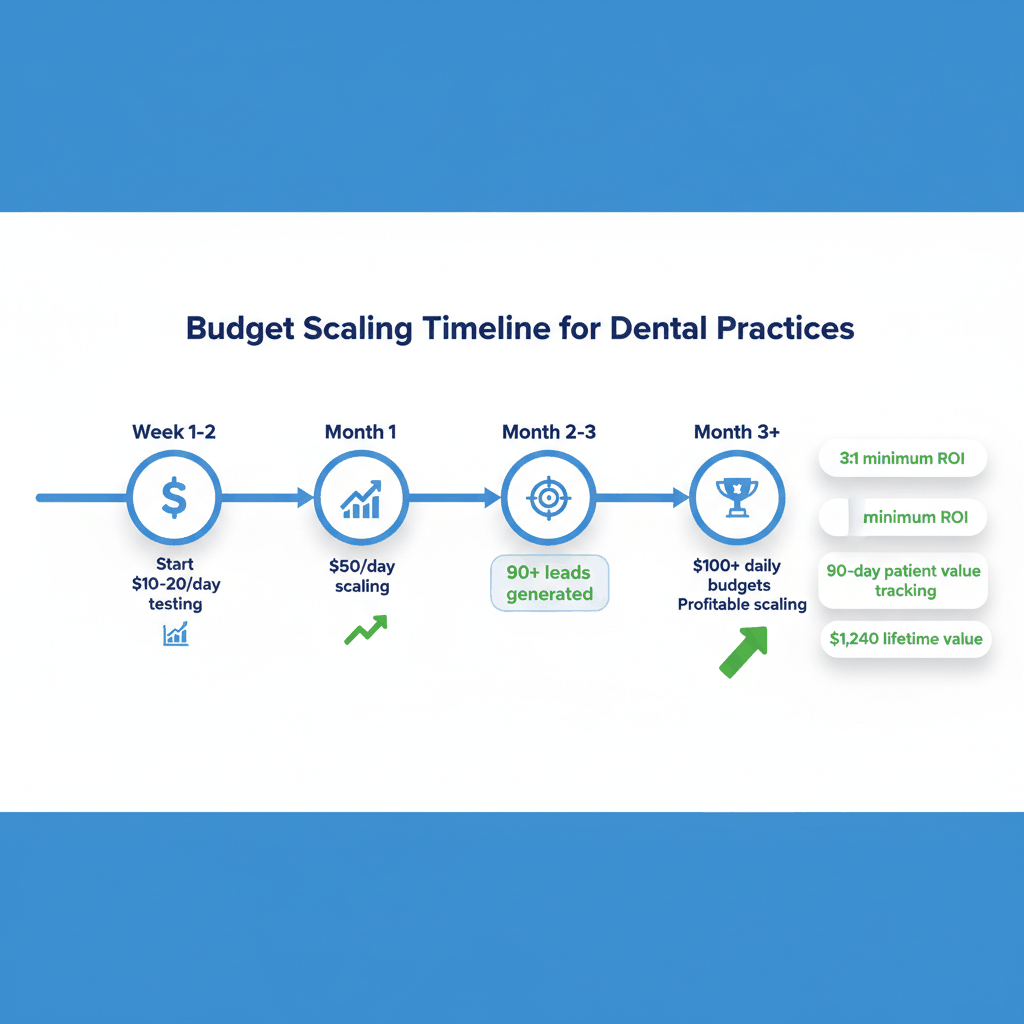
Smart budget allocation maximizes your return on ad spending. Start conservatively, scale successful campaigns, and maintain profitability throughout your growth phase.
Begin with $10-20 daily budgets for testing campaigns. This allows sufficient data collection without risking large losses during the learning phase.
New practices or first-time advertisers can start with $5 daily budgets for initial testing. Focus on one campaign until you achieve consistent results before expanding.
Established practices should allocate 3-5% of monthly revenue to social media advertising. A practice generating $50,000 monthly should budget $1,500-2,500 for social ads.
Increase budgets gradually on winning campaigns. Raise daily spending by 25-50% weekly while monitoring cost per lead stability.
Create additional ad sets with slight variations when scaling. Test different audiences, creative elements, or targeting parameters to maintain performance at higher spend levels.
Geographic expansion works for successful local campaigns. If your 10-mile campaigns perform well, test 15-mile radius with adjusted budgets.
Aim for 3:1 return on ad spend as a minimum. Every dollar spent should generate at least three dollars in revenue from new patient lifetime value.
Cost per new patient varies by market but typically ranges from $100-300 including show rates and conversion factors. High-value markets may see costs up to $500 per patient.
Track 90-day ROI rather than immediate returns. Dental patients often book cleanings first, then invest in higher-value treatments over time.
How much should I budget for Facebook ads for my dental practice?
Start with $10-20 daily for testing campaigns. Successful practices typically allocate 3-5% of monthly revenue to social media advertising. A $50,000 monthly practice should budget $1,500-2,500 for Facebook and Instagram ads.
What's the average conversion rate for dental social media advertising?
The industry benchmark is approximately 8.3% for dental practices from social media traffic. Healthcare Facebook Lead Ads can achieve up to 11% conversion rates with proper targeting and compelling offers.
How do I track phone calls from my Facebook ads?
Use call tracking platforms that assign unique phone numbers to different campaigns. When patients call after seeing your Facebook ad, the system records which campaign generated that lead, solving the attribution challenge.
Should I focus on Facebook or Instagram for dental marketing?
Use both platforms strategically. Facebook excels at reaching established adults needing family dental care, while Instagram dominates with younger demographics seeking cosmetic treatments. Video ads on both platforms achieve 43% higher engagement than static images.
What's the best offer for new patient Facebook ads?
The "$99 cleaning, exam, and X-rays" offer (typically 60% off regular price) consistently generates the most leads. This new patient special addresses cost concerns while providing clear value that motivates appointment booking.
Ready to get pay per call dental leads? Sign up for free with ResultCalls today!

Hello everyone! My name is Alex and I write these blogs to help educate small business owners on different ways to grow their business. My goal is to make lead generation as easy as possible for you. After reading these blogs, I hope you leave with some actionable steps that will get you closer to growing your business :)