Ever wonder why customers can't find your tree service when they ask Siri for help? You're missing a huge opportunity. 72% of voice-activated speaker owners use them to find local businesses.
Your potential customers are asking smart speakers questions right now. "Alexa, find tree removal near me." "Hey Google, what's the best arborist in my area?" When they don't find your business, they call your competitors instead.
Voice search optimization helps tree services capture high-intent customers at the exact moment of need. This guide shows you how to optimize your business for voice searches, improve local rankings, and turn smart speaker queries into paying customers.
You'll learn proven strategies to dominate voice search results and connect with customers who need emergency tree services, seasonal maintenance, and local tree care solutions.
Table of Contents
Most tree services make critical errors that kill their voice search performance. Here are the biggest mistakes to avoid.
The biggest error is cramming keywords into content to rank for voice queries. This outdated approach backfires because voice search users expect natural, conversational responses. Not robotic, keyword-heavy text.
When someone asks "What's the best tree service near me," they want a human-like answer. Not a paragraph stuffed with "tree service" fifteen times. Smart speakers pull answers that sound natural when read aloud.
Write like you're talking to a neighbor. Use "we provide emergency tree removal" instead of "emergency tree removal services tree removal emergency tree service emergency."
Most businesses focus solely on keyword rankings rather than understanding what users actually want to accomplish. This kills your voice search performance.
Voice searches happen on mobile devices. Voice searches on mobile are 3 times more likely to be local-based than text searches. Your desktop rankings don't matter if your mobile experience is broken.
Google uses mobile-first indexing. This means it primarily uses your mobile site for ranking. A slow, clunky mobile experience will hurt your voice SEO potential.
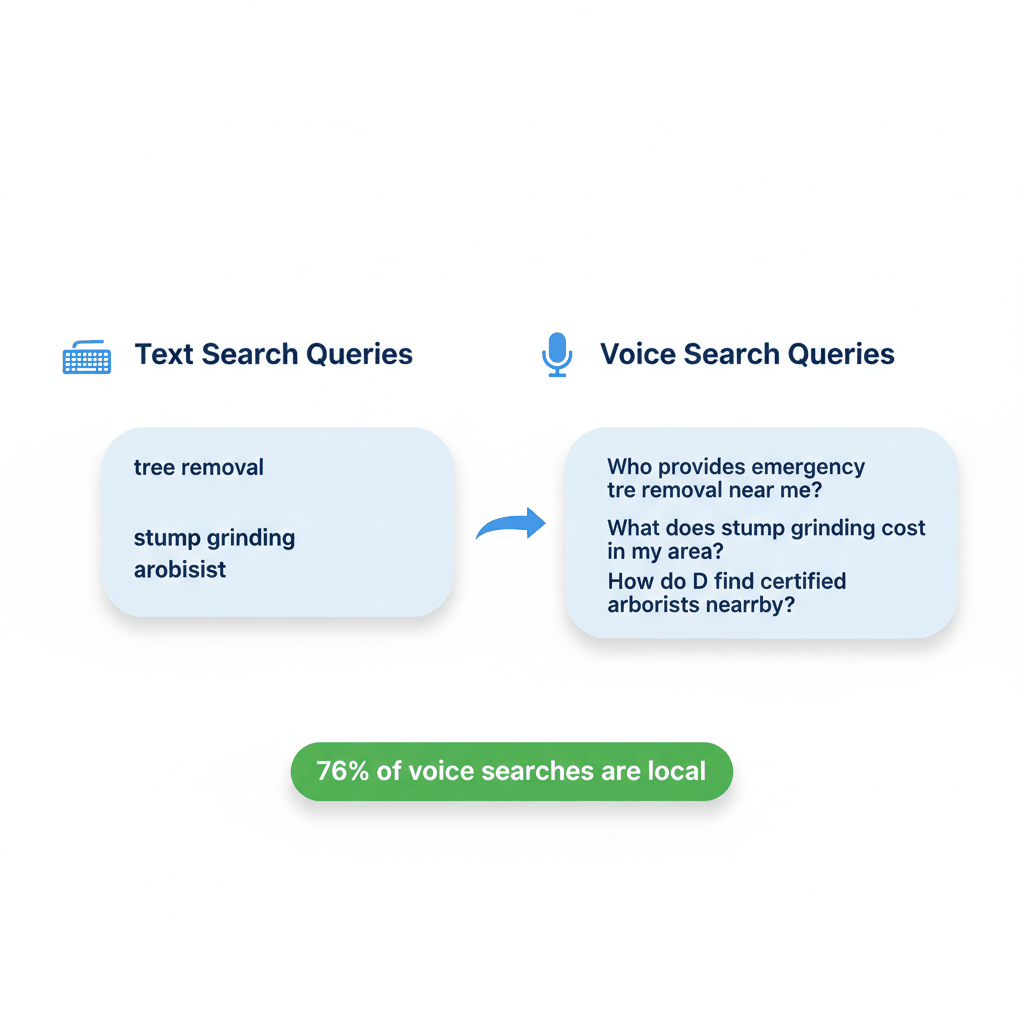
Another frequent mistake is only targeting short keywords. When people use voice search, they ask longer, more complex questions than when they type.
Someone might type "tree removal" into a search engine. But when using voice search, they ask "What are the best tree removal companies in my area?" or "Who can remove a dangerous tree today?"
Start targeting question-based keywords that begin with who, what, where, when, why, and how. These form the basis of most voice queries.
Voice search requires a completely different keyword approach. Focus on how people actually speak, not how they type.
Start with the 5 Ws and one H: Who, What, Where, When, Why, and How. These question words form the basis of most voice queries for tree services.
Brainstorm questions your customers might ask about tree care:
Who provides emergency tree removal service
What does tree trimming cost in my area
Where can I find certified arborists nearby
When should I trim my oak trees
Why are my trees dying
How much does stump grinding cost
These natural questions become your target keywords. They match how people actually ask questions to voice assistants.
Use tools like AnswerThePublic, Google's "People Also Ask" section, and Semrush to find question-based keywords. Look for long-tail keywords that start with who, what, where, when, why, and how.
AnswerThePublic visualizes questions people ask around a keyword. Type "tree removal" and see hundreds of real questions people search for. Google's "People Also Ask" boxes show related questions for any search term.
These tools reveal the actual language customers use when asking about tree services. Use their exact phrases in your content to match voice search queries perfectly.
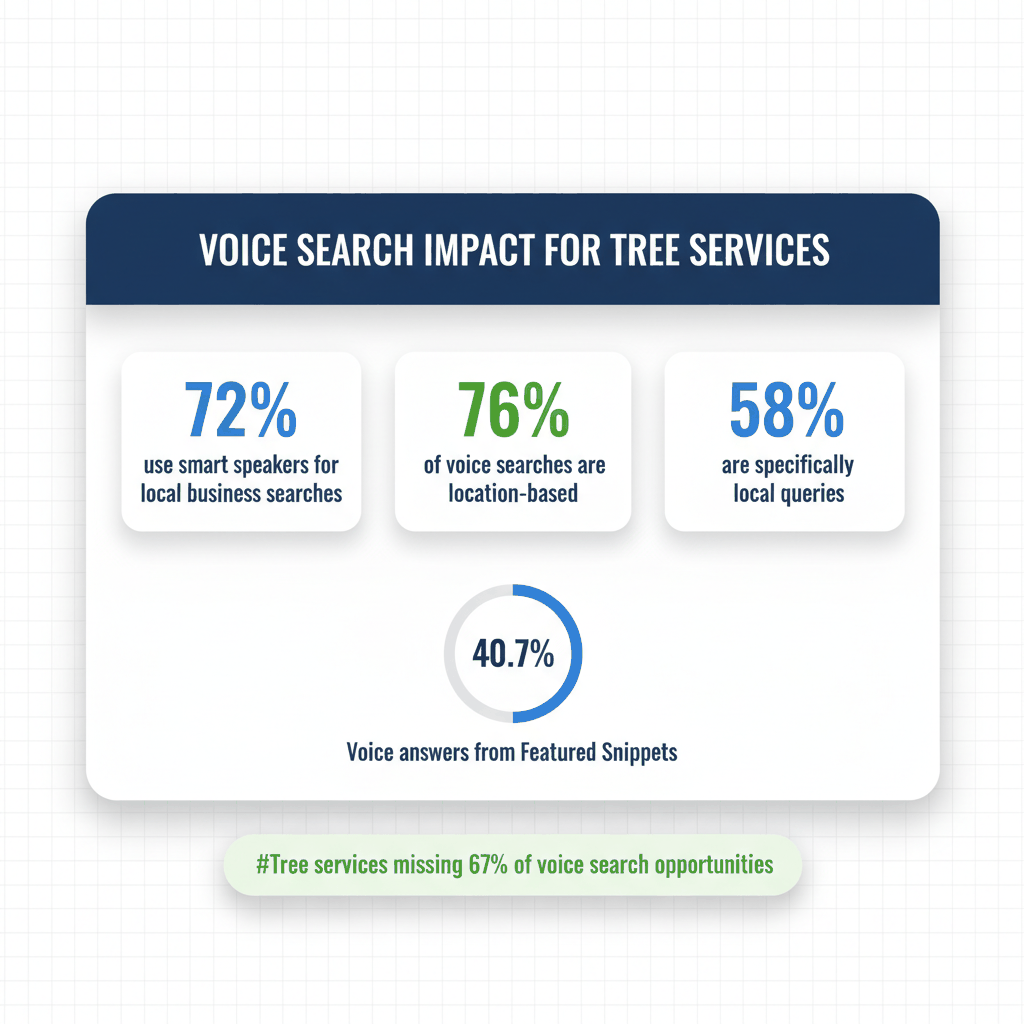
Focus heavily on local question patterns. 76% of voice searches are for things nearby or local, with 22% specifically for local information.
Target these local voice search patterns:
"Tree service near me"
"Emergency tree removal in [city name]"
"Best arborist in [area]"
"Tree trimming companies close to me"
"Who removes trees in [neighborhood]"
Featured snippets are critical for voice search success. 40.7% of all voice search answers come from Featured Snippets.
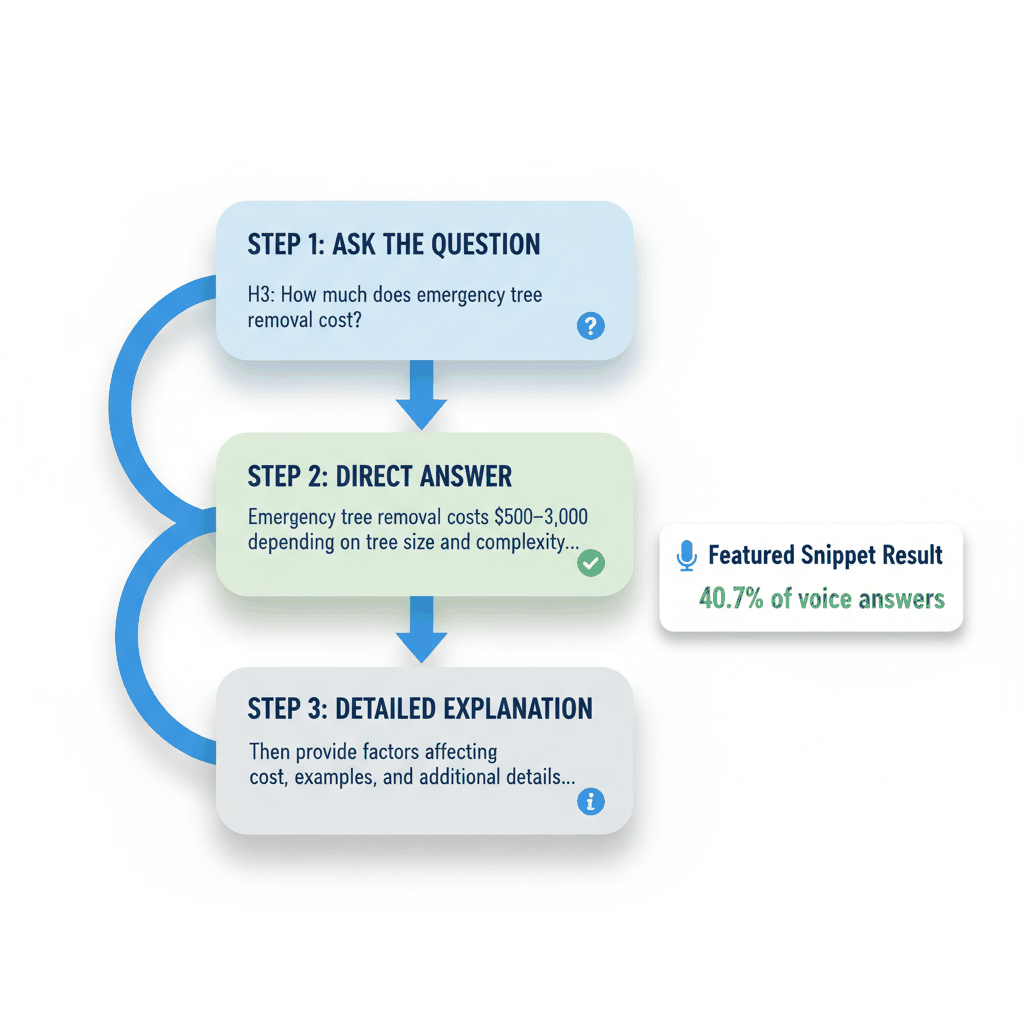
Structure your content to win featured snippets using this framework:
Ask the question: Start a section with the target question in an H2 or H3 tag. Provide a direct answer: Immediately follow with a concise, direct answer in a single paragraph (40-50 words). Elaborate further: After the direct answer, provide more detail and examples for users who want to learn more.
For example:
H3: How much does emergency tree removal cost?
Emergency tree removal costs $500-$3,000 depending on tree size, location, and complexity. Small trees cost $500-$1,000, medium trees $1,000-$2,000, and large or dangerous trees $2,000-$3,000 or more.
Then provide detailed explanations, factors that affect pricing, and examples.
Put answers first, explanations second. Voice assistants want immediate answers to questions, not long introductions.
Poor structure: "Tree trimming is important for many reasons. Property owners often wonder about costs. Various factors influence pricing. The average cost for tree trimming is $200-$800."
Good structure: "Tree trimming costs $200-$800 for most residential properties. Small trees cost $200-$400, medium trees cost $400-$600, and large trees cost $600-$800 or more."
The second version immediately answers the question, making it perfect for voice search results.
Voice search is heavily local. Almost 58% of voice searches are local, so your Google Business Profile becomes a dynamic data source for voice assistants.
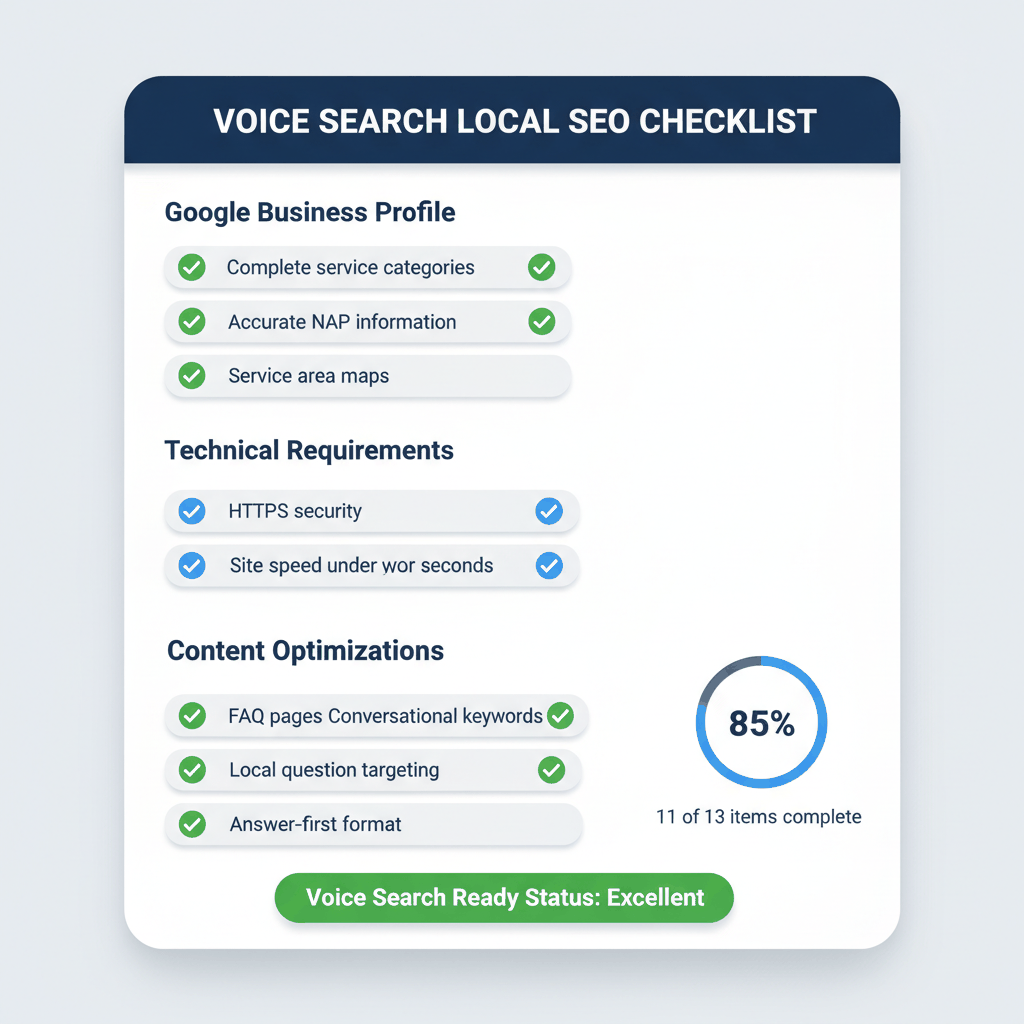
Claim and completely fill out your Google Business Profile. Include accurate categories, hours, holidays, services, photos, and short answers to frequently asked questions.
Add these essential elements:
Complete service categories (tree removal, trimming, stump grinding)
Service area coverage maps
Regular photos of work and equipment
Customer reviews and responses
Holiday and emergency hours
Direct phone number for calls
Google Business Profile data feeds directly into voice search results. When someone asks for "tree service near me," Google pulls information from complete, accurate business profiles.
Implement local business schema markup on your website. More than 34% of voice search answers come from websites using structured data markup.
Include these schema elements:
Business name, address, phone (NAP)
Service areas and locations
Business hours and availability
Services offered with descriptions
Customer review aggregations
Emergency contact information
Properly implemented schema can give a 30% bump in visibility for local searches. This directly impacts your voice search performance.
Ensure your Name, Address, and Phone number are identical across all online directories. Google, Yelp, and Bing comprise approximately 90% of voice search readiness scores.
Unfortunately, only 3.82% of business locations had correct information on these three major directories according to analysis of 73,000 business listings.
Check and update your information on these platforms:
Google Business Profile
Yelp Business
Bing Places for Business
Apple Maps Connect
Facebook Business Page
Industry-specific directories
FAQ content is believed to be the optimal format to match voice search results. Create comprehensive FAQ pages that directly answer common customer questions.
Form a list of the most relevant questions people ask about your tree services. Give clear and concise answers to each question. Write in 8th-9th grade level English and jump right to the point.
Target these common tree service questions:
How much does tree removal cost
When is the best time to trim trees
Do I need a permit for tree removal
How do I know if a tree is diseased
What's included in tree service
How quickly can you remove a dangerous tree
Write answers like you're speaking to a customer face-to-face. Use contractions, simple words, and natural phrasing that sounds good when read aloud by voice assistants.
Example FAQ answer:
Q: How much does emergency tree removal cost?
A: Emergency tree removal typically costs $800-$3,500, depending on the tree's size and how dangerous the situation is. We can remove small emergency trees for $800-$1,500. Large trees blocking roads or damaging homes cost $2,000-$3,500. We provide free emergency estimates and work with insurance companies to handle claims.
This answer uses natural language, provides specific information, and includes helpful details customers want to know.
Voice search has strict technical requirements. Your website must be fast, secure, and mobile-friendly to rank in voice search results.
Voice search answers appear 52% faster than regular search results on average. 70.4% of voice search result pages are HTTPS websites.
Speed up your site by:
Compressing images before uploading
Minifying CSS and JavaScript files
Using browser caching
Reducing redirects
Upgrading your hosting plan
Use tools like Google PageSpeed Insights or GTmetrix to check your load times and find specific improvements. Aim for load times under 3 seconds on mobile devices.
The vast majority of voice searches happen on mobile devices. Your mobile experience directly impacts voice search rankings.
Ensure your mobile site includes:
Responsive design that works on all screen sizes
Large, clickable phone numbers
Simple navigation and clear service pages
Fast-loading images and videos
Easy-to-use contact forms
Test your mobile experience regularly. A slow, difficult mobile site will hurt your voice search performance even if your content is perfect.
Secure your website with HTTPS encryption. Most voice search results come from secure websites, and Google prioritizes HTTPS sites in search results.
Contact your web hosting provider to enable SSL certificates. This protects customer data and improves your search rankings across all devices.
Use specialized tools to research, optimize, and track your voice search performance.
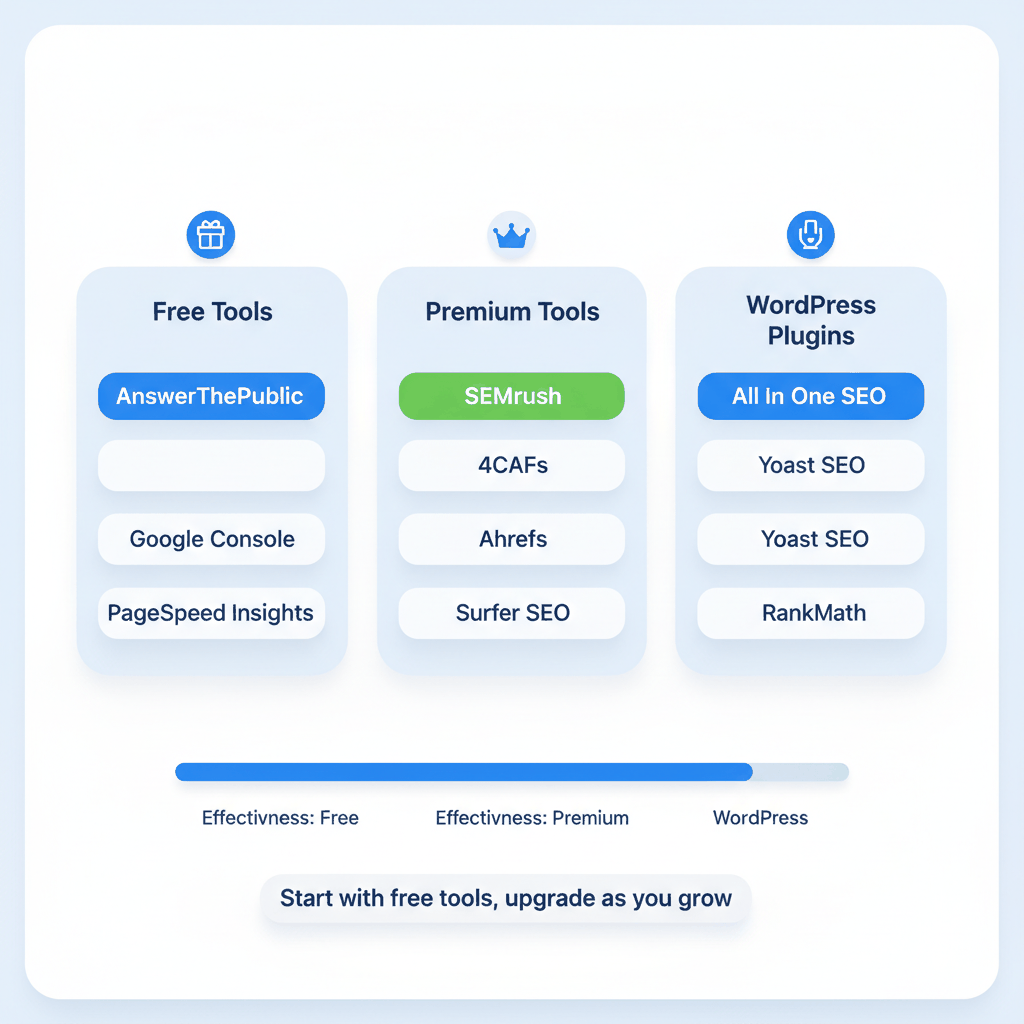
AnswerThePublic shows you questions people actually ask about tree services. Enter "tree removal" and see hundreds of real voice search queries.
Google's "People Also Ask" boxes appear for most search results. These show related questions people search for, giving you voice search keyword ideas.
SEMrush and Ahrefs help you track which featured snippets you currently own and find new question-based keywords to target.
For WordPress users, All In One SEO (AIOSEO) provides powerful voice search optimization tools. The plugin includes local SEO tools and LocalBusiness schema markup.
AIOSEO makes it easier for search engines to connect your site with specific areas, which is critical for "near me" visibility in voice search results.
Google Search Console helps you monitor voice search performance by tracking voice search queries, impressions, and mobile usability issues.
Your existing analytics tools can report on voice search metrics when configured correctly. Track rank positions, query-level data, local discovery metrics, and page engagement connected to conversions.
Over time, this data tells you which question clusters and answer blocks deserve deeper investment for voice search optimization.
How important is voice search optimization for tree services?
Voice search optimization is critical for tree services. 76% of voice searches are local, and customers often need emergency tree removal or seasonal maintenance. Optimizing for voice search helps you capture high-intent customers when they ask smart speakers for tree service recommendations.
What are the best voice search keywords for tree services?
Focus on conversational, question-based keywords like "tree removal near me," "emergency tree service in [city]," "how much does tree trimming cost," and "who removes dangerous trees." These match how people actually speak to voice assistants.
How do I optimize my Google Business Profile for voice search?
Complete every section of your Google Business Profile with accurate business information, service categories, hours, photos, and customer reviews. Add FAQ answers directly to your profile since Google pulls this information for voice search results.
Do I need special tools for voice search optimization?
You can start with free tools like AnswerThePublic, Google Search Console, and Google PageSpeed Insights. These help you research conversational keywords, monitor performance, and improve site speed for voice search success.
How long does it take to see voice search results?
Voice search optimization typically shows results within 3-6 months with consistent effort. Start by optimizing your Google Business Profile and creating FAQ content, then focus on technical improvements and ongoing content optimization.
Ready to buy tree service leads and only pay per call? Sign up for free with ResultCalls today!

Hello everyone! My name is Alex and I write these blogs to help educate small business owners on different ways to grow their business. My goal is to make lead generation as easy as possible for you. After reading these blogs, I hope you leave with some actionable steps that will get you closer to growing your business :)