Choosing the right advertising platform can make or break your solar company's growth. Many solar business owners struggle with this exact question: Should I invest in Google Ads or Local Service Ads?
The wrong choice wastes thousands in marketing budget. You get poor lead quality, high costs, and frustrated sales teams. The result is stagnant growth and missed opportunities in a rapidly expanding market.
This guide breaks down the real performance data between solar Google Ads vs Local Service Ads. You'll discover cost differences, lead quality insights, and platform selection strategies. Plus, you'll learn how to combine both platforms for maximum ROI.
Here's what you'll learn to transform your solar marketing results and drive consistent lead generation.
Table of Contents
The cost difference between these platforms is significant. LSA generates leads at roughly half the cost of Google Ads campaigns.
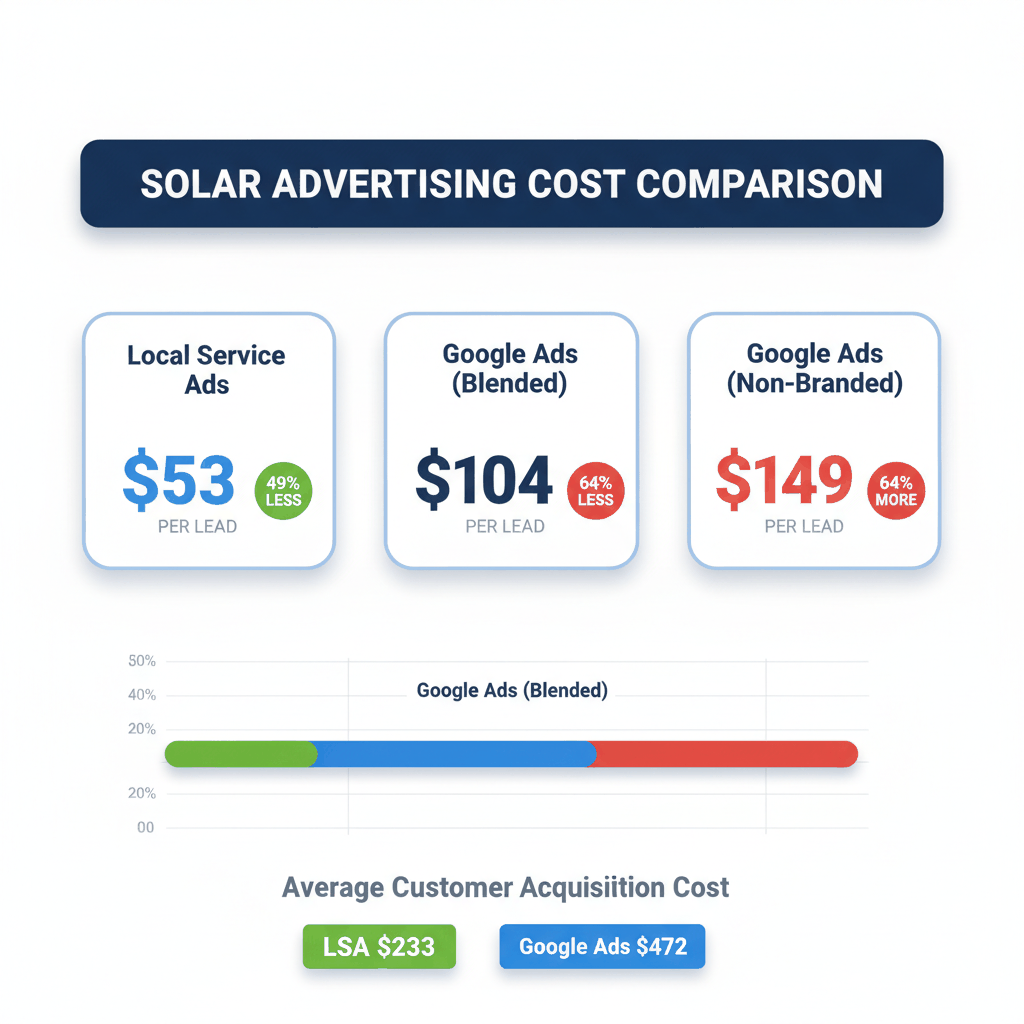
Local Service Ads average $53 per lead for solar companies. This is 49% less expensive than blended Google Ads at $104 per lead. Compared to non-branded Google Ads specifically, LSA is 64% cheaper at $149 per lead.
Here's the reality of Google Ads costs for solar companies:
"Solar installation near me" costs $10-30 per click
"Solar panel cost" runs $8-25 per click
High-competition states see $50-100 per click
Average of 30 clicks needed per qualified lead
Local Service Ads operate on a pay-per-lead model. You only pay when someone contacts you directly. Google Ads use pay-per-click pricing. You pay for traffic regardless of whether visitors convert.
For example: Getting 100 clicks at $20 each costs $2,000 in Google Ads. If only 5 people contact you, that's $400 per lead. With LSA, those same 5 leads would cost about $265 total.
The cost per paying customer tells the real story. LSA averages $233 per closed customer. Blended Google Ads cost $472 per closed customer.
However, there's a trade-off in project value. LSA leads average $1,826 per sale. Google Ads leads close at $2,465 per sale. This reflects LSA's heavier weighting toward service and repair calls versus full installations.
Lead quality varies significantly between these solar advertising platforms. Understanding these differences helps set proper expectations and sales processes.
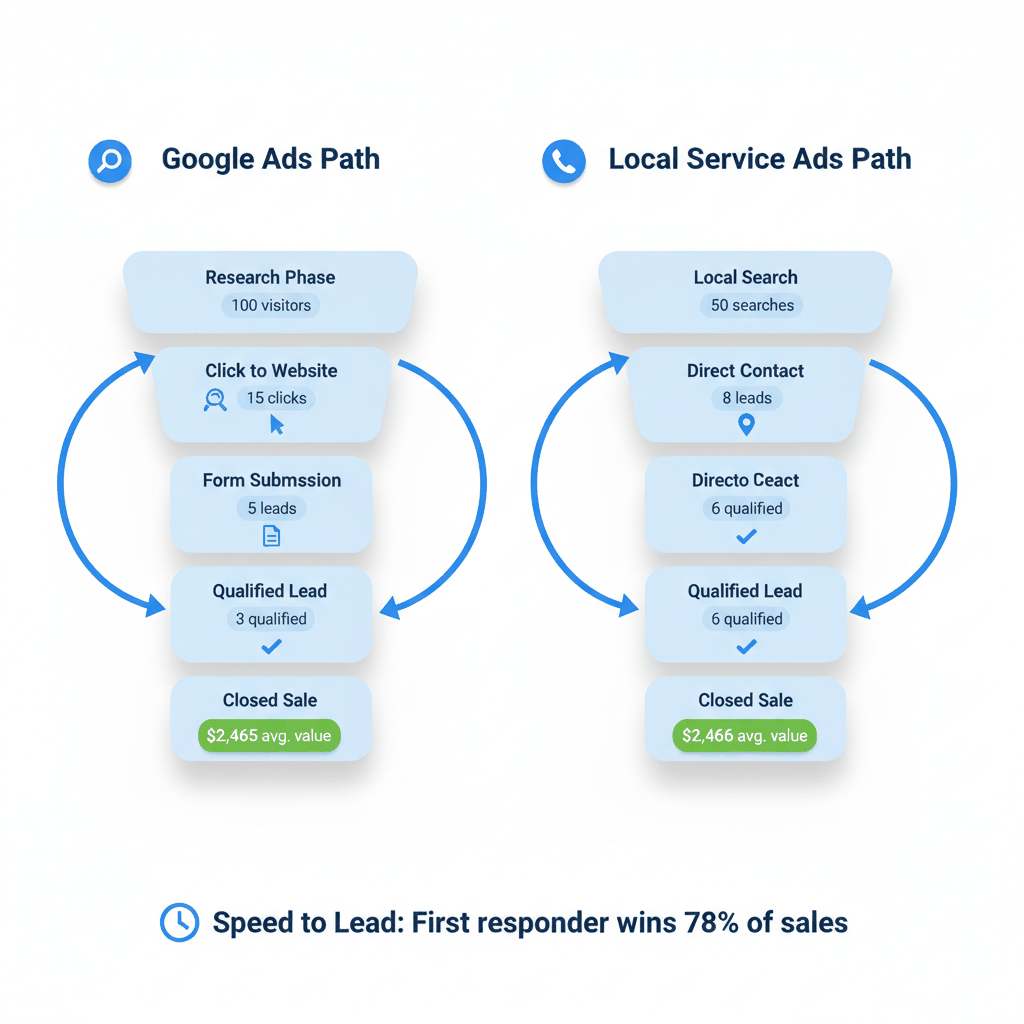
Google Ads attract prospects at different research stages. Early-stage searchers look up "how much do solar panels cost" or "solar panel benefits." These leads need more education but often become higher-value customers.
Ready-to-buy prospects search for "solar installers near me" or "get solar quote." These convert faster but face more competition. Industry research shows the first solar company to respond wins the sale 78% of the time.
Google Ads also let you target specific income levels, home values, and demographics. This creates more qualified leads but at higher costs.
LSA leads come from local searches with immediate intent. People use LSA when they want fast solutions to current problems. This includes solar maintenance, system repairs, and consultation requests.
The leads respond well to phone calls and text messages. They expect quick responses and local service. However, they may not be prepared for large solar installations immediately.
Consumer preference data shows interesting patterns. When people see search results, 27.78% prefer clicking Local Service Ads. This makes LSA the second most popular option after Google Maps at 41.27%.
More importantly, 29% prefer clicking LSAs while only 11% prefer Google Ads. This makes LSA the preferred paid option over traditional ads.
Each platform offers different tools for reaching your ideal solar customers. Understanding these features helps maximize your marketing investment.
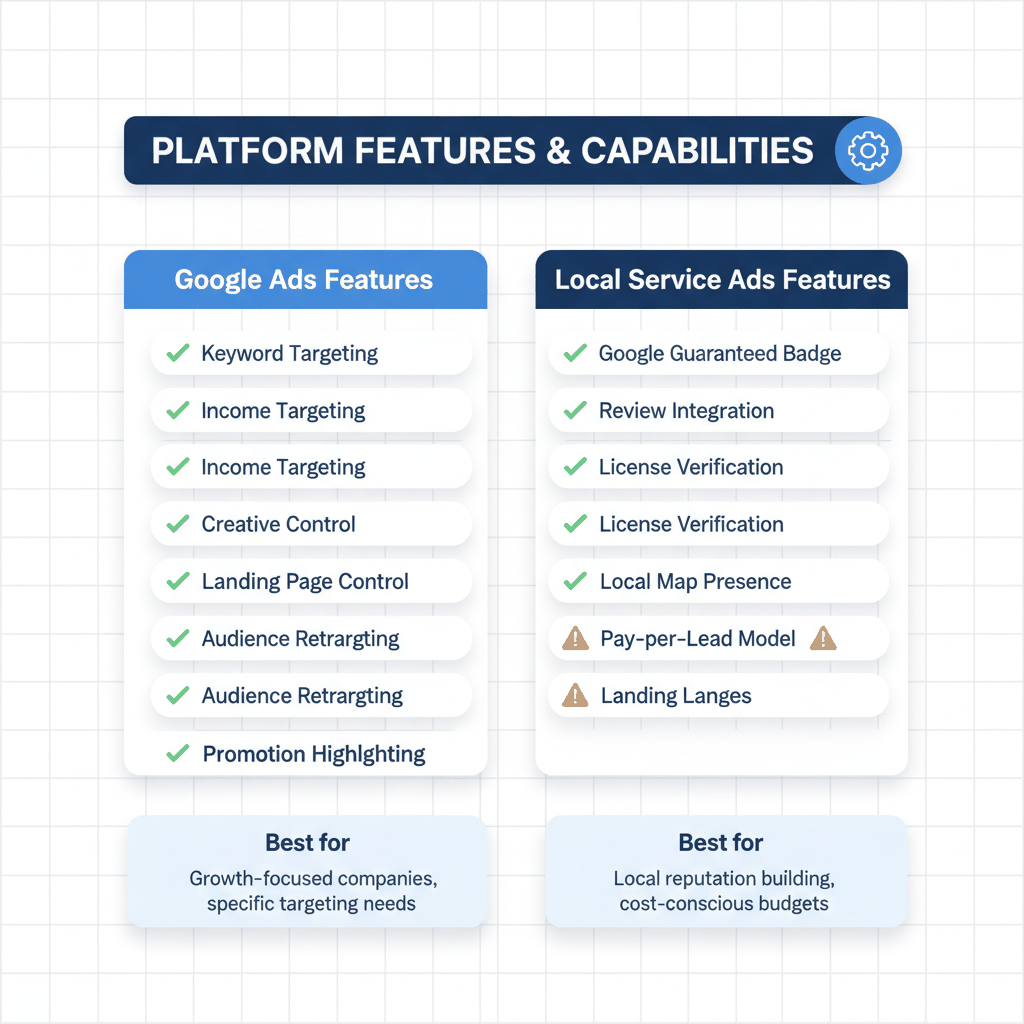
Google Ads provide extensive targeting options. You can reach prospects based on:
Specific keywords and search terms
Geographic locations and radius targeting
Device types and operating systems
Time of day and day of week
Household income and home ownership status
Previous website visitors and similar audiences
You also get complete creative control. Create compelling headlines, descriptions, and ad extensions. Drive traffic to specific landing pages with calculators, incentive information, and lead capture forms.
LSA focuses on local credibility and trust signals. Your ads display:
Google Guaranteed badge for verified businesses
Customer reviews and star ratings
Business location and service areas
License verification and background checks
However, creative control is limited. LSAs show similar information like local map pack listings. You cannot highlight special promotions or unique selling propositions easily.
To participate in Local Service Ads, solar companies must meet specific requirements. You need proper licensing documentation for all service areas. All business owners and employees must pass background checks during the application process.
Google verifies your credentials and maintains ongoing monitoring. This creates higher trust with prospects but requires more administrative work.
The best choice depends on your business goals, market conditions, and growth stage. Many successful solar companies use both platforms strategically rather than choosing one exclusively.
LSA works well for established solar companies with strong local reputations. Choose LSA if you:
Have excellent reviews and high star ratings
Offer maintenance and repair services
Want predictable cost-per-lead pricing
Focus on local market domination
Need immediate lead generation results
LSA also suits companies with limited marketing budgets. The lower cost per lead allows more volume with smaller investments.
Choose Google Ads when you need more control and targeting precision. Google Ads work better if you:
Target specific customer demographics
Have strong landing pages and sales funnels
Want to capture early-stage prospects
Offer specialized solar solutions
Can invest in higher-cost, higher-value leads
Google Ads also provide better scalability for rapid growth companies. You can increase budgets and expand targeting more easily.
Most successful solar companies use both platforms strategically. Industry data shows a 60/40 budget allocation between LSA and Google Ads works well.
Use LSA for immediate local leads and brand visibility. Use Google Ads for targeted campaigns, seasonal promotions, and long-term customer acquisition. This approach maximizes lead volume while maintaining lead quality.
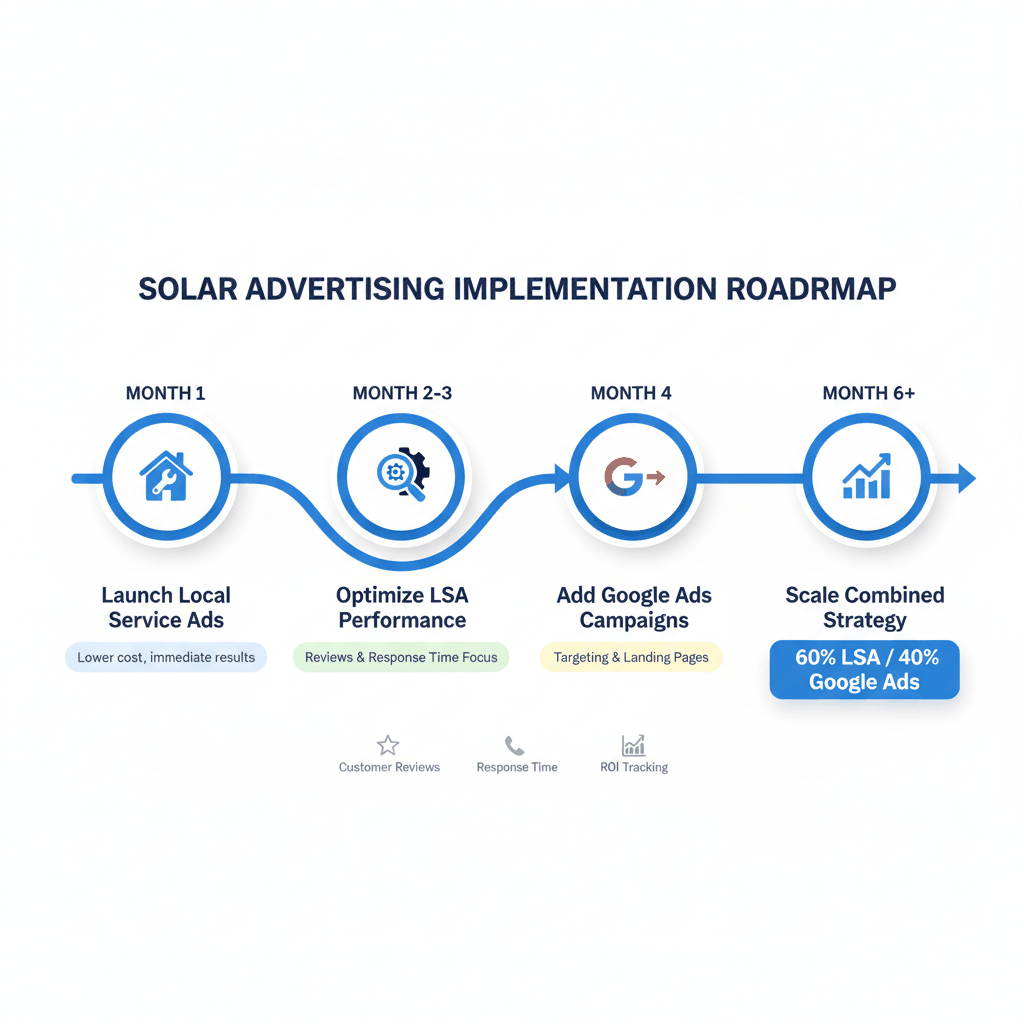
Success with either platform requires ongoing optimization. These proven strategies improve performance and reduce costs over time.
LSA optimization focuses on local operations and customer satisfaction. Google's guidance indicates star ratings and review volume affect ranking within Local Service Ads.
Optimize your LSA performance by:
Maintaining excellent customer service standards
Following up with every customer for reviews
Responding quickly to all lead inquiries
Keeping your business information updated
Managing your service area boundaries effectively
Think less like a media buyer and more like an operator. You're not only optimizing spend. You're optimizing your entire local business operations.
Google Ads optimization requires technical marketing skills and ongoing testing. Focus on these key areas:
Build campaigns around high-intent keywords
Add negative keywords to reduce wasted spend
Create landing pages with instant quote tools
Include savings calculators and incentive information
Test different ad copy and call-to-action buttons
Better filtering reduces wasted spend significantly. Use lead forms that qualify roof type, utility company, and bill size before generating leads.
Response time critically impacts success with both platforms. Implement systems to contact every lead within 15 minutes for phone and live chat inquiries. Respond to online forms within 2 hours.
Consider AI-powered answering services for immediate engagement. Studies show lead value decreases by 80% if not contacted within the first five minutes.
Measuring success requires tracking the right metrics beyond initial cost per lead. Focus on metrics that directly impact your bottom line.
Track these key performance indicators for both platforms:
Cost per qualified lead (not just total leads)
Lead-to-appointment conversion rate
Appointment-to-sale conversion rate
Average project value by lead source
Customer lifetime value including referrals
Time from lead to closed sale
These metrics reveal the true ROI of each platform beyond surface-level costs.
One solar company generated 72 leads through Google Ads and closed 19 installations. The average project value was $20,095. Their cost per closed installation was only $255.78.
From a $4,860 advertising investment, they generated $381,805 in revenue. This represents a 78.5x return on ad spend.
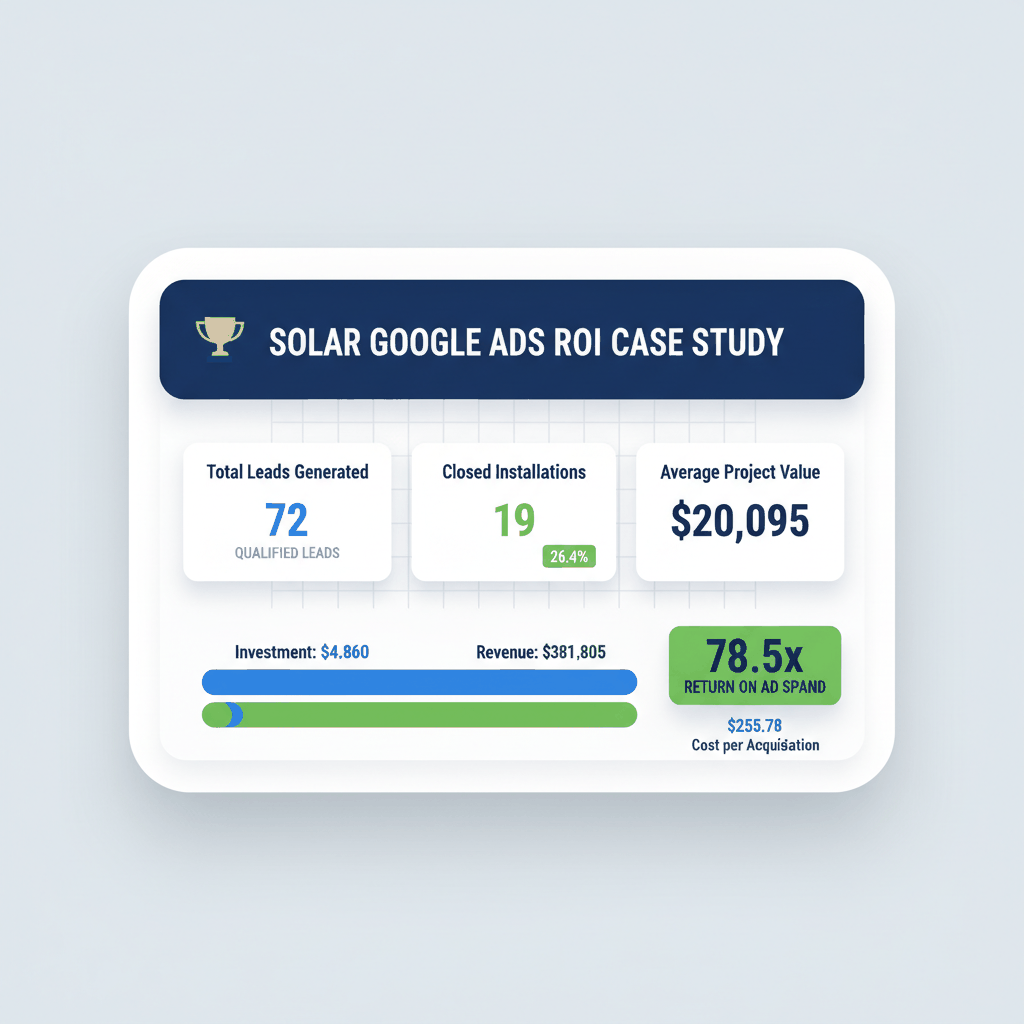
Use this framework to compare platform performance over time:
Calculate true cost per acquisition (not just leads)
Measure revenue per lead source
Track customer quality and satisfaction scores
Monitor long-term customer value
Assess scalability and growth potential
The platform with the highest long-term customer value often proves most profitable.
Which is better for new solar companies: Google Ads or Local Service Ads?
New solar companies should start with Local Service Ads if they meet Google's requirements. LSA provides faster results, lower costs, and builds local credibility. Once established with good reviews, add Google Ads for growth.
How much should solar companies budget for Google Ads vs LSA?
Successful solar companies typically allocate 60% of their paid advertising budget to LSA and 40% to Google Ads. Start with at least $2,000 monthly for LSA and $3,000 for Google Ads to see meaningful results.
Can solar companies use both Google Ads and Local Service Ads together?
Yes, using both platforms together often produces the best results. LSA captures immediate local demand while Google Ads target specific customer segments and growth opportunities. Many successful solar companies use this combination strategy.
What's the average cost per lead for solar Local Service Ads?
Solar Local Service Ads average $53 per lead, which is significantly lower than Google Ads at $104 per lead. However, LSA leads tend to have lower average project values at $1,826 compared to Google Ads at $2,465.
How quickly should solar companies respond to leads from these platforms?
Respond to all leads within 15 minutes for phone and live chat inquiries. Online forms require responses within 2 hours. The first solar company to respond wins the sale 78% of the time, making speed crucial for success.
Ready to buy solar leads? Sign up for free with ResultCalls today!

Hello everyone! My name is Alex and I write these blogs to help educate small business owners on different ways to grow their business. My goal is to make lead generation as easy as possible for you. After reading these blogs, I hope you leave with some actionable steps that will get you closer to growing your business :)