
Does your company struggle to find solar marketing leads without breaking the budget? You're not alone. Customer acquisition costs in solar marketing now average $10,000 per sale. That's 25% of total installation expenses.
Many solar companies face the same problem. Rising competition and expensive lead costs make growth challenging. Traditional marketing methods no longer work effectively in today's market.
This guide shows you proven solar marketing strategies that work. You'll learn how one company reduced lead costs from $127 to $7 per lead. Plus discover digital tactics that generate qualified prospects at lower costs.
By the end, you'll understand exactly how to implement cost-effective solar marketing campaigns. These strategies help you compete against bigger companies while maintaining profitable growth.
Table of Contents
Solar marketing faces unique obstacles that don't exist in other industries. Understanding these challenges helps you develop better strategies.
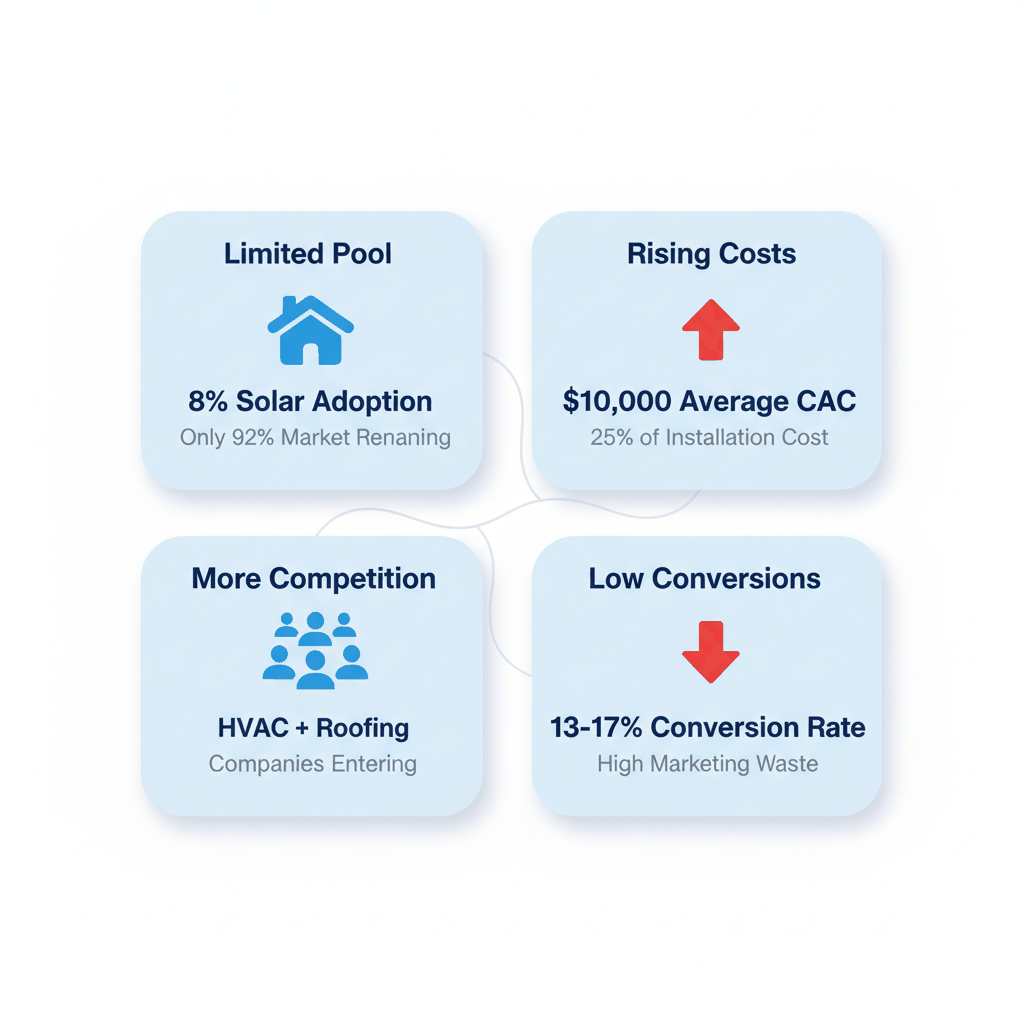
Only 8% of US homes had solar panels in January 2022. While this number will climb to 15% by 2030, you compete for the remaining 92%. To qualify for solar, prospects must be homeowners with good credit and minimal roof shading.
This creates a fixed customer pool. Unlike other industries where you can expand your market, solar companies fight over the same qualified leads.
Solar lead costs vary dramatically by location. They range from $225 per sale in North Dakota to $1,929 in California. These costs continue climbing as more companies enter the market.
Customer acquisition costs averaging $10,000 per sale represent a major challenge. This expense consumes 25% of total installation costs, cutting into profit margins significantly.
The solar industry sees increased consolidation among contractors and manufacturers. Mergers and acquisitions rise while private equity firms take bigger roles.
Established HVAC and roofing companies now enter solar markets. This creates more competition for existing solar businesses trying to maintain market share.
Solar conversion rates hover between 13% and 17%. Many qualified prospects experience burnout from excessive cold calls and high-volume marketing tactics.
Companies spend more than ever to maintain sales pipelines. Yet conversion rates remain stubbornly low, making customer acquisition even more expensive.
Smart solar companies embrace digital-first approaches with local focus. These strategies reduce costs while improving lead quality.
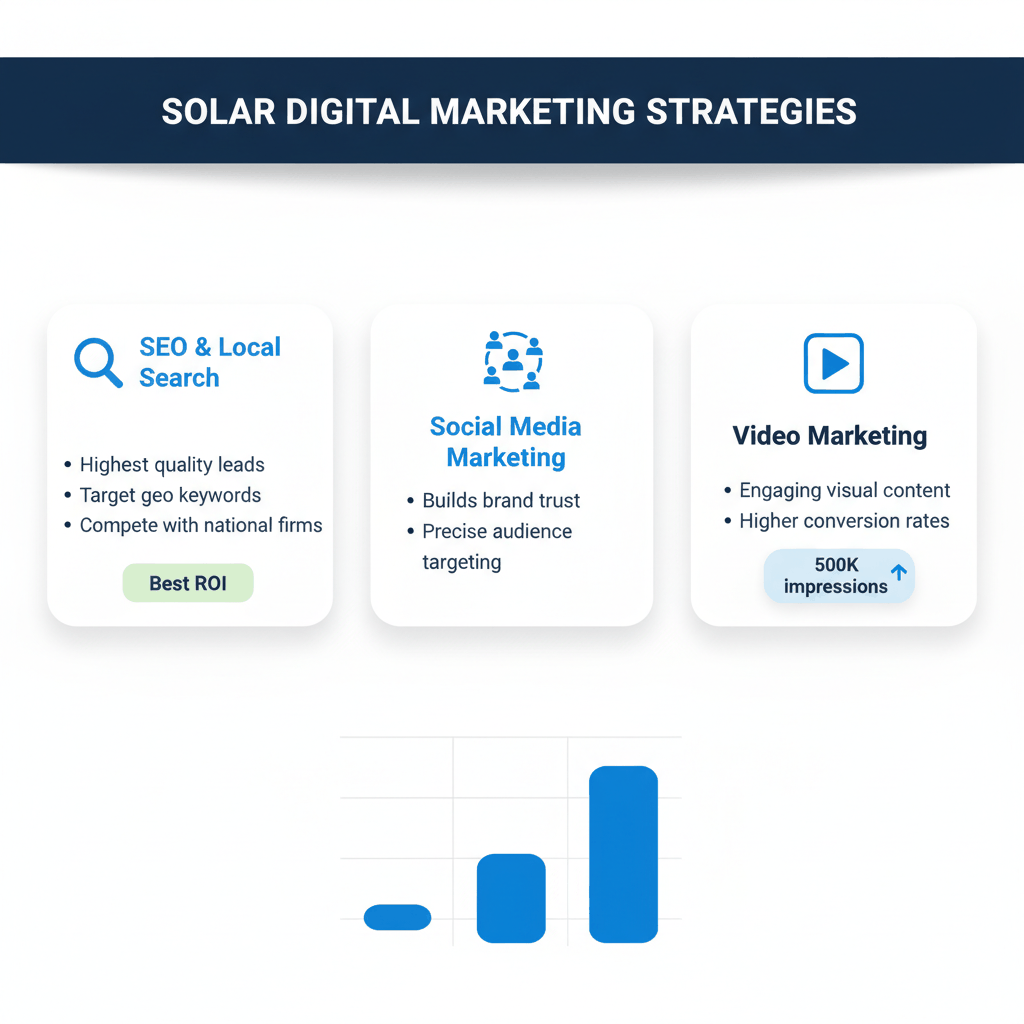
Search engine optimization drives the highest quality leads. Prospects actively searching for solar solutions show genuine purchase intent. This eliminates much of the education required with cold outreach.
Focus on geographical keywords in your area. Target phrases like "solar installation Denver" or "solar panels Austin Texas". Local SEO helps you compete against national companies by dominating your service area.
Create location-specific landing pages for each city you serve. Include local landmarks, weather data, and utility company information. This approach helps search engines understand your service areas.
Social media influences nearly 75% of purchasing decisions. Platforms like Facebook, Instagram, and LinkedIn offer precise targeting for solar prospects.
Share customer installation videos and before/after photos. Real installations build trust better than stock photography. Include customer testimonials about savings and installation experience.
Use Facebook's homeowner targeting options. You can target people by home ownership status, household income, and property value. These filters help you reach qualified prospects more efficiently.
Video content performs exceptionally well in solar marketing. Visual demonstrations help prospects understand complex solar concepts more easily.
Create installation time-lapse videos showing your work process. Include customer interviews discussing their decision-making process and results. Show actual savings data from real customers.
Boston Solar's video campaigns generated nearly 500,000 impressions. They reached over 200,000 people with a 44% view rate. This success started with a single 90-second video.
Content marketing works exceptionally well for solar companies. It addresses the biggest barrier to adoption: lack of understanding about solar energy.
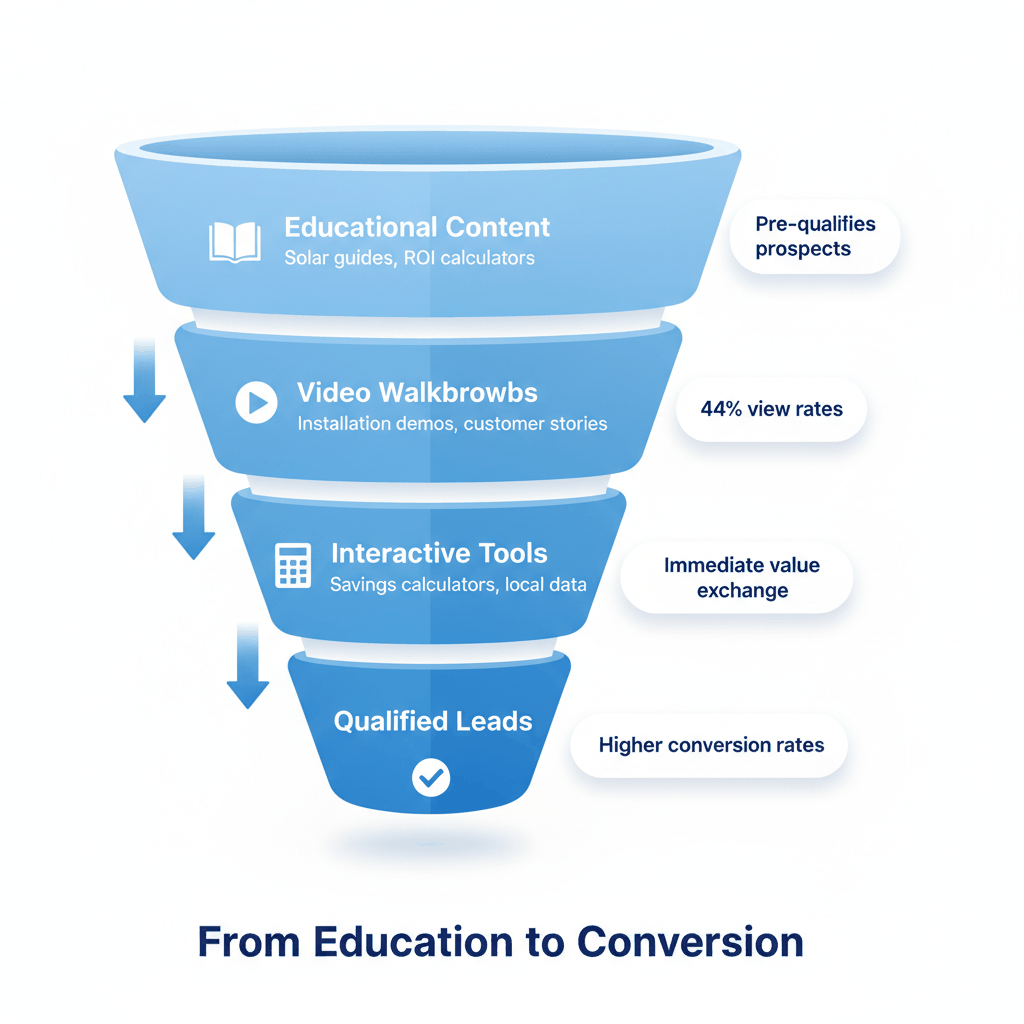
Create content that helps prospects make informed decisions. This approach attracts people actively researching solar options rather than those casually browsing.
Develop step-by-step installation guides explaining the entire process. Include timeline expectations, permit requirements, and utility interconnection steps. This transparency builds trust while setting proper expectations.
Build detailed ROI calculators with real examples from previous installations. Show actual customer bills before and after solar installation. Include seasonal variations and net metering details specific to your area.
Create comprehensive video content showing actual installations. Include time-lapse footage of complete installations from start to finish.
Interview customers about their experience and results. Ask about their decision-making process, concerns they had, and actual savings achieved. Real customer stories prove your claims better than any marketing copy.
Show your installation team's expertise and professionalism. Prospects want confidence that installers will treat their property with respect and deliver quality work.
Solar savings calculators significantly enhance customer engagement. They provide immediate value while collecting prospect information for follow-up.
Include local utility rates and net metering policies in your calculators. Use actual weather data for your service area to provide accurate production estimates.
Offer financing comparisons showing different payment options. Many prospects don't realize they can reduce monthly expenses immediately with solar financing.
The right tools streamline your solar marketing while improving results. Focus on platforms designed specifically for solar companies.
Generic CRMs don't handle solar sales cycles effectively. Solar-specific platforms understand the unique workflow from lead to installation.
Shape CRM offers over 500 features including built-in dialer, email automation, and text messaging. It handles everything from initial lead contact through project completion.
Leap CRM provides end-to-end management from lead generation to installation. It includes proposal generation, contract management, and permit tracking. This eliminates the gaps between sales and installation teams.
Sunbase Solar CRM connects sales and installation processes instead of only tracking contacts. This visibility helps prevent handoff problems that lose customers during the process.
Text messages reach 60% more solar leads than email. SMS open rates often exceed 90%, making text communication extremely effective for follow-up.
Create text templates for your sales team with built-in compliance features. Solar marketing requires careful adherence to telemarketing regulations and opt-in requirements.
SMS marketing campaigns naturally evolve into sales conversations. Unlike email marketing, text messages feel more personal and generate higher response rates.
Use Google Analytics to track your website performance and lead sources. Set up conversion tracking to understand which marketing channels generate the highest quality leads.
Implement solar-specific tracking for proposal views, calculator usage, and content downloads. This data reveals which prospects show genuine interest versus casual browsing.
HubSpot consolidates customer data, lead details, and sales information in one platform. This makes it easier to track performance across your sales and marketing efforts while identifying improvement opportunities.
These case studies show how real solar companies achieved dramatic improvements using proven marketing strategies.
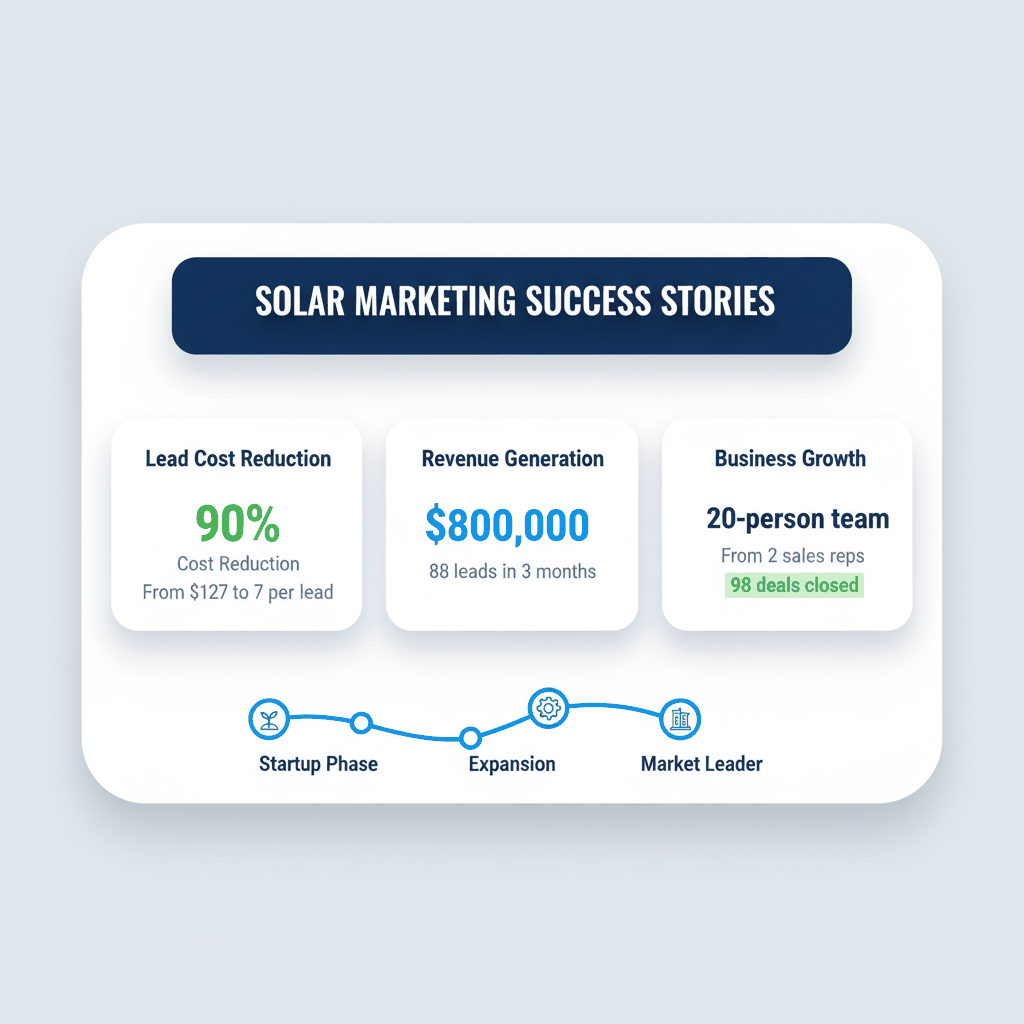
One solar company reduced their cost per lead from $127 to $7 through improved campaign structure. This represents a more than 90% reduction in lead acquisition costs.
The improved campaigns generated more qualified leads while lowering costs. This led to higher conversion rates and increased overall sales volume.
The company achieved these results by focusing on targeted digital marketing instead of broad advertising. They eliminated wasteful spending on unqualified traffic.
Simple Tree Digital generated 88 commercial solar leads in three months for one client. This resulted in 341 closed kilowatts and $800,000 in revenue.
The campaign worked so well that the client added a new salesperson to handle the increased lead volume. They also implemented a CRM system to manage their expanded pipeline.
In the client's own words, "the campaign has worked too well!" This demonstrates how effective digital marketing can quickly scale solar businesses.
Nationwide Solar expanded from 2 sales reps to a 20-person team with their own installation crew in just one year. A single marketing campaign closed 98 deals generating $470,000 in profit.
This growth came from focusing on qualified lead generation rather than volume-based approaches. Quality prospects convert at much higher rates than cold leads.
The company reinvested marketing profits into expanding their team and capabilities. This created a sustainable growth cycle powered by effective marketing.
Prism Global Marketing helped a solar client reengage 301 previous contacts who requested quotes. These were contacts already in the database who became active opportunities through improved nurturing.
The same client achieved a 190% increase in landing page views through search engine optimization. Better content and link placement throughout their website drove this improvement.
This shows how content marketing works for both new lead generation and reactivating existing prospects who weren't ready to buy initially.
Tracking the right metrics helps you optimize solar marketing campaigns for better results. Focus on metrics that directly impact revenue growth.
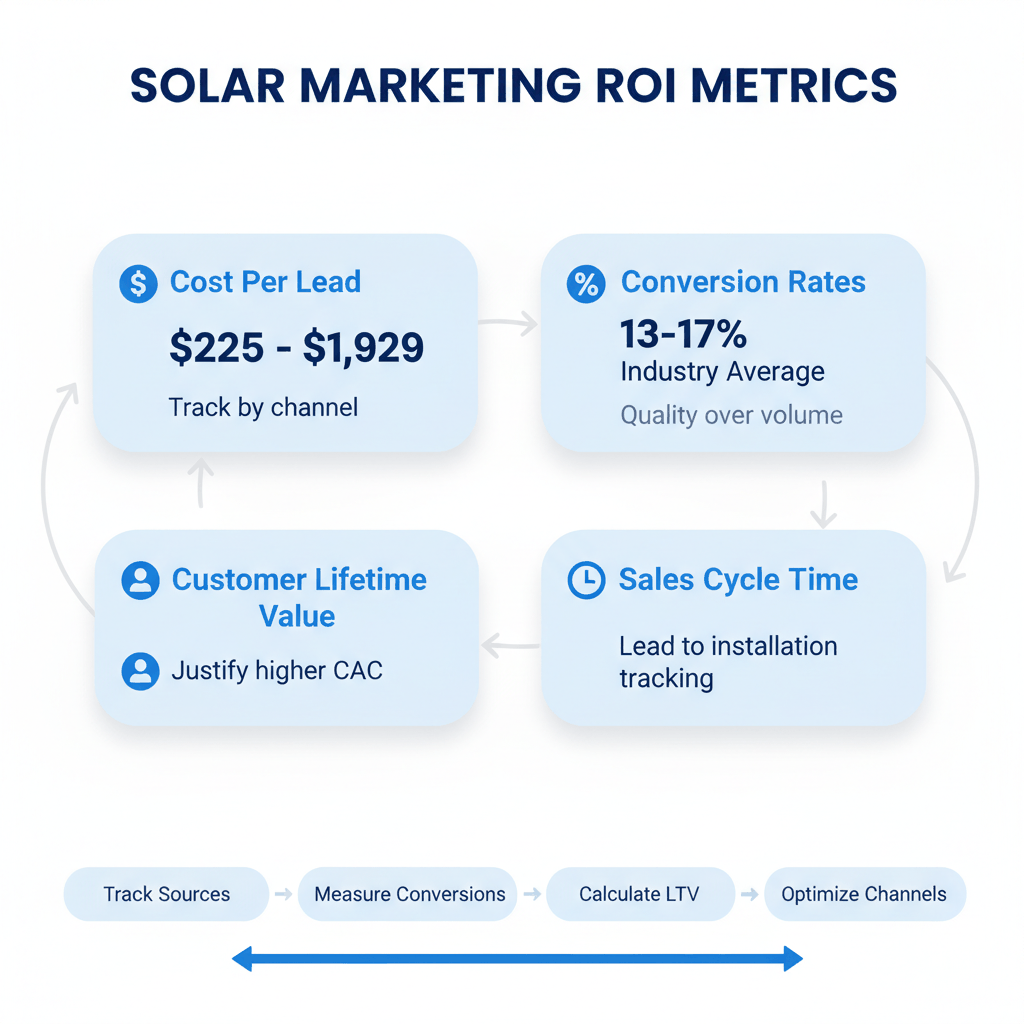
Cost per lead tells you how efficiently your marketing generates prospects. Track this metric by channel to identify your most cost-effective lead sources.
Lead-to-sale conversion rates reveal campaign quality beyond just volume. A campaign generating 100 leads with 5% conversion performs worse than one generating 50 leads with 15% conversion.
Customer lifetime value helps justify higher acquisition costs for better customers. Premium customers often provide referrals and testimonials that generate additional business.
Track time from lead to installation. Shorter sales cycles indicate better lead quality and more effective sales processes.
Use Google Analytics to understand which marketing channels drive the highest value customers. Set up goal tracking for key actions like calculator usage, proposal requests, and consultation bookings.
Implement phone call tracking to measure offline conversions from online marketing. Many solar prospects prefer calling rather than filling out forms.
Track assisted conversions to understand how different channels work together. A prospect might discover you through social media but convert through email marketing.
Monitor organic search rankings for your target keywords. Improved rankings reduce your dependence on paid advertising over time.
Track referral rates from existing customers. Satisfied customers provide the highest quality leads at zero acquisition cost.
Measure brand recognition in your service area through surveys or brand mention tracking. Strong local brand recognition drives inbound leads naturally.
Frequently Asked Questions
What's the average cost per lead for solar marketing?
Solar lead costs range from $225 per sale in North Dakota to $1,929 in California. However, one company reduced their costs from $127 to $7 per lead through improved digital marketing strategies. Focus on qualified lead generation rather than volume to achieve better results.
Which digital marketing strategies work best for solar companies?
SEO and content marketing generate the highest quality leads because prospects actively search for solar information. Video marketing also performs exceptionally well, with some companies achieving 44% view rates. Local SEO targeting geographical keywords helps smaller companies compete effectively.
How can solar companies improve their conversion rates?
Focus on education-based content marketing to pre-qualify prospects before sales contact. Use interactive tools like ROI calculators to engage prospects and collect information. SMS follow-up reaches 60% more prospects than email and generates higher response rates.
What CRM system works best for solar marketing?
Solar-specific CRM systems like Shape CRM, Leap CRM, or Sunbase handle the unique workflow from lead to installation better than generic platforms. These systems include features like proposal generation, permit tracking, and installation scheduling that generic CRMs lack.
How do I measure solar marketing ROI effectively?
Track cost per lead by marketing channel, lead-to-sale conversion rates, and customer lifetime value. Use Google Analytics with conversion tracking to understand which channels generate the highest value customers. Monitor time from lead to installation as an indicator of lead quality.
Ready to get solar marketing leads? Sign up for free with ResultCalls today!

Hello everyone! My name is Alex and I write these blogs to help educate small business owners on different ways to grow their business. My goal is to make lead generation as easy as possible for you. After reading these blogs, I hope you leave with some actionable steps that will get you closer to growing your business :)