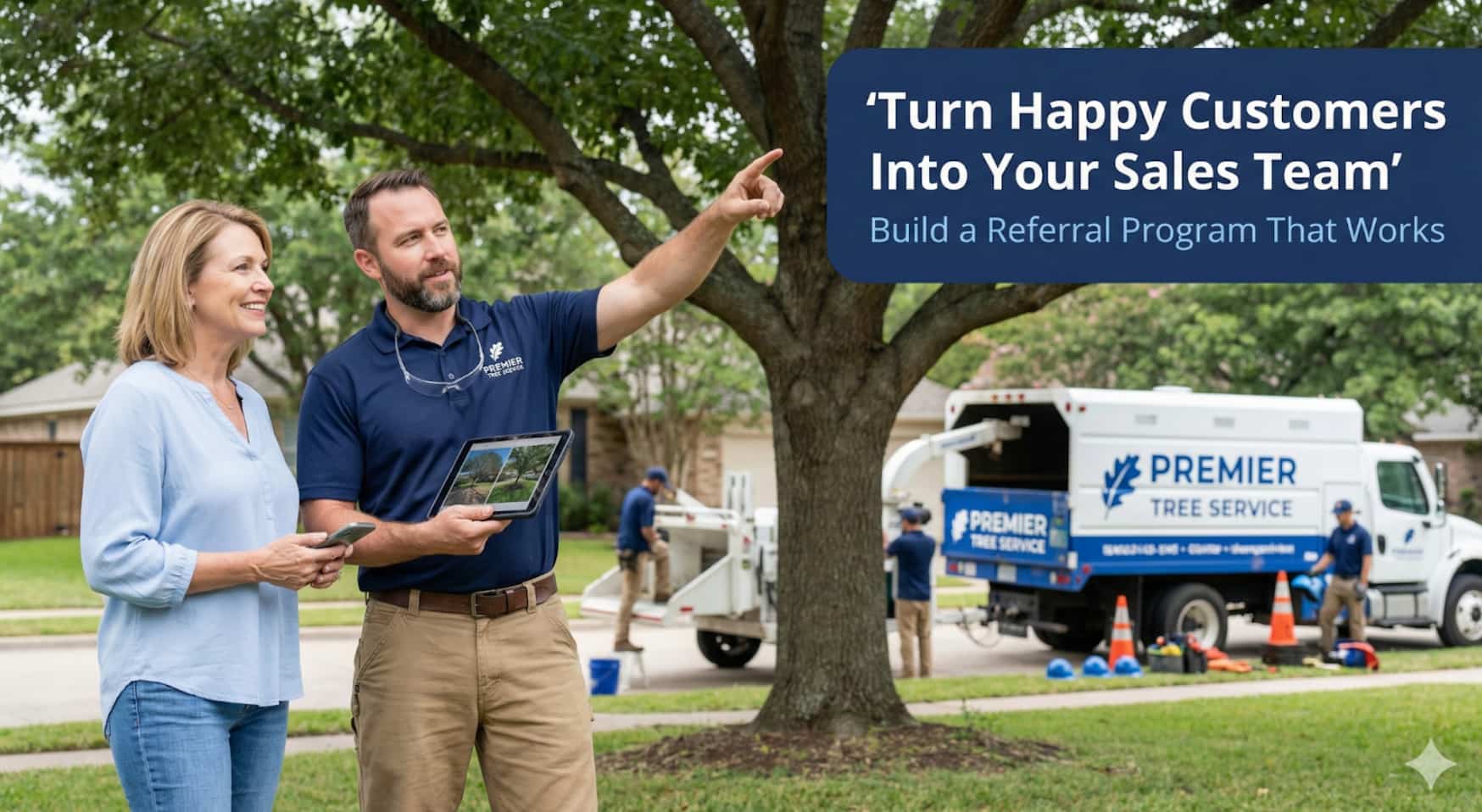
Are you spending thousands on ads while your best customers stay quiet about your tree service? You're missing a goldmine. Happy customers want to help their neighbors find reliable tree care.
Most tree service companies struggle with expensive marketing and seasonal demand swings. They pour money into Google ads and print marketing without building systems to turn satisfied customers into active promoters.
A smart tree service referral program changes everything. It transforms your customer base into a sales team that works around the clock. The best part? Referral programs typically close at rates of 75-85%, far higher than cold advertising.
This guide shows you exactly how to build, launch, and manage a referral program that generates consistent leads while cutting your marketing costs.
Table of Contents
Why Tree Service Referrals Work
Common Referral Program Mistakes
Building Your Reward Structure
Timing and Communication Strategy
Team Training and Implementation
Tracking and Measuring Success
Best Referral Program Tools
Tree care creates visible transformations that neighbors notice immediately. When you remove a dangerous tree or save a diseased oak, the whole neighborhood sees the results.
82% of consumers trust referrals from people they know. In tree care, this trust factor becomes even stronger because homeowners need reliable contractors for expensive, safety-critical work.
Your customers already talk about your work. They mention the professional crew, fair pricing, or how you saved their favorite shade tree. A formal referral program captures these conversations and turns them into qualified leads.
Tree service work has built-in referral triggers that other businesses lack. Emergency tree removal creates dramatic before-and-after results. Pruning transforms curb appeal overnight. Disease treatment saves treasured family trees.
These moments naturally spark conversations with neighbors and friends. Digital channels now lead tree service marketing, but word-of-mouth still drives the highest-converting leads.
Referred customers also spend more money. They skip the bargain shopping phase because they trust the recommendation. This means higher-value jobs and better profit margins for your business.
Most tree service companies make the same basic mistakes when launching referral programs. These errors kill program effectiveness before it starts.
Offering $10 gift cards for $1,000 tree removal jobs won't generate referrals. The reward needs to feel significant compared to the service value and effort required to make a referral.
Successful tree companies offer $50-$100 credits per qualified referral. Some use tiered systems that increase rewards for multiple referrals throughout the year.
The best time to ask for referrals is right after completing excellent work. Your customer feels grateful and impressed with the transformation. Wait two weeks, and that emotional connection fades.
Smart operators ask within 24-48 hours while customers still feel excited about the results. They follow up on referrals within 24 hours and contact prospects at least three times.
Your field crews talk to homeowners every day. They see neighbors watching the work and asking questions. But if your team doesn't know about your referral program, they miss these perfect opportunities.
Quiz your team regularly about program details. Whether in sales, office, or field roles, everyone should know the reward amount and how customers can refer friends.
Losing track of who referred whom frustrates customers and kills program credibility. You need simple systems to record referrals and track reward payments.
Use basic CRM software or detailed notes to monitor referral sources. Follow through on reward payments quickly to maintain customer trust and enthusiasm.
Your reward structure determines program success more than any other factor. Get it right, and customers actively promote your business. Get it wrong, and the program generates no referrals.
Leading tree service companies offer $100 credits to clients who refer friends and family. This amount feels significant enough to motivate action while remaining profitable for most jobs.
Smaller companies often start with $50 gift cards for qualified referrals. For example: "For every referral you give, we will give you a $50 gift card." This works well when building initial program momentum.
Davey Tree offers $100 service credits for each qualified referral. Credits apply after the referred customer starts their job, with a 36-month expiration period.
Set minimum job values to ensure referral profitability. Many successful programs require $500-$2,000 minimum jobs before rewards apply.
Legacy Tree Service requires $2,000 minimum jobs. When referrals hire them for qualifying work, both the referrer and new customer receive 10% discounts on their next service.
This approach ensures profitable referrals while providing mutual benefits that strengthen customer relationships.
Advanced programs use tiered rewards to encourage multiple referrals from top customers. For example:
First referral: $100 VISA gift card
Second referral: $250 credit
Third referral: $500 credit or weekend getaway
This structure rewards your most enthusiastic promoters while encouraging ongoing referral activity throughout the year.
Offer value to both the referring customer and new prospect. Your referral receives 10% off their first tree care project while the referring customer earns their reward.
This creates win-win scenarios that make referrals easier to make and more likely to convert into paying customers.
Perfect timing turns satisfied customers into active referral sources. Miss the moment, and even your biggest fans stay silent about your services.
Ask for referrals within 24-48 hours of job completion. Customers feel most grateful and impressed immediately after seeing dramatic tree care transformations.
Most tree service companies wait weeks to request reviews or referrals. By then, customers have moved on mentally and the emotional impact has faded.
Speed matters for follow-up too. Contact referred prospects within 24 hours while the recommendation feels fresh and relevant.
Promote your referral program across multiple touchpoints to maximize visibility and participation:
Website navigation with dedicated program page
Email signatures and follow-up messages
Invoice inserts and billing statements
Vehicle decals and yard signs during jobs
Social media posts and customer newsletters
Consistent messaging across all channels reinforces program benefits and keeps referrals top-of-mind for customers.
Align referral campaigns with peak tree care seasons when customers book multiple services. Spring cleanup and fall preparation create natural referral opportunities.
Storm seasons also generate referral chances as neighbors see emergency tree removal and ask for contractor recommendations.
Create automated email sequences that nurture referral prospects through multiple touchpoints. First contact within 24 hours, second follow-up in 3-5 days, and third contact after one week.
Tree service software like Jobber includes automated referral tracking and follow-up tools that streamline this process.
Your referral program succeeds or fails based on team execution. Every employee needs to understand program details and feel confident discussing referrals with customers.
Quiz your team frequently about program details. Whether in sales, office, or field roles, everyone should know:
Exact reward amounts and qualification requirements
How customers can make referrals
When and how to mention the program
Follow-up procedures for referred prospects
Test knowledge monthly through team meetings or informal check-ins. Consistent reinforcement keeps program details fresh in everyone's mind.
Field teams talk to homeowners daily and see neighbors watching tree care work. They're perfectly positioned to mention referral programs during natural conversations.
Train crews to mention referrals during job completion walkthroughs. Simple scripts work best: "If you know anyone who needs tree care, we offer $100 credits for referrals that turn into jobs."
Provide business cards or flyers that crews can leave with customers who express interest in making referrals.
Sales staff should mention referral programs during estimate presentations and contract signings. This plants seeds for future referrals while demonstrating confidence in service quality.
Include referral information in proposal packets and follow-up materials. Make it easy for prospects to understand program benefits before becoming customers.
Office teams handle referral tracking, reward processing, and customer communication. They need systems to:
Record referral sources and track progress
Process reward payments quickly
Update referring customers on referral status
Generate reports on program performance
Clear procedures prevent confusion and ensure consistent program management across all customer interactions.
Effective tracking separates successful programs from failed experiments. You need clear metrics to measure performance and identify improvement opportunities.
Referral programs typically close at rates of 75-85%, significantly higher than other marketing channels. This provides your target conversion rate for measuring success.
Track these essential metrics monthly:
Number of referrals received
Referral-to-customer conversion rate
Average job value from referred customers
Cost per referred customer acquisition
Customer lifetime value of referred clients
Compare referral program costs to other marketing channels like Google ads or direct mail to demonstrate ROI.
Use basic CRM software or detailed notes to record referrals and monitor reward payments. Track who referred whom, when referrals convert, and reward payment dates.
Create simple spreadsheets if sophisticated software feels overwhelming initially. The key is consistent record-keeping that prevents customer frustration and program confusion.
Calculate program ROI by comparing referral program costs to revenue generated from referred customers. Include reward payments, administrative time, and promotional materials in total costs.
Referred customers typically spend 16% more than other customers and have higher retention rates. Factor these benefits into long-term ROI calculations.
Review program performance quarterly to identify improvement opportunities. Common optimization areas include:
Adjusting reward amounts based on response rates
Testing different communication timing
Expanding team training and involvement
Improving tracking and follow-up procedures
Small adjustments can significantly improve program effectiveness and customer participation rates.
The right tools simplify program management and improve results through automation and better tracking capabilities.
ArboStar offers CRM solutions built specifically for tree care companies. It streamlines jobs, crew management, billing, and customer relationship tracking in one platform.
ArborNote provides industry-leading tree care software with inventory management, mapping, and professional proposal tools. Their system helps track customer information and referral sources effectively.
Jobber's Marketing Suite helps tree service companies build automated referral programs alongside review collection and reputation management tools.
ReferralRock offers referral software designed for seamless integration with existing CRM and marketing platforms. It automates referral tracking and reward processing.
GrowSurf provides plug-and-play referral software that generates unique referral links for each customer without requiring engineering team support.
These platforms integrate with existing business systems to reduce manual work while improving program tracking and performance.
WorkWave attracts customers through awareness-building campaigns and automated referral programs designed for service businesses.
Zentive helps tree care companies get and retain more customers through automated CRM and marketing modules. It tracks lead sources including Google, referrals, social media, and storm events.
These comprehensive solutions handle multiple business functions while maintaining referral program integration and tracking.
Choose software that integrates with your existing marketing technology stack. CRM integrations allow automatic referral link generation and seamless lead management workflows.
Integration also enables automatic lead qualification based on CRM activities, reducing manual work while improving program efficiency.
What's the best reward amount for a tree service referral program?
Most successful tree service companies offer $50-$100 credits per qualified referral. The reward should feel significant compared to your average job value while remaining profitable for your business.
How quickly should I follow up on tree care referrals?
Contact referred prospects within 24 hours while the recommendation feels fresh. Speed demonstrates professionalism and increases conversion rates significantly.
Should tree service referral programs have minimum job requirements?
Yes, set minimum job values of $500-$2,000 to ensure referral profitability. This prevents reward costs from exceeding profit margins on small jobs.
How do I track referrals without expensive software?
Start with simple spreadsheets or basic CRM software to record referral sources, conversion dates, and reward payments. Consistent tracking matters more than sophisticated tools initially.
What's the typical conversion rate for tree service referral programs?
Well-managed referral programs typically convert at 75-85% rates, much higher than cold advertising or other marketing channels. This makes referrals extremely cost-effective for customer acquisition.
Ready to get pay per call tree service leads? Sign up for free with ResultCalls today!

Hello everyone! My name is Alex and I write these blogs to help educate small business owners on different ways to grow their business. My goal is to make lead generation as easy as possible for you. After reading these blogs, I hope you leave with some actionable steps that will get you closer to growing your business :)