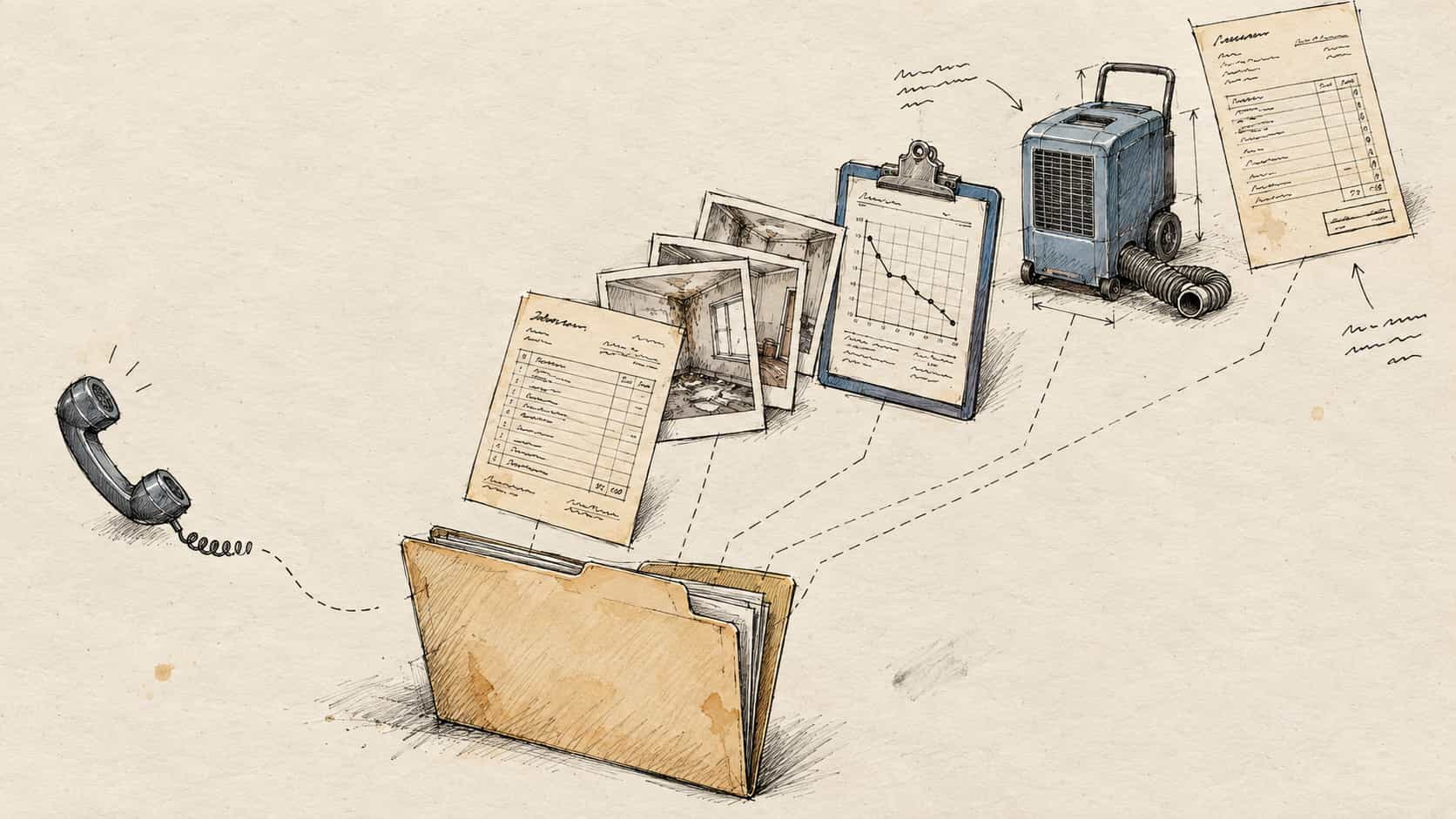
Restoration software splits into two halves that do not overlap. Xactimate prices the claim. A job management platform runs the job. Neither one does the other's work.
That split is the single most expensive misunderstanding in this trade. Contractors buy Xactimate, discover it cannot track moisture readings or text a homeowner, and conclude the software failed them.
Xactimate is close to mandatory regardless. More than 70% of U.S. property insurance claims are estimated using it, which makes it functionally required for any shop doing insurance work.
The combined cost is real. Xactimate runs roughly $1,500 to $2,500 a year per license, and a job management platform adds another $1,200 to $6,000 annually on top.
This guide lays out five layers in the order you should buy them, with 2026 pricing for each. It names real platforms and says plainly where each one stops, including the layer none of them covers.
How We Ranked This Restoration Software Stack
The Five Layers of the ResultCalls Restoration Stack
Xactimate and the Estimating Layer
Encircle and Field Documentation Tools
Job Management: DASH, Albi, PSA, Xcelerate
Accounting and Job Costing Integration
The Layer Most Companies Skip
What This Stack Costs Per Year
Building Your 2026 Strategy
Frequently Asked Questions
These five layers are ordered by what breaks first without them, not by price or popularity. A restoration company without Xactimate cannot get paid on insurance work. A company without field documentation gets supplements denied.
Three criteria set the order: whether insurance work is possible without it, whether it protects you in a dispute, and whether it saves labor you are currently paying for.
Mitigation is a documentation sprint measured in days, priced through Xactimate, and judged on cycle time. Generic field service tools are built for a different shape of work.
Jobber and similar platforms are capable at scheduling and invoicing. They lack moisture mapping, psychrometric calculations, and insurance documentation packages, which are the three things mitigation actually runs on.
Software that templates IICRC S500-aligned documentation materially reduces denied supplements and improves program scoring. Encircle, MICA, PSA, and DASH all do this.
That is the real return on this stack. You are not buying convenience. You are buying the evidence that survives an adjuster review.
The ResultCalls Restoration Stack is five software layers a restoration company needs, in buy order. Each layer does a job the others cannot.
Most contractors buy layers one and three and wonder why the job file still falls apart.
Layer 1, estimating: Xactimate and XactAnalysis, which price the claim and receive carrier assignments
Layer 2, field documentation: Encircle, MICA, Magicplan, CompanyCam, which capture the evidence on site
Layer 3, job management: DASH, Albi, PSA, Xcelerate, which run scheduling, equipment, and the job lifecycle
Layer 4, accounting: QuickBooks or Sage, connected to job costing
Layer 5, intake: how the call that started the job gets answered and recorded
Xactimate and XactAnalysis are the estimate and assignment layer, not a fifth job management system. That distinction is worth repeating because it costs contractors money every year.
Xactimate does not manage your jobs, text customers with updates, track moisture readings over time, assign tasks to crews, or generate job-linked photo documentation.
Xactimate is the estimating standard for property insurance claims and is effectively required for insurance restoration work. Its pricing database is what adjusters expect and accept, which is why building estimates in Xactimate format is not really optional.
Verisk owns it, and license pricing varies by tier.

Most full licenses run roughly $1,500 to $2,500 per year, though pricing changes periodically
XactAnalysis handles carrier assignment flow and program scoring, separate from estimating itself
Symbility is the main alternative, supported by some carriers and some platforms
Confirm current rates directly with Verisk before budgeting, since tiers shift
Xactimate prices the loss and nothing more. Every operational function in your business sits outside it.
That is not a flaw. It is scope. Treating it as a business management system is the error, and it is the reason the next three layers exist.
Verdict: unavoidable for insurance work, excellent at the one thing it does, and useless for running a job.
Field documentation tools capture the evidence that justifies the claim. Encircle is the category standard, priced from $250 per month with unlimited users.
This layer buys two things: faster capture on site, and a job file that holds up when an adjuster challenges a supplement.

Photos linked to the job and the room, not loose in a phone camera roll
Moisture content readings by room and material, logged daily
Psychrometric readings tracked against the dry standard under IICRC S500
Contents inventories for pack-out work
Sketches and floor plans, which is where Magicplan and MICA also compete
Encircle is the strongest field documentation experience in the category and it is a documentation tool rather than a full platform. Scheduling, costing, and billing live elsewhere.
Plenty of shops run both, pairing Encircle for capture with a job platform for the lifecycle. That pairing is a deliberate choice, not a failure of either product.
Verdict: the layer that protects your supplements, and worth buying before a job management platform if your documentation is currently photos on a phone.
Four purpose-built restoration job platforms dominate this layer in 2026: Cotality DASH, Albi, PSA by Canam, and Xcelerate. Each one is built for a different kind of restoration company.
All four integrate with Xactimate, so integration alone is not a differentiator anymore.
Per-user pricing and flat team pricing diverge sharply as you grow. Albi climbs quickly with high-permission users and breaks against PSA flat pricing somewhere around 20 seats.
Xactimate access can also be gated. Albi integrates with Xactimate and XactAnalysis on Pro seats at $100 per user per month, so verify your Pro seat count covers every estimator before signing.
DASH carries the deepest carrier ecosystem connection and SOC 2 Type II certification, which matters if TPA program work drives your revenue. It is custom-quoted through a demo process.
Updoot runs $5 per user per month with everything included, and has no native Xactimate or XactAnalysis integration. Restoration Manager runs $300 to $745 per month.
If your work is mostly retail rather than insurance, the Xactimate gap matters far less than the price difference.
Verdict: pick by revenue source rather than feature list, since TPA-heavy, retail-heavy, and job-costing-focused companies land on different platforms.
Your accounting system has to connect to job costing or the stack produces numbers nobody trusts. QuickBooks Online, QuickBooks Desktop, and Sage are the common integrations across restoration platforms.
This layer ranks fourth because it is usually already in place. The work is connecting it, not buying it.

Labor hours by job, not by week
Equipment run time and rental charges attached to the job
Subcontractor costs against the estimate line they belong to
Invoice status, so a closed job shows as unpaid rather than complete
Supplements, tracked separately from the original estimate
PSA puts job costing next to the estimate, and Xcelerate exposes a job margin view built from work orders and sub scopes. Those views are the reason this layer exists.
Without them you know your revenue and your bank balance and nothing in between.
Verdict: the least exciting layer and the one that tells you which jobs actually made money.
Layer five is intake, meaning how the call that started the job gets answered, qualified, and recorded. No restoration platform on this list produces that call.
Every layer above manages work you already won. That is worth stating plainly, because software vendors in this category market on growth language.
24/7 answering, since water losses do not wait for business hours
Call recording, so the first conversation is part of the job file
Source tracking, so you know which channel produced the job
Routing to an on-call tech with the loss address and type
A record created before anyone opens Xactimate
A missed call at 2 AM is a job that never enters any of the four layers above. The best documentation software in the category cannot document a loss you were not called to.
If your intake is covered and the shortage is inbound calls rather than software, that is a separate problem. ResultCalls sends exclusive water damage restoration calls that are never shared with another company, on pay per call with no contracts.
Verdict: the cheapest layer to fix, the one no platform in this roundup includes, and the one that determines whether the other four have anything to work on.
A small restoration company can run a complete stack for roughly $4,000 to $9,000 a year. A mid-size insurance-heavy operation lands closer to $15,000 to $30,000.
Build the budget layer by layer rather than shopping for one all-in-one product.
Per-user pricing is what scales the bill. A ten-estimator shop on Albi Pro seats at $100 per user is paying $12,000 a year before anything else, which is why flat team pricing becomes attractive past a certain headcount.
One published comparison lists a job management entry tier at $150 per month for two users with Xactimate integration as a $50 monthly add-on. Entry pricing and real pricing diverge fast once your crew grows.
Three decisions set up this stack correctly. Make them in this order.
Count every person who builds or edits an estimate. At $1,500 to $2,500 per license annually, and with some platforms gating Xactimate integration to higher-cost seats, this number drives more of your budget than any other decision.

If your moisture logs live on paper and your photos live in a camera roll, documentation software returns more than a job platform will. S500-aligned templating reduces denied supplements, which is money back rather than time saved.
TPA and program work points toward DASH. Retail and customizable workflow points toward Albi. Job costing at scale points toward PSA. Process discipline and margin visibility points toward Xcelerate.
Five layers: Xactimate for estimating, a field documentation tool like Encircle, a job management platform such as DASH, Albi, PSA or Xcelerate, an accounting connection, and intake. Xactimate and job management are separate products that do not replace each other. More than 70% of U.S. property insurance claims are estimated in Xactimate, which makes it close to mandatory for insurance work.
Xactimate licenses run roughly $1,500 to $2,500 per year each, and a job management platform adds $1,200 to $6,000 annually at entry level. Field documentation starts around $250 per month with unlimited users. A small company can run a complete stack for $4,000 to $9,000 a year, while a mid-size insurance-heavy operation lands closer to $15,000 to $30,000.
No. Xactimate prices the claim and nothing else. It does not manage jobs, text customers with updates, track moisture readings over time, assign tasks to crews, or produce job-linked photo documentation. It is the estimate and assignment layer, not a job management system.
All four major platforms do as of 2026: DASH, Albi, PSA and Xcelerate. Albi gates Xactimate and XactAnalysis to Pro seats at $100 per user per month, so verify your seat count covers every estimator. DASH carries the deepest carrier ecosystem connection, and PSA adds Symbility coverage.
For retail work, sometimes. For mitigation, they are missing the things the job runs on: moisture mapping, psychrometric calculations, and insurance documentation packages. Generic field service tools handle scheduling and invoicing well and were not built for a documentation sprint judged on cycle time.
The restoration software stack works when you stop looking for one product that does everything. Xactimate prices the claim, documentation protects the supplement, a job platform runs the lifecycle, and accounting tells you which jobs paid.
Buy in that order and each layer makes the next one worth more. Buy a job platform first and you will still be arguing supplements with photos from a phone.
And remember the layer no vendor in this roundup sells. If your documentation is solid and the schedule is still thin, the gap is inbound calls rather than software, and water damage restoration lead generation is where to look next.

Hello everyone! My name is Alex and I write these blogs to help educate small business owners on different ways to grow their business. My goal is to make lead generation as easy as possible for you. After reading these blogs, I hope you leave with some actionable steps that will get you closer to growing your business :)