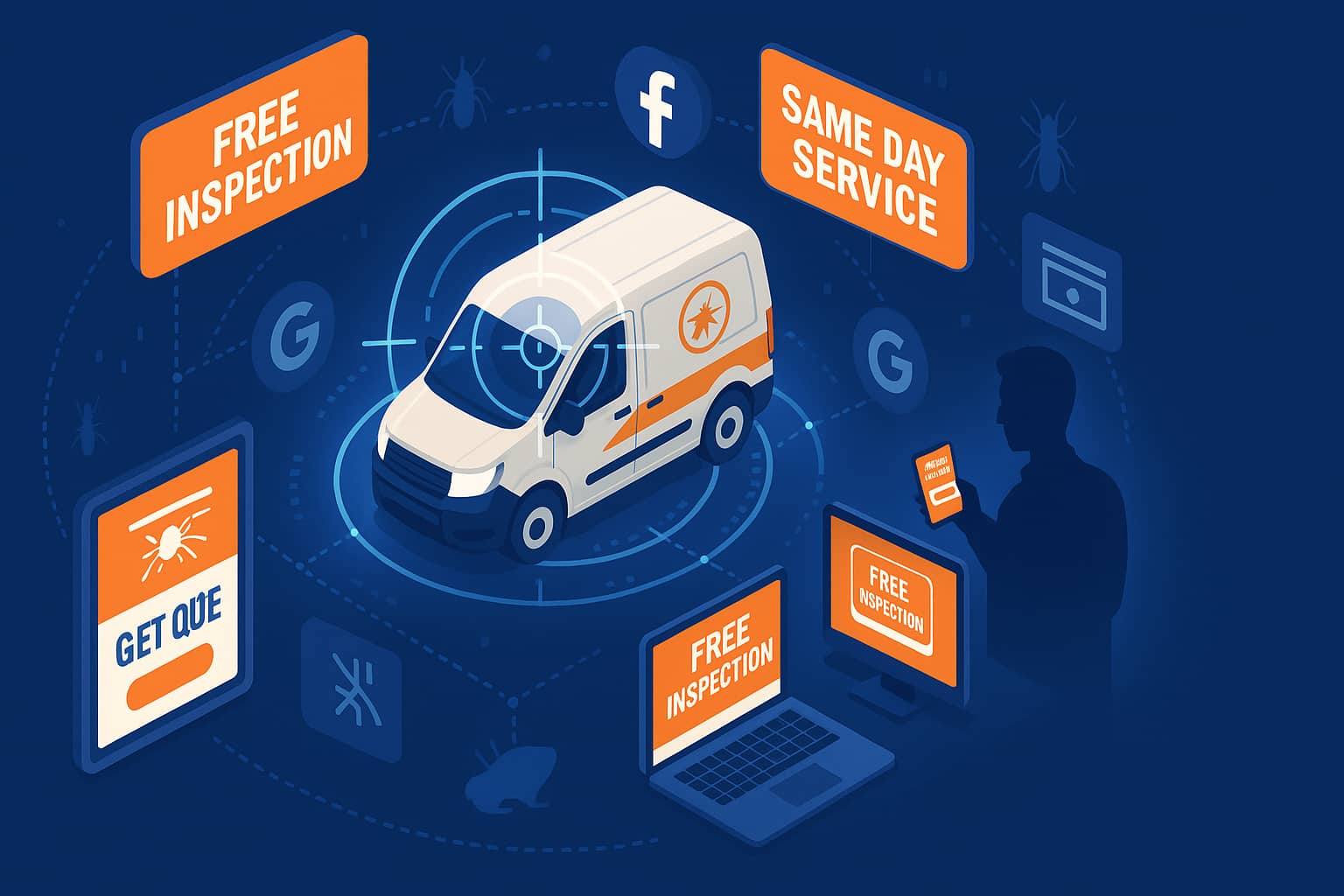
Here's a frustrating problem: A homeowner finds termites in their basement. They panic and search Google for help. They find your pest control website and browse your services. They check your pricing page. Then they leave without calling.
This happens with nearly every visitor to your site. In fact, 96-98% of website visitors leave without booking service. You paid to get them there, but they vanished.
Pest control retargeting fixes this problem. It shows targeted ads to people who already visited your website. You get multiple chances to convert warm leads who showed clear interest. The results speak for themselves. Retargeted visitors are 70% more likely to convert than cold prospects. Plus, retargeting ads get 10x higher click-through rates than standard display ads.
This guide shows you exactly how to launch effective retargeting campaigns. You'll learn proper pixel setup, smart audience segmentation, and platform-specific strategies. We'll cover seasonal adjustments and privacy changes that affect your ads.
What Retargeting Means for Pest Control
Five Costly Retargeting Mistakes to Avoid
Platform Strategies That Drive Leads
Audience Segmentation That Converts
Ad Creative That Drives Conversions
Seasonal Retargeting Adjustments Needed
Privacy Changes Reshaping Strategy
Tools and Platforms Compared
Performance Metrics to Track
What Retargeting Means for Pest Control Businesses
Retargeting shows your ads to people who visited your website but didn't book service. Think of it as getting a second, third, and fourth chance with interested prospects.
The terms "retargeting" and "remarketing" mean the same thing. Google calls its display retargeting "remarketing" while most marketers say "retargeting." Both accomplish the same goal: bringing warm leads back to convert.
Here's how it works. You install a tracking pixel on your website. This pixel adds visitors to an audience list. Then you show them targeted ads across Facebook, Google, and other platforms as they browse the web.
When homeowners spot pests, they don't spend weeks researching. They call the first reliable company that comes to mind. Your retargeting ads keep you top-of-mind during this critical window.
Research shows consumers need an average of 7 touchpoints before buying. Retargeting delivers those repeated brand exposures efficiently. For pest control, where phone calls convert at 10-15x the rate of web forms, retargeting strategies that drive phone inquiries deliver exceptional ROI.
The Business Case for Retargeting:
These numbers show why pest control companies that skip retargeting leave money on the table. You already paid to drive traffic. Retargeting helps you maximize the value of every visitor.
Most pest control businesses either skip retargeting or implement it poorly. They waste budget while annoying potential customers. Understanding these failures helps you avoid them.
The biggest mistake is showing identical ads to all website visitors. A person who spent three minutes on your termite page is different from someone who bounced in five seconds. They need different messages.
The fix: Use behavioral segmentation. Show quote-page abandoners urgent CTAs with special discounts. Show blog readers softer educational content that builds trust over time.
Research shows consumer tolerance drops after 6+ impressions per week. Only 5% of users accept this frequency level. An advertising executive from Adblock Plus explained: "If you chase people through the web and they see the same ads everywhere, people feel hunted."
The fix: Set frequency caps at 17-20 ads per month per user. Rotate your creative regularly to prevent banner blindness.
Showing ads to customers who just booked service is annoying and costly. This mistake wastes 20-30% of campaign budgets on people who cannot convert again.
The fix: Create exclusion lists for recent converters. Update them frequently through your CRM integration.
Generic brand awareness ads don't work for someone viewing your pricing page. They're ready to buy. They need compelling offers and clear CTAs, not educational content.
The fix: Match your ad content to demonstrated intent level. High-intent visitors need direct response ads. Low-intent visitors need nurturing content.
CTR declines significantly after 5 months of identical creative. Continuous testing and optimization are essential. This is especially true for pest control where seasonal trends dramatically shift demand.
The fix: Test new ads monthly. Adjust messaging for seasons. Spring focuses on termites. Fall focuses on rodents. Optimize based on performance data.
Meta's platform reaches over 2.9 billion monthly active users. For pest control companies, Facebook retargeting excels at brand awareness and reaching homeowners in specific areas.
Setting Up Your Pixel
Start in Meta Business Suite under Events Manager. Create your pixel. Install the base code in your website header using Google Tag Manager. Configure standard events for pest control:
Lead (form submissions)
Contact (phone clicks)
ViewContent (service page views)
CompleteRegistration (quote requests)
Conversions API Is Essential
Post-iOS 14, you need Conversions API (CAPI). Server-side tracking bypasses browser restrictions and ad blockers. It captures 20-30% more data than pixel-only setups. Verify your domain in Business Manager. Configure Aggregated Event Measurement with your 8 priority events.
Custom Audiences for Pest Control:
Budget Guidelines
Marketing experts recommend $600/month minimum for Facebook ad auctions. Start at $20-30/day. Scale based on performance. For retargeting specifically, allocate 10-20% of your total ad budget.
Set frequency caps at 3-5 impressions per person per week. High-intent audiences (quote page visitors) can see up to 7 per week. Low-intent audiences (blog readers) should see only 2-3.
Google's remarketing reaches 90% of internet users through its display network, YouTube, and partner sites. Click-through rates are lower than Facebook (0.35-0.5% vs 0.9-1.2%). But Google's lower cost-per-click ($0.66-$1.23) makes it essential.
Technical Setup
Use Google Tag Manager for cleanest implementation. In Google Ads, go to Tools & Settings → Audience Manager → Audience Sources. Generate your Conversion ID. Create a Google Ads Remarketing tag in GTM with an "All Pages" trigger. Minimum audience sizes are 100 users for Display Network and 1,000 for Search remarketing.
Time-Based Segmentation:
For pest control, the sales cycle is typically 7-14 days for residential services. Emergency services may convert within 24-48 hours. Commercial contracts often take 30-60 days.
Responsive Display Ads
Upload 15 marketing images and 5 logos. Use both landscape (1.91:1) and square (1:1) formats. Include your logo for brand recognition. Add clear CTAs like "Get Your Free Quote." Use service-specific imagery. Exclude mobile game apps, parked domains, and forums to reduce wasted clicks.
Microsoft/Bing remarketing offers 20-30% lower CPCs than Google. It performs better with the 50+ demographic. This is often your primary homeowner segment. Cross-platform reach extends across MSN, Outlook, Skype, Yahoo, and AOL.
Setup mirrors Google's process using Universal Event Tracking (UET) tags. Import your Google Ads campaigns directly. Apply the same segmentation strategy. Leverage LinkedIn profile targeting integration for commercial pest control. Target facility managers and property management companies.
When targeting commercial clients, LinkedIn retargeting delivers qualified leads other platforms miss. Think restaurants, healthcare facilities, property management companies, and hotels. Research shows LinkedIn generates 80% of B2B social media leads.
Install the LinkedIn Insight Tag via Campaign Manager. Create Matched Audiences from website visitors. Segment by professional criteria like job title, company size, and industry. Performance benchmarks show 30% increase in CTR with website retargeting. They also show 14% drop in post-click cost-per-conversion.
Effective retargeting requires more than "all website visitors" lists. You need to match message intensity and offer type to demonstrated purchase intent.
High Intent (Priority Audiences):
Pricing/quote page visitors
Contact form openers who didn't submit
Phone number clickers
Return visitors within 7 days
Medium Intent:
Service page viewers
Reviews page visitors
Sessions over 2 minutes
Low Intent:
Blog readers
Single-page visitors with bounce
Social media engagers
Use radius targeting around your service area. Completely exclude areas you don't serve. Layer homeowner targeting with "newly moved" behavioral targeting. New residents have high pest discovery rates. They also have no existing provider relationship. This combination delivers higher conversion rates for local service businesses.
Ad Creative That Drives Pest Control Conversions
Top of Funnel (Blog Readers)
Focus on education and lead magnets. Use soft CTAs like "Learn More." For example: "5 Signs You Have a Termite Problem" paired with "Download Our Pest Prevention Guide." Build authority without pressure.
Middle of Funnel (Service Page Visitors)
Emphasize social proof and authority. Show ratings like "Rated 4.9★ by 2,500+ Homeowners." Mention credentials like "Licensed, Bonded, and Insured Since 1985." Build trust without hard selling. Showcase your professional credentials and customer testimonials.
Bottom of Funnel (Quote Page Visitors)
Use direct offers with urgency. Try "Get $50 Off Your First Treatment." Use "Schedule Today – Same Day Service Available." Add "100% Satisfaction Guarantee." These high-intent visitors are ready to buy. Give them a compelling reason to choose you now.
Before/after photos of pest damage and treatment results work well. They demonstrate expertise tangibly. Team photos build trust. Uniformed, professional technicians reassure homeowners about who's entering their property.
Video content (15-30 seconds) outperforms static images. Show treatment processes or customer testimonial clips.
For mobile (65-75% of pest control traffic), use square (1:1) or vertical (9:16) formats. The first 3 seconds must capture attention. Lead with the problem or outcome, not your logo.
The most effective calls-to-action for pest control:
"Get Your Free Inspection"
"Call Now – Same Day Service"
"Request Free Quote"
"Book Online in 2 Minutes"
Action verbs get 22% higher CTR than passive language. Make phone numbers click-to-call on mobile. Phone leads are your highest-value conversions.
Pest control advertising has distinct seasonal patterns. You need budget and messaging adjustments throughout the year.
This is the "Super Bowl of pest control." You face highest competition and highest CPCs. But you also get highest search volume. Termite swarm season messaging dominates.
Retarget winter visitors with spring urgency CTAs. Bundle inspection + treatment + maintenance packages together.
Shift focus to mosquitoes, wasps, and outdoor pests. "Take back your backyard" messaging resonates with homeowners planning outdoor entertaining. Retarget spring leads who didn't convert with summer-specific offers.
Emphasize rodent prevention as mice seek winter shelter. "Prepare for winter" campaigns perform well. Commercial pest control pushes work great in fall. Retarget summer customers for annual plan upgrades before the busy season ends.
You get lower CPCs due to reduced competition. Focus on rodents and cockroaches. Invest in content marketing and SEO preparation for spring. Build audiences now for your high-season retargeting push.
Winter represents prime opportunity to capture higher-intent leads at lower costs.
Apple's App Tracking Transparency framework hurt traditional retargeting. Remarketing audiences shrunk dramatically. Attribution windows shortened to 7 days on Facebook. Meta estimated $10 billion in revenue loss.
What Pest Control Marketers Must Do:
Verify your domain in Facebook Business Manager (mandatory for iOS 14+ compliance)
Implement Conversions API alongside your pixel for server-side tracking
Configure Aggregated Event Measurement with your 8 priority events
Build engagement-based audiences like video views and page engagement
Upload customer lists from your CRM for privacy-compliant retargeting
Google's original plan to remove third-party cookies has been abandoned. In July 2024, Google reversed course. Instead of removing cookies, Chrome will implement a user-choice prompt. Safari and Firefox already block third-party cookies by default.
Strategies That Work Now:
First-party data collection is essential. Companies using first-party data see 2.9x better customer retention and 1.5x higher marketing ROI. For pest control, this means email capture strategies and CRM integration. Build customer lists for audience uploads.
Server-side tracking moves data collection from browser to server. GA4 and GTM server-side tagging are recommended.
Contextual targeting places ads based on content relevance rather than user behavior. It's privacy-compliant by design. AI improvements are making it increasingly sophisticated.
ServiceTitan offers native CRM features with call tracking and marketing attribution. Integration paths include exporting customer email lists for Facebook/Google Custom Audiences. Connect HubSpot or Marketo for audience sync. Use Zapier for custom data flows.
Housecall Pro includes built-in email marketing with Mailchimp integration. It connects to Google Local Service Ads. Retargeting requires Zapier workarounds or manual customer data exports.
Jobber integrates with QuickBooks, Mailchimp, and Zapier. But it lacks native pixel/retargeting integration. Users report needing workarounds to sync lead data with marketing platforms.
Week 1 (Foundation):
Install Google Tag Manager on website
Set up Meta Pixel via GTM with Conversions API
Set up Google Ads remarketing tag via GTM
Verify domain in Facebook Business Manager
Install cookie consent banner
Weeks 2-4 (Audience Building):
Create website visitor audiences (30, 60, 90-day windows)
Create service page-specific audiences
Export CRM customer list and upload as Custom Audience
Create Lookalike audiences from best customers
Set up exclusion lists (converters, out-of-area)
Week 4+ (Campaign Launch):
Start with broad website visitor retargeting
Create high-intent ads for quote page visitors
Set frequency caps (15-20 impressions/month)
A/B test ad creatives
Monitor performance weekly, refresh creative monthly
For pest control's short sales cycle (7-14 days residential), data-driven attribution works best. You need sufficient conversion volume though. Alternatively, time decay attribution gives more credit to touchpoints closer to conversion. This works well when customers research briefly then call.
Track both first-click source and last-click source. This shows you the full customer journey.
Pest control businesses that skip retargeting waste their marketing budget. You pay to get leads. Then you watch 98% of them walk away forever.
The economics are clear. Retargeting delivers 10x higher click-through rates at a fraction of cold acquisition costs. Visitors are 70% more likely to convert after exposure to your retargeting ads.
The implementation path is straightforward. Start with proper pixel installation across Facebook and Google. Segment audiences by intent level and service interest. Match messaging to funnel stage. Respect frequency limits to avoid ad fatigue.
Seasonal adjustments maximize relevance and ROI. Ramp up during spring's termite season. Shift to rodent prevention in fall. These adjustments keep your ads relevant year-round.
Privacy changes require adaptation, not retreat. Server-side tracking, first-party data strategies, and engagement-based audiences work well. The pest control businesses that master retargeting now will compound their competitive advantage. Paid acquisition costs continue rising across the industry.
Ready to get more leads? Discover how ResultCalls' pest control marketing solutions can get pay per call pest control leads today!
Pest control retargeting shows your ads to people who visited your website but didn't book service. It works by installing a tracking pixel on your website. The pixel adds visitors to an audience list. Then you show them targeted ads across platforms like Facebook and Google. This keeps your company top-of-mind and brings warm leads back when they're ready to book.
Allocate 10-20% of your total digital advertising budget to retargeting campaigns. For Facebook retargeting specifically, experts recommend a minimum of $600/month. Google Display Network remarketing requires approximately $500/month minimum. Start at $20-30/day and scale based on performance and lead quality.
The terms mean the same thing in practice. Google calls its display retargeting "remarketing." Most marketers use "retargeting" for pixel-based paid ads. Remarketing sometimes specifically refers to email-based re-engagement campaigns. Both strategies accomplish the same goal: re-engaging people who visited your website but didn't convert.
Apple's iOS 14+ privacy changes reduced retargeting audience sizes by approximately 90%. Most iOS users opted out of tracking. Pest control companies must now implement Conversions API for server-side tracking. Verify your domain in Facebook Business Manager. Build engagement-based audiences. Google's decision to keep third-party cookies means retargeting remains viable. But first-party data collection through email capture and CRM integration is essential for long-term success.
Expect 3-5% conversion rates from Facebook retargeting campaigns. Expect 0.5-1.5% from Google Display Network remarketing. High-intent audiences (pricing page visitors, form abandoners) often convert at 12-15% or higher. Retargeted visitors are 70% more likely to convert than cold prospects. This makes retargeting one of the highest-ROI advertising strategies available.

Hello everyone! My name is Alex and I write these blogs to help educate small business owners on different ways to grow their business. My goal is to make lead generation as easy as possible for you. After reading these blogs, I hope you leave with some actionable steps that will get you closer to growing your business :)