Is your solar company losing qualified leads to competitors who respond faster? You're not alone. Most solar installation companies don't have a lead generation problem. They have a lead conversion problem.
The challenge is clear: 78% of leads buy from the company that responds first. Yet the average response time is almost 47 hours. That's way too long in today's competitive solar market.
Solar CRM automation solves this problem by streamlining your lead nurturing process. It handles follow-ups automatically and keeps prospects engaged throughout their buying journey. The result? Companies using proper automation see revenue increases of 10% or higher.
This guide shows you how to implement solar CRM automation that converts more leads into customers. You'll learn proven strategies that top solar companies use to dominate their markets.
Table of Contents
Why Solar CRM Automation Works
Common Solar Lead Management Challenges
Best Solar Automation Strategies
Essential Solar CRM Tools
Step-by-Step Implementation Guide
Measuring Your Automation Success
Solar CRM automation transforms how you handle leads throughout the extended solar buying journey. Unlike quick purchase decisions, solar installations require multiple touchpoints and education.
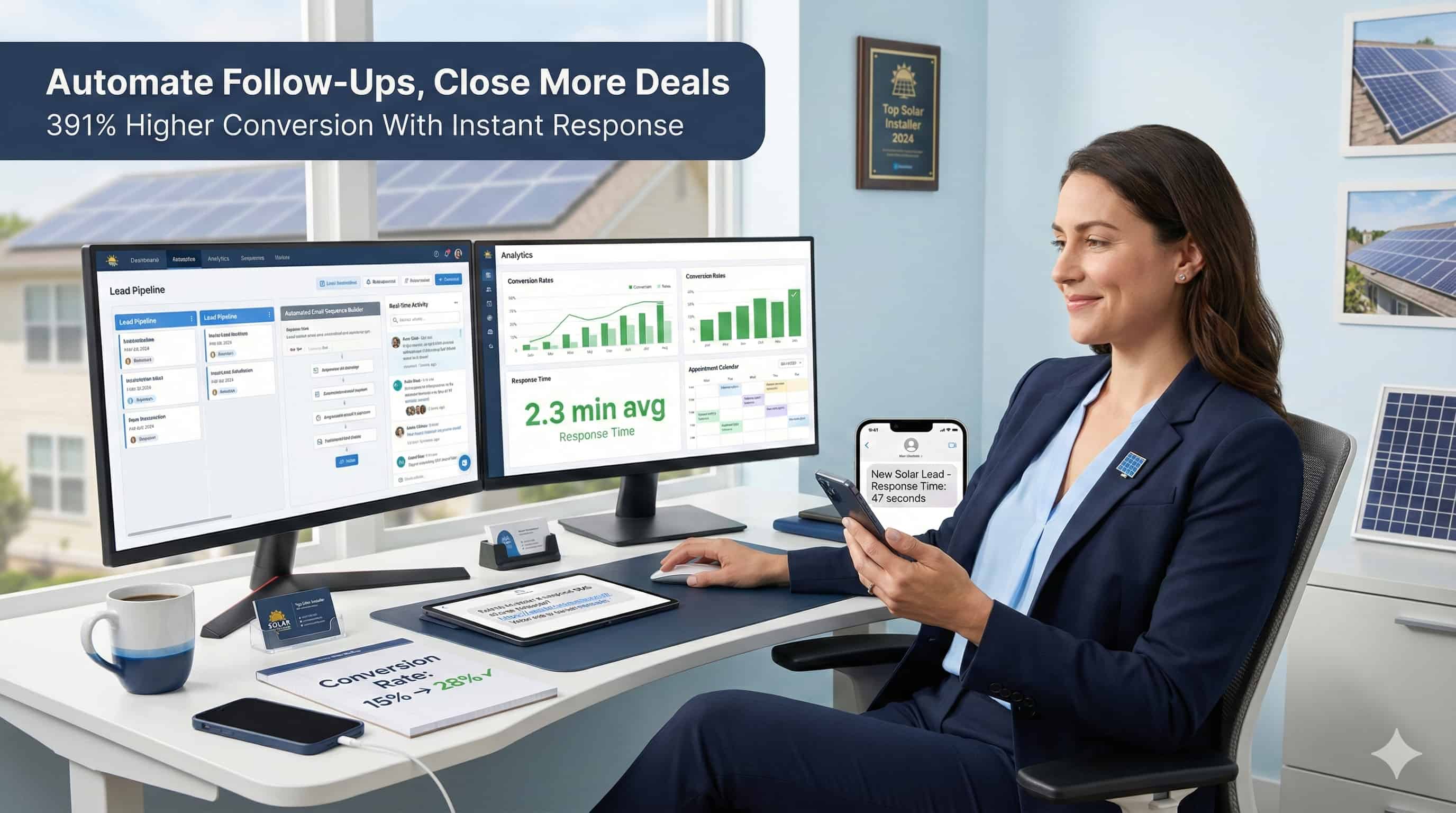
The numbers tell the story. Calling a lead in the first minute boosts conversion chances by 391%. Calls placed within five minutes are 100 times more likely to connect.
Here's why automation makes such a big difference:
Automated systems respond to new leads immediately. When someone fills out your contact form, they get a confirmation email within seconds. Your CRM can also trigger SMS alerts to your sales team.
This speed advantage is crucial. While competitors take hours or days to respond, you're already building relationships with prospects.
About 80% of sales require five follow-up touchpoints. For busy solar professionals, following up with every lead that many times isn't sustainable manually.
Automation handles this perfectly. Your system can send personalized emails, SMS messages, and even schedule phone calls automatically.
Companies using CRM systems experience an average ROI of 8:1. When you nurture leads properly, you convert more prospects from the same marketing budget.
Solar companies face unique obstacles that automation can solve. Understanding these challenges helps you implement the right solutions.
The average response time for solar leads is almost 47 hours. This delay costs you sales every single day.
When prospects research solar options, they're actively comparing companies. The first company to provide helpful information and schedule a consultation usually wins the business.
Manual follow-up processes can't compete with automated systems that respond instantly.
Solar customers respond to different communication channels. Some prefer email, others engage via SMS, and many respond to phone calls.
When you rely on just one channel, you miss opportunities. SMS messages reach 98% open rates compared to email's 20-30% rates.
Automation lets you coordinate messages across all channels for maximum impact.
The solar industry typically sees conversion rates between 13% and 17%. This reflects intense competition among solar providers.
Other construction sectors often achieve 20% or higher conversion rates. The gap shows solar companies need better lead nurturing systems.
Without proper CRM systems, companies rely on spreadsheets, manual logs, or scattered notes. This results in lost prospects due to forgotten follow-ups and disorganized processes.
A potential customer expresses interest in solar installation. Without automated reminders, that lead gets lost to a competitor with better systems.
Top-performing solar companies use specific automation strategies that consistently outperform manual processes. Here are the most effective approaches.
Create automated email sequences that educate prospects and build trust over time.
Here's a proven sequence structure:
Immediate thank you email with helpful resource
Solar financing options email after 3 days
Customer success story after 1 week
Free consultation invitation after 2 weeks
Limited-time incentive offer after 1 month
For example, if someone downloads your "Guide to Solar ROI," your system automatically sends relevant follow-up content. Each email provides value while moving prospects closer to a consultation.
SMS marketing offers immediate engagement that email can't match. Text messages are read within minutes and achieve 98% open rates.
Use SMS for:
Appointment confirmations and reminders
Quick follow-ups after consultations
Time-sensitive offers and promotions
System monitoring alerts for existing customers
Keep SMS messages short, personal, and valuable. Avoid being pushy or sending too many messages.
Not all leads are equal. Solar companies score leads based on specific criteria like roof size, orientation, energy consumption, and location.
Your CRM can automatically assign scores based on:
Geographic location and solar incentives
Property characteristics from satellite data
Energy usage patterns
Engagement with your content
Budget indicators from forms
High-scoring leads get immediate attention from your best sales reps. Lower-scoring leads enter longer nurturing sequences.
Speed matters in solar sales. Automated lead distribution rules instantly route new leads to the right team member based on location, lead source, or availability.
This eliminates manual assignment delays and ensures prospects connect with qualified sales reps immediately.
Modern CRM systems add personal touches to automated messages. They include the recipient's name, reference their specific property, and send communications from assigned team members.
When prospects respond, they reach the appropriate person directly. This creates seamless transitions from automated nurturing to personal conversations.
The right tools make all the difference in your automation success. Here are the top platforms solar companies use to streamline their processes.
Shape Solar CRM delivers comprehensive marketing automation with over 1,000 pre-built templates for email, text, and video campaigns. Their automated marketing journeys nurture leads and book more appointments without manual effort.
Key features include:
Drag-and-drop campaign builder
Automated appointment scheduling
Lead scoring and routing
SMS and email integration
Performance analytics dashboard
Sunbase Solar CRM focuses on automation engines that keep prospects engaged. Their system handles email sequences, scheduled follow-ups, and lead prioritization automatically.
ClickPoint specializes in converting solar leads through email automation delivered at critical sales cycle stages.
Textdrip offers solar-specific SMS automation with drip campaigns, quick response features, and message scheduling. Their platform integrates with most CRM systems for seamless communication.
SlickText provides simple, scalable SMS marketing tools ideal for local solar companies. Their automation features include keyword triggers, scheduled campaigns, and list segmentation.
For companies considering general CRM platforms, Pipedrive vs HubSpot comparison shows important differences.
Pipedrive wins on transparent, affordable pricing. Even with multiple add-ons, Pipedrive costs 30-40% less than HubSpot's equivalent plans.
HubSpot's value comes from its generous free plan and comprehensive all-in-one capabilities. However, for most solar companies focused on sales execution, Pipedrive delivers needed functionality at lower cost.
Successful solar CRM automation requires systematic implementation. Follow these steps to build effective automated systems.
Start by mapping your existing lead management workflow. Document every step from initial contact to signed contract.
Identify bottlenecks and delays in your current process. Common issues include:
Slow lead assignment to sales reps
Inconsistent follow-up timing
Missing contact information or preferences
Lack of lead scoring criteria
This audit shows you exactly where automation will have the biggest impact.
Select CRM and automation tools that integrate well together. Consider your team size, budget, and technical capabilities.
Essential features to prioritize:
Email and SMS automation
Lead scoring and routing
Integration with your website
Mobile accessibility for field teams
Reporting and analytics
Most solar companies benefit from starting with one comprehensive platform rather than connecting multiple tools.
Define what makes a high-quality lead for your business. Solar-specific factors might include:
Roof condition and orientation
Monthly electricity bills
Property ownership status
Available roof space
Local incentive availability
Assign point values to each factor. High-scoring leads get immediate sales attention.
Build automated sequences for different lead sources and types. Common workflows include:
Website contact form submissions get immediate email confirmation plus SMS to assigned sales rep. Lead scoring determines if they enter high-priority or nurturing workflows.
Trade show leads receive educational content series about solar benefits and financing options over 30 days.
Referral leads get personal attention from senior sales reps with expedited consultation scheduling.
Your automation system only works if your team uses it properly. Provide training on:
How to respond to automated lead alerts
When to move leads between workflow stages
How to personalize automated communications
Reporting and performance monitoring
Create simple procedures that team members can follow consistently.
Start with basic automation and improve over time. Monitor key metrics like response times, conversion rates, and customer feedback.
Test different email subject lines, SMS timing, and call-to-action approaches. Small improvements compound into significant results.
Track the right metrics to ensure your automation efforts deliver results. Focus on these key performance indicators.
Measure how quickly you respond to new leads. Top-performing solar companies respond within minutes, not hours.
Track both automated responses (should be immediate) and human follow-up times. Set goals for improvement and monitor progress weekly.
Compare conversion rates before and after implementing automation. Industry averages range from 13% to 17%, but well-optimized companies achieve much higher rates.
One solar company improved from 15% to 30% conversion through radio advertising integration with their CRM system.
Monitor whether your automation attracts higher-quality leads. Better lead scoring should increase the percentage of qualified prospects in your pipeline.
Track lead-to-appointment rates and appointment-to-sale rates separately. This shows where your process works best and where it needs improvement.
Calculate the average revenue generated per lead before and after automation. Effective nurturing should increase this metric significantly.
Factor in the time value of faster sales cycles. Automation typically reduces the time from initial contact to signed contract.
Measure how automation affects your sales team's productivity. Track calls per day, appointments scheduled, and deals closed per rep.
Good automation should free up time for high-value activities like consultations and relationship building.
How much can solar CRM automation increase my conversion rates?
Studies show that calling leads within the first minute can boost conversion by 391%. Companies implementing comprehensive automation typically see 10% or higher revenue increases. However, results depend on your current processes and implementation quality.
What's the best CRM platform for small solar companies?
Shape Solar CRM and Sunbase are designed specifically for solar companies and offer industry-specific automation features. For budget-conscious businesses, Pipedrive provides excellent value with solar-friendly customization options.
Should I use SMS marketing for solar lead nurturing?
Yes, SMS marketing achieves 98% open rates compared to email's 20-30% rates. Use SMS for appointment reminders, quick follow-ups, and time-sensitive offers. Keep messages personal and valuable to maintain engagement.
How do I score solar leads effectively?
Score leads based on roof characteristics, energy usage, property ownership, and local incentive availability. High-scoring leads should receive immediate attention from your best sales reps, while others enter longer nurturing sequences.
What ROI can I expect from solar automation tools?
Companies using CRM systems experience an average ROI of 8:1. The exact return depends on your current conversion rates, average deal size, and how well you implement automation workflows. Most solar companies see positive ROI within 3-6 months.
Ready to get solar marketing leads? Sign up for free with ResultCalls today!

Hello everyone! My name is Alex and I write these blogs to help educate small business owners on different ways to grow their business. My goal is to make lead generation as easy as possible for you. After reading these blogs, I hope you leave with some actionable steps that will get you closer to growing your business :)