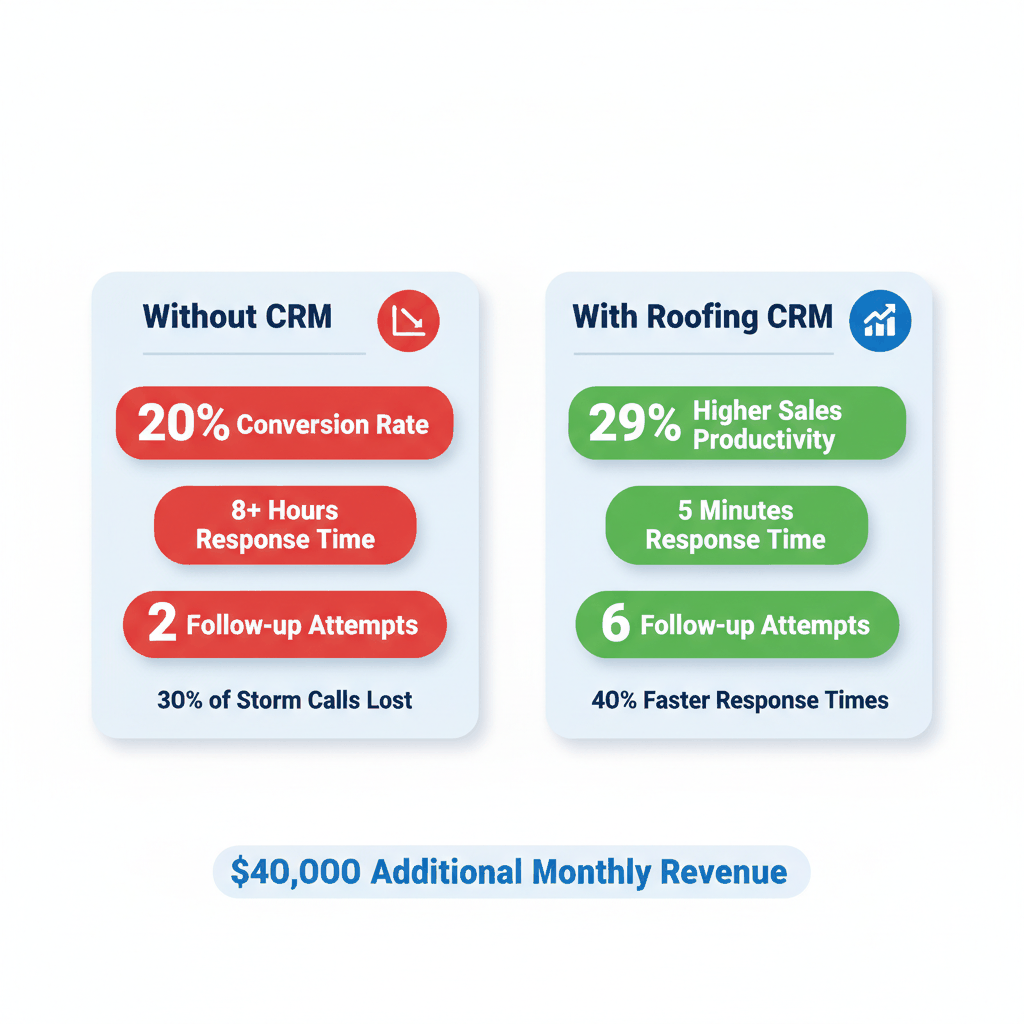
Are you losing roofing leads while your competitors close more deals? You're not alone. Most roofing companies lose up to 30% of storm calls due to missed calls and slow follow-up.
The difference between struggling and thriving roofing companies isn't just better marketing. It's having systems that capture every lead, follow up fast, and close more deals. That's where a roofing CRM becomes your secret weapon.
Roofing contractors using CRM software report 29% more sales productivity and 27% better customer satisfaction rates. The key is choosing the right platform and setting it up correctly.
This guide shows you exactly how to select, implement, and optimize a roofing CRM that transforms your lead management and boosts your bottom line.
Table of Contents
Generic CRMs don't understand roofing. You need systems built for storm response, insurance claims, and field estimates. A roofing CRM tracks every lead from first contact through final payment.
The cost of poor lead management is staggering. Research shows that 78% of customers choose the contractor who responds first. Yet most roofing companies take 8+ hours to respond to new leads.
Speed matters more than you think. Leads contacted within 5 minutes are 21 times more likely to convert than those contacted after 30 minutes. That's why successful roofing companies prioritize immediate response systems.
Best Roofing grew from $6 million to $60 million in revenue by implementing proper CRM systems. Their secret wasn't spending more on marketing. They captured more value from existing leads.
Here's what proper roofing lead management delivers:
40% faster response times with automated lead routing
25% higher conversion rates through structured follow-up
30% recovery of previously lost leads
Reduced administrative time by hours per week
Better customer satisfaction through consistent communication
The math is simple. If you're generating 100 leads per month and closing 20%, that's 20 jobs. Improve your conversion rate to 25% through better systems, and you gain 5 additional jobs monthly. At $8,000 average job value, that's $40,000 more revenue per month.
Not all CRMs work for roofing contractors. You need platforms that handle storm response, insurance workflows, and mobile field operations. Here are the top options for 2026.
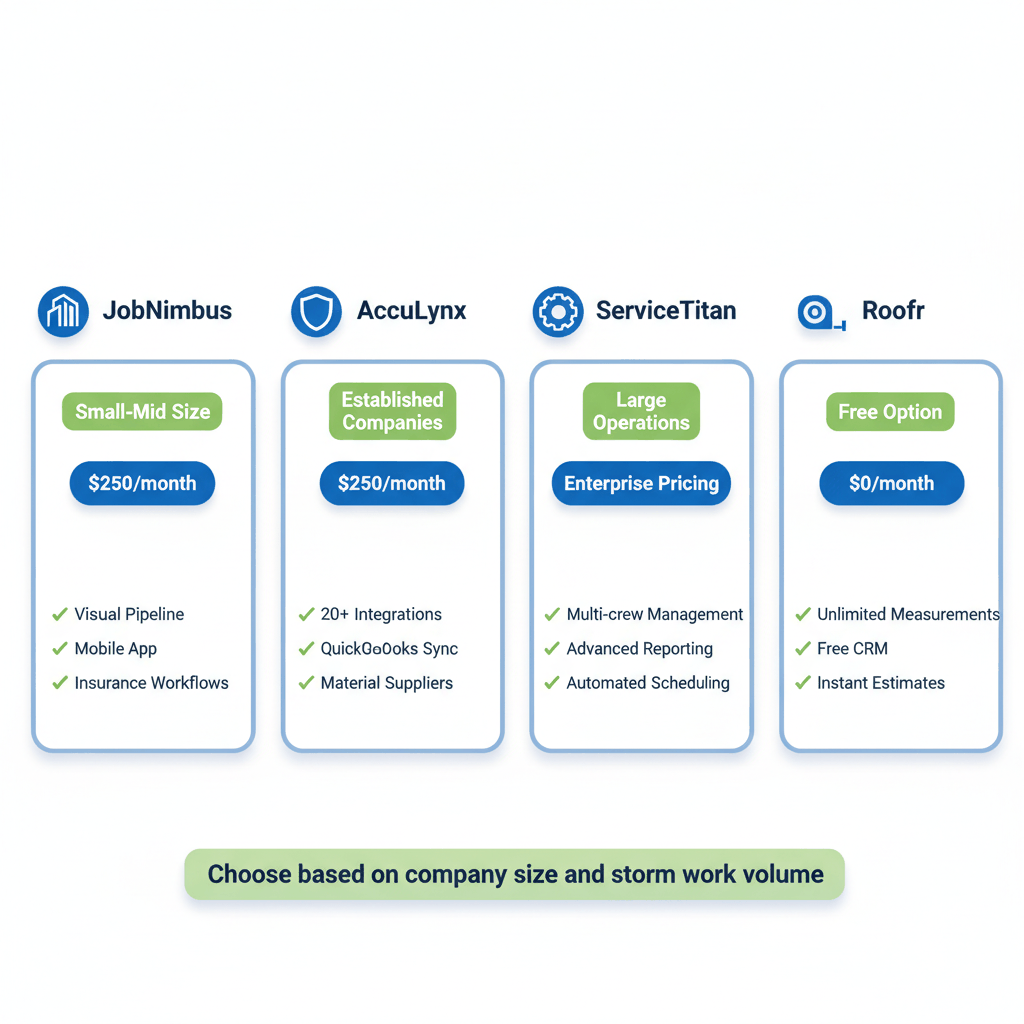
JobNimbus combines lead tracking, job management, and insurance workflows in one platform. It gives your team a visual pipeline and mobile app that works in the field.
Perfect for storm and insurance work with teams of 3-20 reps. The visual pipeline makes it easy to see where every job stands. Plus, the mobile app lets your team update records from the roof.
AccuLynx offers deep roofing functionality and supplier integrations. Their Essential plan starts at $250/month and includes everything needed to get organized and win more jobs.
The platform provides over 20+ integrations with key industry providers. This includes material suppliers, measurement software, and accounting platforms like QuickBooks.
ServiceTitan works best for roofing companies with multiple crews and complex operations. The multi-option estimate builder helps close more jobs at higher average tickets.
The platform automates business reporting, job progress updates, and technician scheduling. This makes day-to-day management much more efficient for larger operations.
Roofr offers unlimited measurements at $0/month. Their CRM integrates with instant estimating, proposals, and material ordering. Good starting point for smaller companies testing CRM benefits.
Proper setup determines whether your CRM becomes a revenue driver or expensive paperweight. Follow this proven implementation framework.
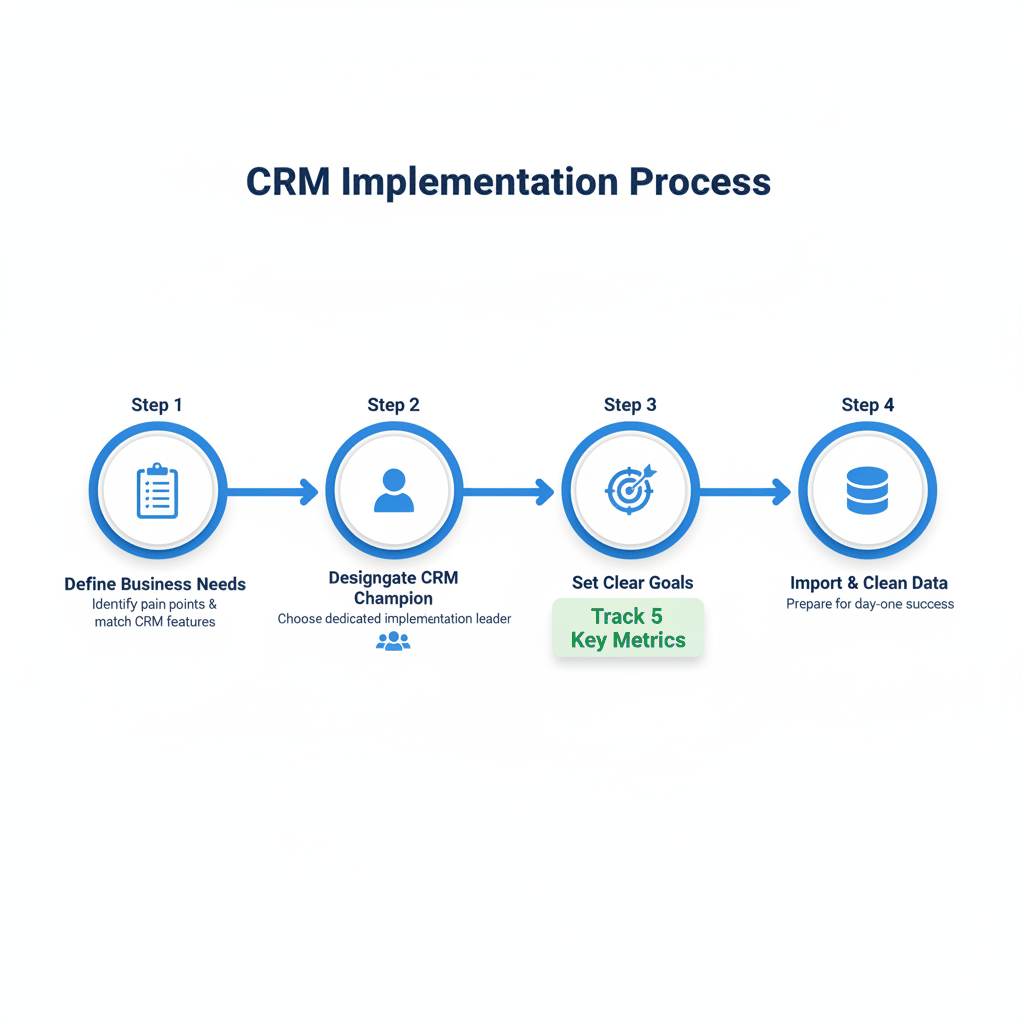
Start by identifying your biggest pain points. Are you missing leads due to slow response? Losing track of follow-ups? Struggling with estimate delivery?
Different roofing CRM features solve different problems:
Lead capture automation for response speed issues
Follow-up sequences for conversion problems
Mobile estimating for field efficiency
Insurance workflows for storm work
Material ordering for job management
Match your needs to platform strengths. Don't pay for features you won't use. Focus on solving your top 3 operational challenges first.
Choose one person to lead the implementation. This should be someone who understands your sales process and has time to focus on setup.
Your CRM champion handles research, coordinates training, and ensures everyone adopts the new system. Without dedicated leadership, CRM projects fail 70% of the time.
Define specific, measurable targets. Want faster response times? Aim for under 5 minutes. Want better follow-up? Target 6 attempts per lead over 30 days.
Track these key metrics:
Average response time to new leads
Lead conversion rates by source
Number of follow-up attempts per lead
Time from estimate to signed contract
Revenue per lead by sales rep
Gather all existing customer and prospect information. Clean up duplicate entries, standardize formatting, and verify contact details before importing.
Most CRMs offer data import assistance. Take advantage of this service. Clean data from day one prevents major headaches later.
Your roofing lead management system determines how many prospects become paying customers. The difference between 20% and 35% conversion rates is systematic follow-up.
Speed kills deals or saves them. 85% of customers who don't get an answer won't call back. They'll contact a competitor who answers immediately.
Set up this response protocol:
Automated confirmation within 60 seconds of lead submission
Personal phone call within 5 minutes during business hours
Follow-up text if call goes to voicemail
Email with company information and next steps
Your automated message should say: "Thank you for your roofing inquiry! Our team will contact you within 15 minutes during business hours to discuss your project."
Most roofing leads require 5-7 follow-up attempts before conversion. Yet most sales teams stop after just 2 attempts. This is where money gets lost.
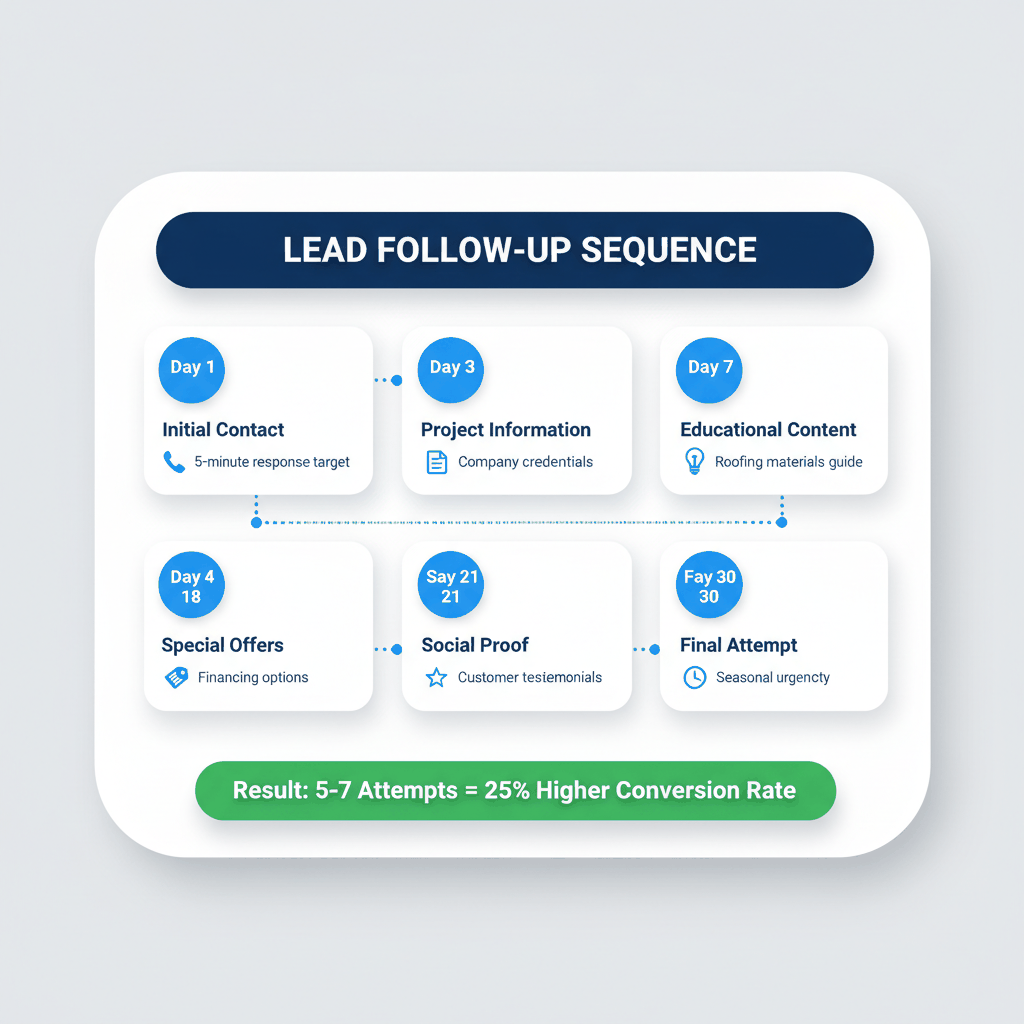
Create a 30-day follow-up sequence that provides value at each touchpoint:
Day 1: Initial contact and appointment scheduling
Day 3: Project information and company credentials
Day 7: Educational content about roofing materials
Day 14: Special offers or financing options
Day 21: Customer testimonials and local references
Day 30: Final attempt with seasonal urgency
After 30 days, move leads to a quarterly nurture sequence. Don't abandon them completely. Market conditions change, and today's "not interested" becomes tomorrow's "ready to buy."
Different customers prefer different communication methods. Your CRM should track preferences and adjust accordingly.
Use this communication mix:
Phone calls for immediate needs and urgent situations
Text messages for appointment confirmations and quick updates
Email for detailed information and documentation
Direct mail for high-value prospects in your service area
Track response rates by channel. Some customers never answer phones but respond to texts immediately. Others prefer detailed emails. Adapt your approach based on individual preferences.
Your CRM should streamline every step from lead to signed contract. The faster you move prospects through your pipeline, the higher your conversion rates.
Not all leads are created equal. Storm-damaged roofs with insurance coverage convert at 60%+. General inquiries might convert at 15%. Your CRM should help prioritize high-value opportunities.
Score leads based on these factors:
Damage type (storm damage scores highest)
Insurance involvement (increases conversion likelihood)
Timeline urgency (active leaks need immediate attention)
Budget indicators (financing pre-approval signals readiness)
Geographic location (closer leads convert better)
High-scoring leads get immediate personal attention. Lower-scoring leads enter automated nurture sequences until they show buying signals.
Roofing sales happen on-site, not in the office. Your CRM must work flawlessly on mobile devices. Field reps need to access customer information, take photos, and update records from the roof.
Essential mobile features include:
Offline access to customer data and product information
Photo capture with automatic job linking
Digital contract signing on tablets
Real-time estimate generation and delivery
GPS tracking for efficient scheduling
CompanyCam integration has become standard for leading roofing companies. Best Roofing credits photo documentation with saving hours per week and improving accountability.
Time kills deals. The faster you deliver professional estimates, the higher your closing rate. Manual estimating creates delays that lose jobs to faster competitors.
Modern roofing CRMs include:
Satellite measurement integration for instant material calculations
Branded proposal templates with multiple option pricing
Digital signature capability for immediate contract execution
Automatic material ordering based on signed contracts
Progress tracking from sale through completion
The goal is same-day estimates delivered professionally. Homeowners should be able to review, compare options, and sign contracts without waiting for callbacks or office scheduling.
Your CRM is only valuable if it improves business results. Track these metrics to ensure your system drives revenue growth.
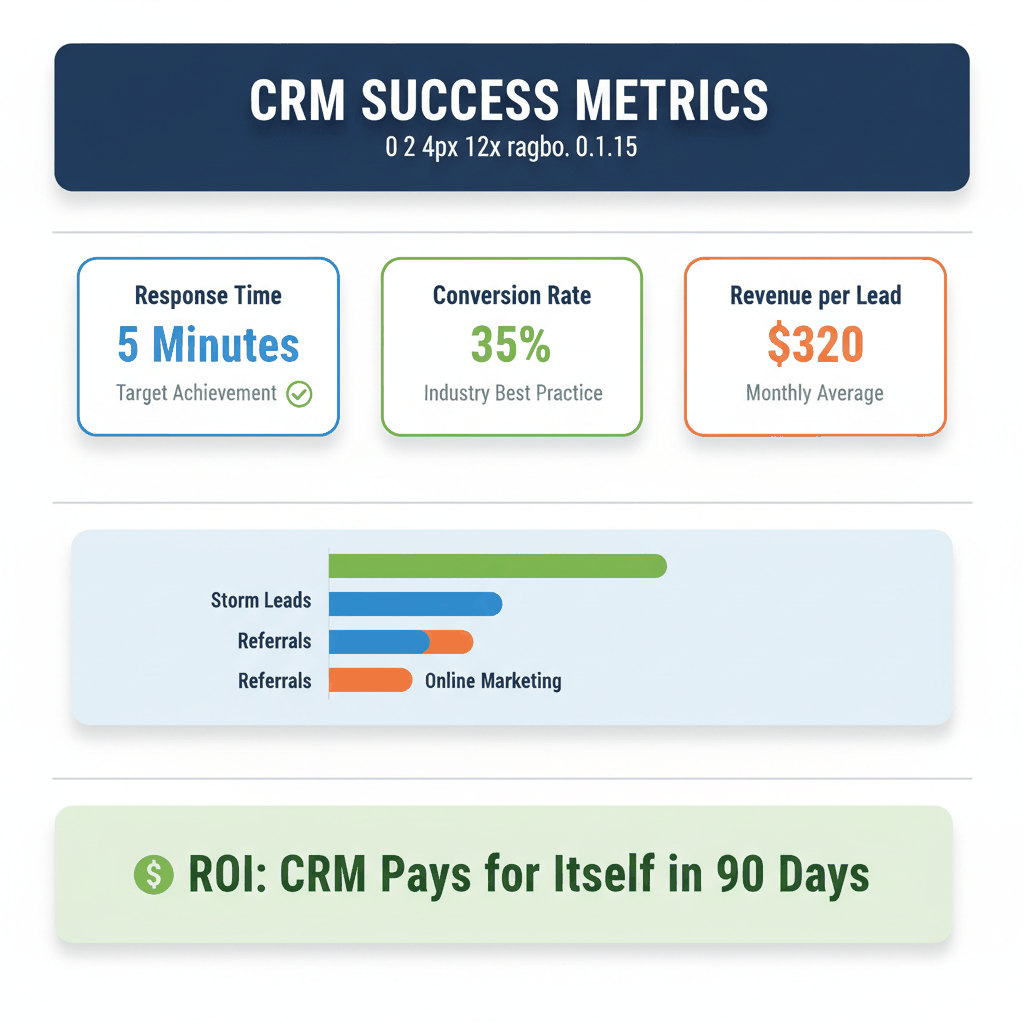
Monitor conversion rates by lead source, sales rep, and time period. Identify which marketing channels produce the highest-quality leads and double down on those sources.
Key conversion metrics include:
Overall lead-to-customer conversion rate
Conversion rate by lead source (organic, paid ads, referrals)
Time from first contact to signed contract
Average deal size by conversion path
Seasonal conversion rate variations
Industry benchmarks show good roofing companies convert 25-35% of qualified leads. Exceptional companies hit 40%+ through superior follow-up and sales processes.
Speed matters more in roofing than most industries. Storm damage creates urgency. Insurance deadlines add pressure. Fast response wins jobs.
Track these timing metrics:
Average time from lead submission to first contact
Percentage of leads contacted within 5 minutes
Number of follow-up attempts before conversion
Time between estimate delivery and decision
Response rates by communication channel
Set aggressive targets. Aim for 90%+ of leads contacted within 5 minutes during business hours. Use answering services or mobile apps to maintain responsiveness during peak periods.
Your CRM should clearly show which activities generate the most revenue. This helps allocate resources to the highest-return activities.
Calculate these financial metrics:
Revenue per lead by marketing channel
Cost per acquisition including CRM subscription costs
Average job value by lead source
Lifetime customer value from referrals and repeat business
Sales rep productivity measured in revenue per month
A properly implemented roofing CRM should pay for itself within 90 days through improved conversion rates and operational efficiency.
What's the best roofing CRM for small companies?
JobNimbus is the top choice for small to mid-sized roofing companies. It combines lead tracking, job management, and mobile access in one affordable platform. Roofr offers a good free option for companies just starting with CRM systems.
How much should a roofing CRM cost per month?
Expect to pay $50-$300 per user per month depending on features. AccuLynx starts at $250/month for their Essential plan. The ROI typically justifies the cost within 90 days through better lead conversion rates.
Can a roofing CRM help with storm response?
Yes, specialized roofing CRMs include storm response features like hail mapping, insurance claim workflows, and rapid lead intake systems. These tools help capture more storm leads and process them faster than competitors.
How long does roofing CRM implementation take?
Plan for 30-60 days for full implementation including data migration, team training, and process optimization. However, you can start capturing benefits within the first week by improving lead response times.
What's the biggest mistake in roofing lead management?
Slow response times kill more deals than anything else. 78% of customers choose the contractor who responds first, yet most roofing companies take hours to follow up on new leads. Fix response speed first, then optimize other processes.
Ready to get exclusive roofing leads? Sign up for free with ResultCalls today!

Hello everyone! My name is Alex and I write these blogs to help educate small business owners on different ways to grow their business. My goal is to make lead generation as easy as possible for you. After reading these blogs, I hope you leave with some actionable steps that will get you closer to growing your business :)