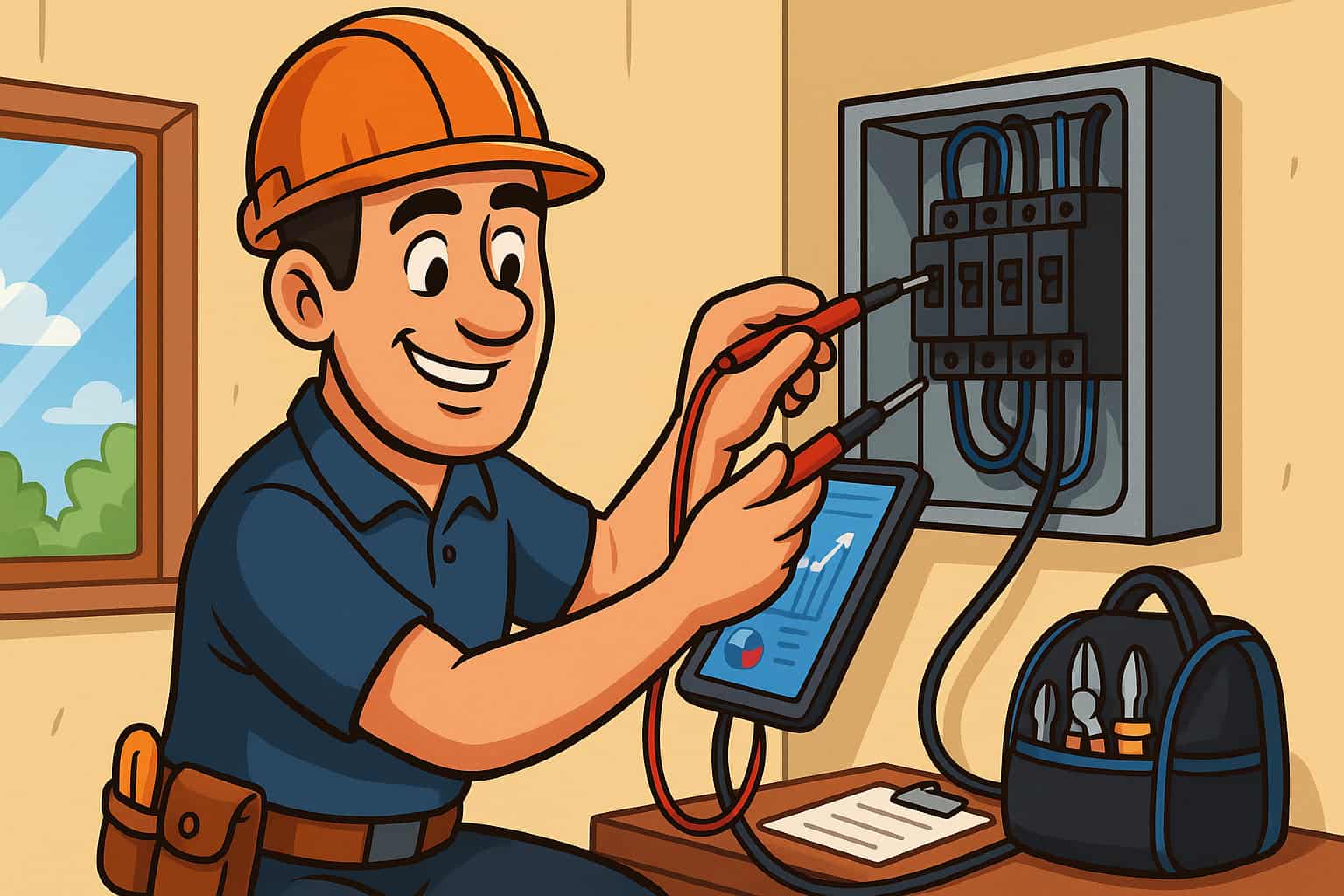
Running an electrical business used to mean relying on word-of-mouth referrals and Yellow Pages ads. Those days are gone. Today's homeowners search online when they need an electrician. They're on Google at 9 PM when they smell burning plastic. They're on Facebook comparing electricians for panel upgrades.
The problem is that electrician paid ads cost an average of $12.18 per click in 2025. Cost per lead averages $93.69. In competitive cities, these numbers can double. If you don't know what you're doing, you'll burn thousands of dollars with nothing to show for it.
This guide shows you how to run profitable electrician paid ads. You'll learn which platforms work best. You'll discover how to calculate your break-even numbers. You'll see exactly what successful electrical contractors are doing right now to generate consistent leads.
Let's turn your ad spend into booked revenue.
Understanding Electrician Advertising Economics
Google Local Services Ads Strategy
Google Search Ads for Electricians
Facebook Ads for Electrical Contractors
How AI is Changing Search Advertising
Tracking Your Advertising ROI
Electrician Marketing Budget Guide
Frequently Asked Questions
Before you spend a dollar on ads, you need to understand your numbers. Most electrical contractors lose money on paid ads because they don't know their break-even point.
Not all searches are equal. Understanding search intent saves you money.
Emergency searches come from homeowners who need help now. They search for "emergency electrician" or "24 hour electrician near me." These clicks cost $15 to $35 each. But conversion rates are high because people are desperate. If you answer the phone, you book the job.
Service-specific searches come from homeowners planning projects. They search for "panel upgrade cost" or "EV charger installation." These clicks cost $10 to $20. Users are comparison shopping. They'll call multiple electricians. Your booking rate depends on fast follow-up and building trust.
Informational searches come from DIY homeowners. They search "how to wire a switch" or "electrician salary." These clicks cost less but convert at near zero. These are budget killers. You must block these searches in your campaigns.
Here's the formula that determines if you can afford electrician paid ads.
Start with your average job value. Let's say it's $650 for a typical service call. Your gross margin after labor and materials is 45%. That's $292.50 in gross profit per job.
If you want a 20% profit margin on marketing, you can spend up to $234 to acquire one customer. That's $292.50 times 0.80.
Now factor in your booking rate. If your dispatch team books 35% of leads, your maximum cost per lead is $82. That's $234 times 0.35.
The problem is that industry average cost per lead is $93.69. You're losing money at average performance.
To become profitable, you need to do one of three things:
Increase your average job value by training technicians to upsell
Improve your booking rate with better call handling
Lower your cost per lead with smarter ad campaigns
Most successful electrical contractors do all three. That's how they turn electrician lead generation into a profit center.
Google Local Services Ads should be your foundation. These ads appear at the very top of search results with the green "Google Guaranteed" checkmark.
You only pay when someone calls or messages you. No payment for worthless clicks. This shifts risk away from you.
The Google Guarantee requires background checks and license verification. This creates trust. Homeowners feel safer calling you than calling an unknown electrician from regular ads.
Local Services Ads appear above everything else. They show before regular Google Ads. They show before the map pack. You get first shot at every lead.
Google doesn't rank Local Services Ads by who pays the most. They use a hidden score based on customer experience.
Responsiveness matters most. Google tracks every call. Answer within 30 seconds and you climb rankings. Let calls go to voicemail and you drop fast. An electrician who answers calls immediately will outrank one with twice as many reviews.
Review velocity beats total review count. A 4.8 rating with 150 reviews where the most recent was posted yesterday beats a 5.0 rating with 20 old reviews. Google wants to see that you're actively serving customers.
Proximity to the searcher matters. The closer your business location to the searcher, the higher you rank. This is why service area settings need careful configuration.
Operating hours give you an edge. List 24/7 availability and you get a ranking boost during evenings and weekends. This is gold for emergency electrical work when competitors' ads are turned off.
Set your weekly budget higher than your actual target. This sounds crazy but it works. Set a $10,000 weekly budget even if you only want to spend $2,000. Since you pay per lead, not per click, the actual spend is limited by market demand. This prevents Google from throttling your ad impressions.
Manage your job types carefully. In the dashboard, you can toggle specific services on and off. Turn off low-value services like ceiling fan repair if the margin is too thin. Focus on high-ticket services like panel upgrades and whole-house rewiring. This trains the algorithm to send you better jobs.
Dispute invalid leads religiously. Request credit for leads that are spam, outside your service area, or for services you don't offer. Regular disputing can lower your effective cost per lead by 15% to 20%.
Local Services Ads have limited inventory. Only 2-3 ads show at once. Google Search Ads let you scale without limits.
Most electrical contractors throw all their keywords into one campaign. This creates chaos. Your ads compete against each other. Your budget gets wasted on wrong searches.
Build separate campaigns for each service type. Create an emergency campaign with high bids for "emergency electrician" and "power outage repair." Run it 24/7. This captures the user who needs help right now.
Build a residential projects campaign for "panel upgrade" and "EV charger installation." Run it during business hours. Use lower bids. These users are comparison shopping.
Create a brand protection campaign. Bid on your company name. This is cheap but critical. It stops competitors from stealing referrals who search for your business specifically.
Your ad copy must match what the user searched for. If they search "Emergency Electrician Austin," your headline should say "Emergency Electrician Austin." Use their exact words.
Focus on reducing fear and friction. Homeowners calling an electrician are worried about safety and cost. Address both immediately.
Use all ad extensions. Call extensions let mobile users tap to call. Sitelink extensions show links to "Coupons" and "Reviews." Location extensions display your address and distance. These extensions make your ad bigger and more trustworthy.
This is where most electrical contractors waste the most money. Without negative keywords, Google shows your ads to people searching for jobs, training, and DIY advice.
Block all employment searches: career, careers, salary, wage, pay, job, jobs, hiring, apprenticeship, resume.
Block all education searches: school, college, training, course, class, certification, exam, how to become.
Block all DIY searches: how to, diy, do it yourself, tutorial, video, guide, diagram, schematic.
Block automotive searches: car, auto, automotive, truck, alternator, 12v, battery, trailer.
Block retail searches: supply, store, wholesale, parts, home depot, lowes, wire price, breaker cost.
Adding these negative keywords before launch can save 20% to 30% of your budget immediately. This alone can make the difference between profit and loss.
Start with Manual CPC for new campaigns. This gives you control. Bid $25 for "emergency electrician" and $8 for "light switch repair."
Switch to Target CPA once you have 30+ conversions in 30 days. Tell Google "I want to pay $60 per lead" and it optimizes automatically. This requires accurate conversion tracking.
Avoid Maximize Clicks. This strategy optimizes for traffic volume, not lead quality. You'll get lots of clicks from people who will never hire you.
Google Ads capture existing demand. Someone searches and finds you. Facebook Ads create demand. You find homeowners before they even know they need you.
Facebook works best for proactive services. Panel upgrades, generator installations, EV charger setups, and aesthetic lighting all work well. These are planned purchases, not emergencies.
Most homeowners don't search for "panel upgrade" until their panel fails catastrophically. Facebook lets you educate them about dangerous panels before the failure happens. You create the desire.
Generic stock photos fail on social media. You need authentic, attention-grabbing content.
Safety-based creative works best. Post photos of melted wires or burnt outlets from actual local homes. Caption it "Is your home hiding this fire hazard?" This triggers primal fear and gets clicks.
Before-and-after content performs well. Show a messy, dangerous fuse box transformed into a clean, modern breaker panel. Visual proof builds desire.
Team humanization builds trust. Post photos of your uniformed technicians, your truck fleet, or the owner. This matters because homeowners invite strangers into their homes. They need to trust you first.
Short video content outperforms polished ads. Film a technician explaining why a breaker trips using just a smartphone. Authentic, rough content feels like peer advice rather than corporate advertising.
Facebook's targeting has limitations after iOS14 privacy changes. But you can still reach the right people.
Use geographic pin-dropping. Target specific high-income zip codes. Focus on neighborhoods with older homes built between 1960 and 1990. These homes need rewiring and panel upgrades.
Upload your customer list. Export emails and phone numbers from your CRM. Facebook creates a custom audience of past customers. Use this for cross-selling and upsells.
Create lookalike audiences. Facebook analyzes your past customers and finds similar people in your area. This is how you scale beyond your current customer base.
Retarget website visitors. Show ads to people who clicked your Google Ads but didn't call. This omnichannel approach keeps you top-of-mind until they're ready to book.
Google's AI Overviews are reshaping the search landscape. These AI-generated answers appear at the top of search results.
When an AI Overview appears, click-through rates drop by over 60%. Users find their answers without clicking any result. This includes paid ads.
For informational searches like "Why is my breaker buzzing," AI answers the question completely. Users never visit your website. This eliminates an entire category of potential traffic.
Shift more budget to transactional keywords. AI Overviews appear most often on informational searches. High-intent searches like "electrician near me" and "emergency electrician" still show traditional ads prominently.
Optimize to get cited in AI summaries. Brands that appear as sources in AI Overviews see a 35% increase in organic clicks and a 91% increase in paid clicks. Create authoritative content about local electrical codes and safety issues.
Increase investment in Local Services Ads. These appear above AI Overviews. They're becoming more valuable as traditional ad positions lose visibility.
Diversify beyond Google. Relying only on Google Search is riskier than ever. Balance your budget across Local Services Ads, traditional Google Ads, and social media platforms.
Running ads without precise tracking is financial negligence. Most electrical sales happen over the phone, not online. This makes tracking complex but essential.
Use a call tracking service like CallRail. This technology swaps phone numbers on your website based on where visitors came from.
A visitor from Google Ads sees one number. A visitor from Facebook sees a different number. A visitor from organic search sees a third number. Every call gets attributed to its source.
This shows you exactly which keywords drive calls. You discover that "emergency electrician" generated 15 calls while "electrician services" generated only 2. Now you know where to invest more budget.
The gold standard is closed-loop attribution. This connects your ads to actual revenue, not just phone calls.
Here's how it works. A lead calls from a Google Ad. CallRail captures the Google Click ID and passes it to your CRM like ServiceTitan or Housecall Pro. Your dispatcher books the job. Your technician completes a $4,500 panel upgrade.
The CRM sends the revenue data back to Google Ads. Google now knows that specific click generated $4,500 in revenue. It optimizes for high-revenue leads, not just phone calls.
This is how sophisticated electrical contractors separate themselves from amateurs. They track every dollar from search to invoice.
Privacy regulations limit cookie tracking. Enhanced Conversions let you send customer data like email and phone number securely to Google. This helps recover lost attribution when people switch devices.
Someone might search on their phone but call from their desk phone. Enhanced Conversions connects these actions and gives you accurate data.
The question every electrical contractor asks is "How much should I spend?" The answer depends on your growth stage.
For emerging contractors with $1,500 to $3,000 monthly, focus on survival and cash flow. Spend 70% on Local Services Ads because they're low risk. Spend 30% on Google Search Ads targeting only emergency keywords.
For growing contractors with $5,000 to $10,000 monthly, focus on expansion. Split 40% to Local Services Ads, 40% to Google Search Ads across all services, and 20% to Facebook for retargeting and brand awareness.
For market leaders with $15,000+ monthly, focus on market dominance. Allocate 30% to Local Services Ads, 40% to comprehensive Google Search campaigns, and 30% to brand building through video and social media.
Don't run Google Smart Campaigns without oversight. These automated campaigns lack the negative keyword control you need. They waste money on job searches and DIY queries.
Don't group all services into one campaign. A user searching for "EV charger installation" has completely different intent than someone searching "emergency repair." Different services need different strategies and budgets.
Don't send traffic to an unanswered phone. If you can't answer calls immediately, pause your ads. Burning ad spend while calls go to voicemail is throwing money away.
Don't forget negative keywords. Excluding DIY, salary, and training searches is the single biggest waste reduction you can make.
Best Quality Electric in California implemented ServiceTitan for tracking and automated review generation. Revenue nearly doubled from $1.5M to $2.8M in the first year. They expanded from 3 trucks to 9 trucks. The key was ruthlessly tracking ROI and cutting underperforming channels.
An Arlington, Texas residential electrician adopted the "Full Circuit Method" combining Local SEO with high-intent Google Ads. In 60 days, they doubled booked appointments. By optimizing campaigns and removing negative keywords, they reduced cost per lead from $91 to under $40.
These results come from treating electrician lead generation as data engineering, not just advertising. Track everything. Test continuously. Cut what doesn't work. Double down on what does.
Electrician paid ads average $12.18 per click for Google Ads in 2025. Cost per lead averages $93.69 across all platforms. Emergency keyword clicks can cost $15 to $35. Local Services Ads charge per lead rather than per click, with costs varying by market. Your actual costs depend on your location, competition, and campaign optimization.
Google Search Ads charge per click whether the person calls or not. Local Services Ads charge only when someone contacts you. Local Services Ads show at the very top with the Google Guaranteed badge, creating more trust. They also have limited inventory, while Search Ads can scale infinitely. Most successful electrical contractors use both platforms together.
Yes, but for different purposes than Google. Facebook ads work best for planned services like panel upgrades, generators, and EV chargers. They create demand rather than capturing existing demand. Use safety-focused creative showing dangerous electrical conditions. Target neighborhoods with older homes. Facebook ads complement Google's emergency-focused campaigns.
Use call tracking software like CallRail to attribute calls to specific ads and keywords. Integrate with your CRM (ServiceTitan or Housecall Pro) to track which leads turn into revenue. This closed-loop tracking shows exactly which campaigns generate profit. Without tracking, you're guessing which ads work and which waste money.
Local Services Ads can generate calls within days once your profile is verified and active. Google Search Ads typically need 2-4 weeks to gather data and optimize. Facebook ads require 4-6 weeks to test creative and find the right audience. Budget for at least 90 days to properly test and refine any advertising strategy.
Ready to turn your electrician paid ads into a predictable revenue stream? Contact ResultCalls today to get pay per call electric leads!

Hello everyone! My name is Alex and I write these blogs to help educate small business owners on different ways to grow their business. My goal is to make lead generation as easy as possible for you. After reading these blogs, I hope you leave with some actionable steps that will get you closer to growing your business :)