
Running a dental practice without Google Ads is like having the best dental chairs in town but keeping your doors locked. You might offer amazing care, but if patients can't find you, your schedule stays empty.
Most dental practices struggle with patient acquisition in 2026. Competition is fierce, and traditional marketing methods don't work like they used to. You need a system that connects you with patients actively searching for dental care right now.
Dental Google Ads solve this problem. They put your practice in front of high-intent patients at the exact moment they search for dental services. With proper setup and management, dental Google Ads deliver 300-500% ROI.
This guide shows you everything you need to know about dental Google Ads in 2026. You'll learn realistic costs, proven strategies, and how to avoid the mistakes that waste thousands in ad spend.
Table of Contents
Google Ads connect you with patients at the perfect moment. They search "dentist near me" or "emergency dental care," and your practice appears at the top. This timing creates powerful results.
The numbers prove this works. Average cost-per-click for dental keywords ranges from $6.50-$9.75 in competitive markets. That investment delivers average conversion rates of 4.2% for dental ads.
Consider the lifetime value perspective. When the average new patient is worth $1,500 to $3,000 in lifetime value, paying $50-80 per lead becomes an obvious investment. The math works in your favor.
Dental clinics face intense competition online. Google Ads give you instant visibility at the top of search pages. This placement is crucial because people usually only look at the top search results.
SEO takes months to show results. Google Ads work immediately. Your practice can appear above competitors who have been building their online presence for years.
Google Ads target people actively searching for dental services. These aren't casual browsers. They have dental problems and need solutions now.
This high intent translates to better conversion rates. Someone searching "tooth pain relief" or "dental implants near me" is ready to schedule an appointment. They just need to find the right dentist.
Well-managed Google Ads campaigns create predictable patient flow. You can forecast how many new patients you'll acquire based on your ad spend and conversion data.
This predictability helps with practice planning. You can adjust your budget up or down based on your capacity and growth goals. Want more patients? Increase the budget. Need to slow down bookings? Reduce spend temporarily.
Budget planning separates successful dental Google Ads from expensive failures. Most practices underestimate the investment required for meaningful results.
A realistic starting budget for dental Google Ads is $3,000-$5,000 per month in ad spend. Less than that produces thin data volume that's difficult to optimize effectively. Successful practices allocate 4-7% of gross revenue to total marketing.
For a practice generating $1 million annually, that's $40,000-$70,000 in total marketing spend. Google Ads should represent 20-40% of this budget, depending on your local market dynamics.
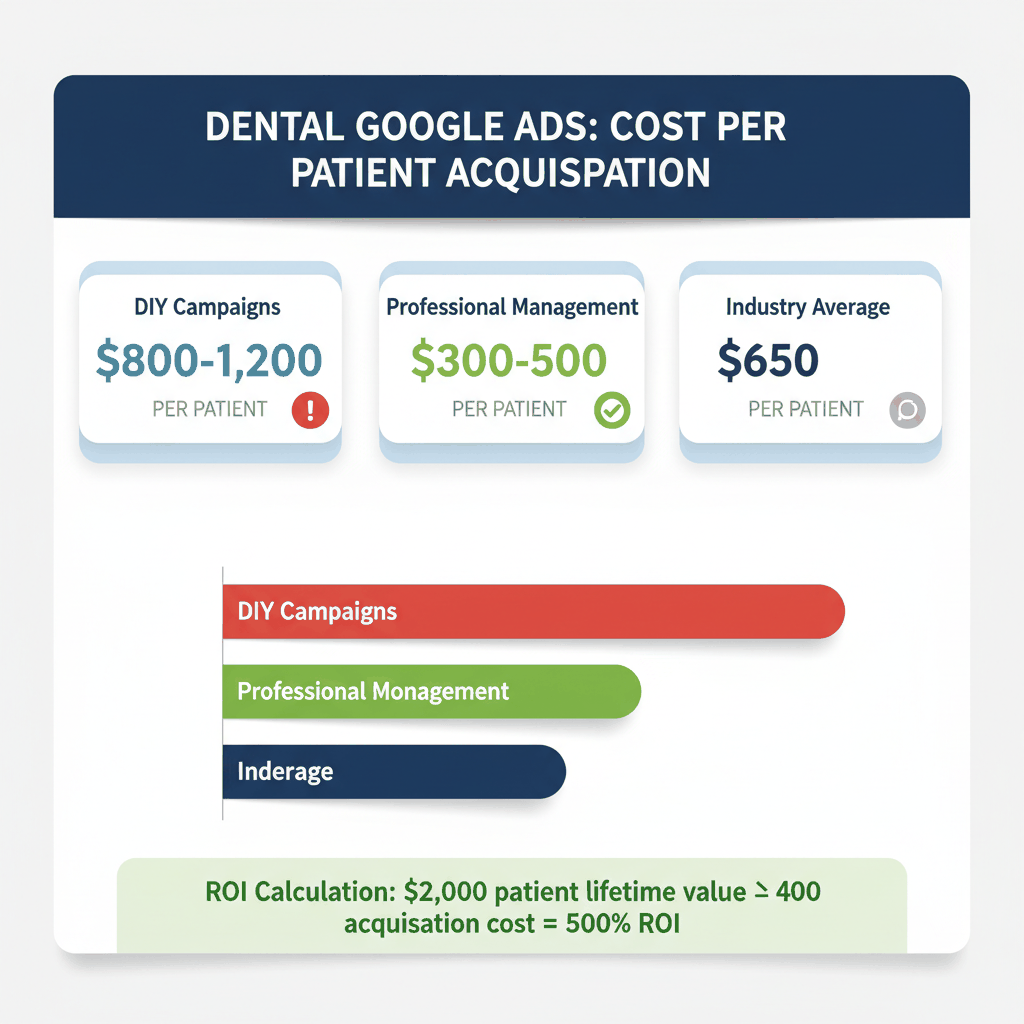
New patient acquisition via Google Ads costs $300-$500 per patient minimum with well-managed campaigns. DIY campaigns routinely exceed $1,000 per acquired patient.
At best, expect 6-10 new patients per month from ad spend alone. You won't see the 20-30 new patients many practices expect when starting out. Set realistic expectations to avoid disappointment.
The investment makes sense when you calculate lifetime value. Stop thinking about single appointments. A new patient might represent $2,000-$5,000 in lifetime revenue when you factor in ongoing care, family referrals, and additional procedures.
Location dramatically affects costs. Urban markets like Chicago or Atlanta have higher competition and click costs. Rural areas often have lower costs but smaller search volumes.
Research your local market using Google Keyword Planner. Look at average cost-per-click for terms like "dentist [your city]" and "dental implants [your city]." This gives you baseline budget expectations.
Limit location targeting to a 5-10 mile radius around your practice. Broader targeting wastes money on people who won't travel for dental care. In urban areas, a 20-mile radius could encompass millions of people who will never fight traffic for a cleaning.
Most dental Google Ads failures result from preventable mistakes. These aren't dramatic disasters but "death by a thousand cuts" that slowly drain budgets without delivering results.
Studies show that 75% of Google Ads budgets are misallocated due to targeting errors and lack of optimization. Learning these common mistakes helps you avoid expensive lessons.
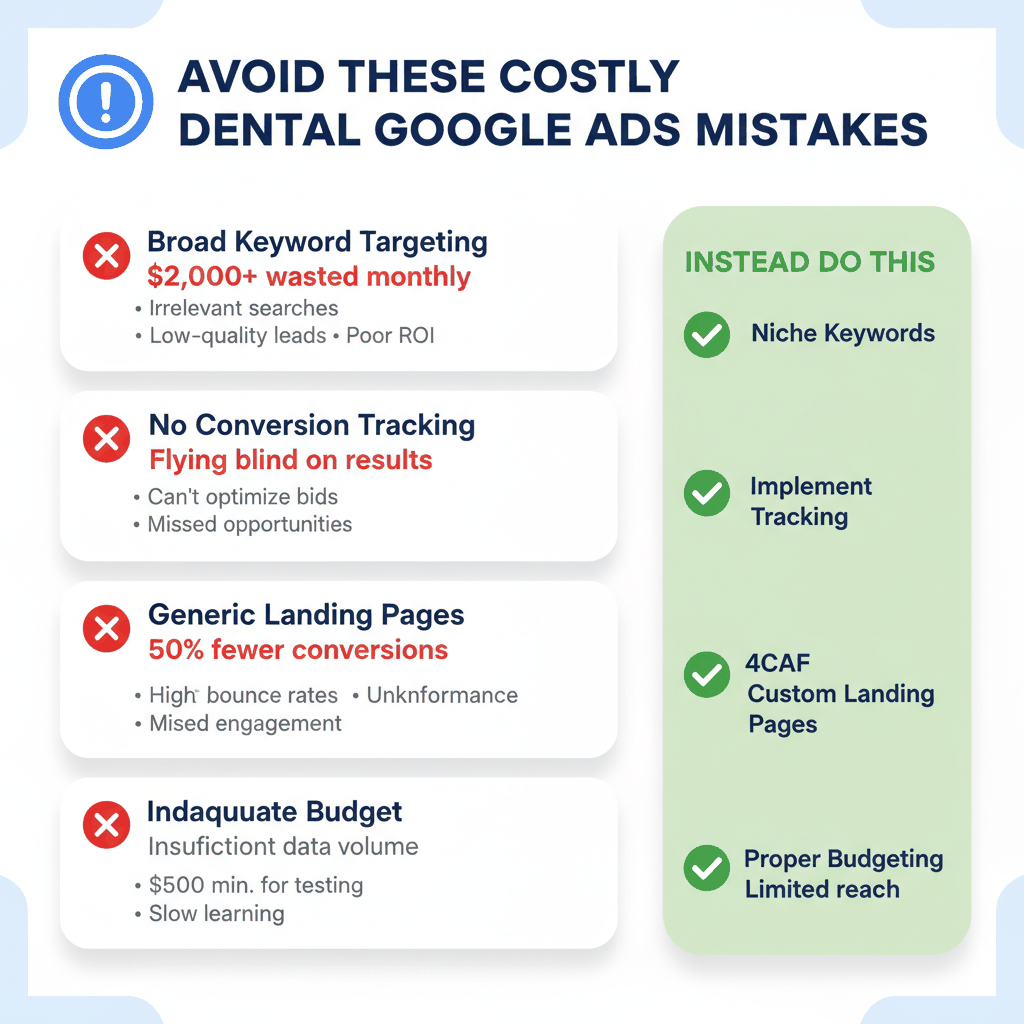
The most expensive mistake dentists make is targeting overly broad keywords without proper controls. Broad targeting allows Google to show ads for loosely related searches.
For example, targeting the broad keyword "dentist" might trigger ads for searches like:
Dentist job openings
Dental school requirements
Dentist memes or jokes
Dental supply companies
None of these represent someone looking to book an appointment. When practices allow broad targeting without negative keywords, budgets get consumed by irrelevant clicks.
Focus on high-intent keywords instead:
Dentist near me
Emergency dental care
Dental implants [city]
Teeth cleaning appointment
Most dental practices running Google Ads have no idea if clicks turn into booked appointments. They stare at impressions, clicks, and cost-per-click in dashboards without tracking actual results.
Without conversion tracking, those numbers are pretty wallpaper but useless for decisions. Spend $3,000 monthly and you don't know if that generates one patient or ten.
Proper tracking requires call tracking phone numbers for each campaign. Tools like CallRail or CallTrackingMetrics show exactly which ads generated calls and how many converted to appointments.
DIY campaigns routinely produce acquisition costs 3-5x higher than professionally managed ones. The knowledge gap isn't in starting campaigns but in landing page design, call tracking, negative keyword management, and continuous optimization.
Expect 60-90 days before campaigns produce reliable, actionable data. The first month is largely Google's algorithm learning and calibrating. Practices that quit in the first 30 days are throwing in the towel before there's enough data for optimization.
Sending all ad traffic to your homepage wastes conversions. Generic pages don't address the specific needs that brought people to search in the first place.
Create service-specific landing pages that match your ads. Someone searching "dental implants" should land on an implants page, not your general homepage. This relevance can boost conversions by up to 50%.
Successful dental Google Ads require strategic campaign structure and ongoing optimization. These proven strategies help you maximize results while controlling costs.
Professional dental lead generation services understand these nuances, but you can implement many strategies yourself with proper guidance.
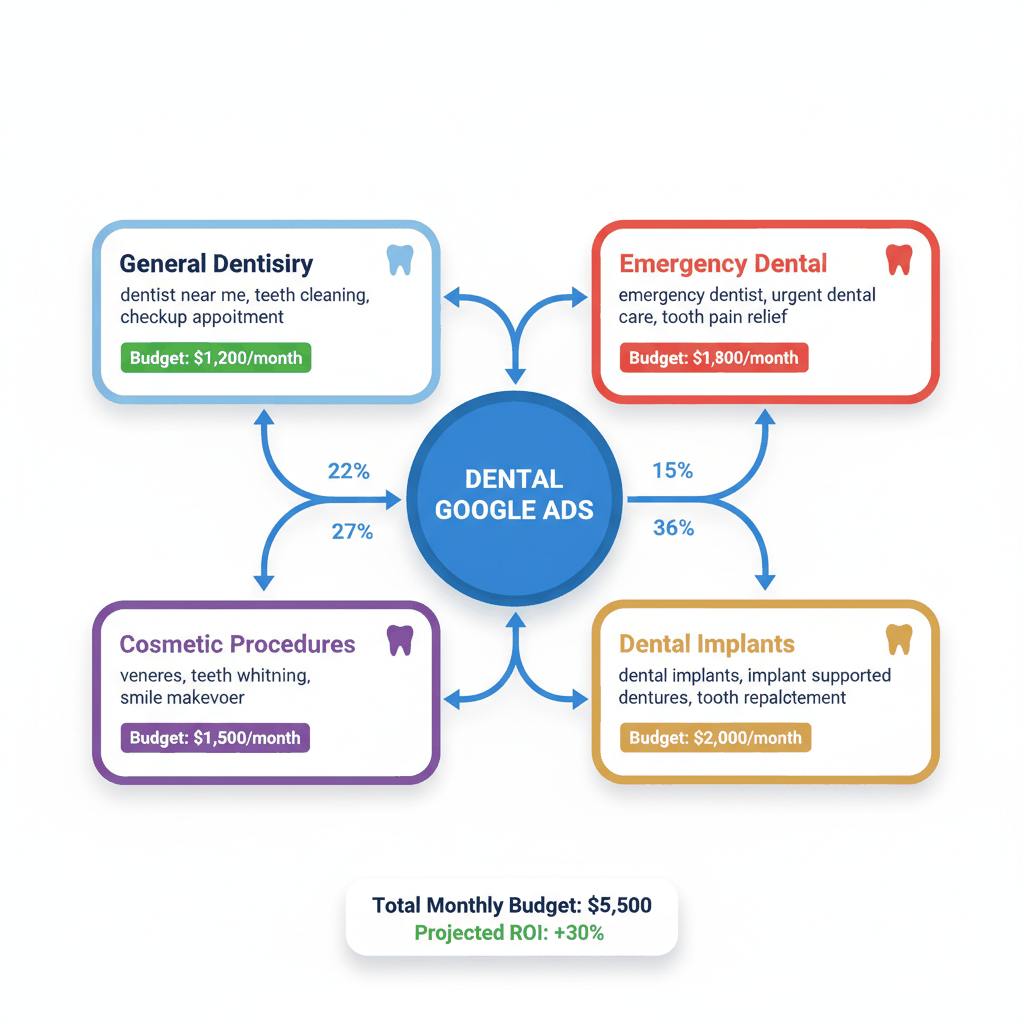
Organize campaigns by service type rather than throwing everything together. Create separate campaigns for:
General dentistry
Cosmetic procedures
Emergency dental care
Specialty services (implants, orthodontics)
This organization allows you to control budgets based on profitability and patient urgency. Emergency dental campaigns might get higher budgets because those patients convert quickly.
Use phrase match and exact match keywords when possible to improve targeting accuracy. Broad match keywords often trigger irrelevant searches that waste budget.
Start with exact match for your highest-value terms. Add phrase match variations as you gather data. Only use broad match with extensive negative keyword lists to prevent waste.
Quality Score matters more than budget size. Improving ad relevance and landing page experience can cut costs by 50% while maintaining top positions.
Focus on these Quality Score factors:
Ad relevance to search terms
Landing page experience and loading speed
Expected click-through rate
High Quality Scores reward you with lower costs and better ad positions. It's Google's way of encouraging relevant, helpful advertising.
Google's AI-driven bidding strategies now outperform manual bidding in most scenarios. Target CPA (Cost Per Acquisition) and Maximize Conversions work well for dental practices.
Manual CPC bidding is effectively obsolete for dental practices. Google has more data about searcher intent than you'll ever access. Let the machine learning optimize your bids.
Tracking infrastructure separates profitable campaigns from money-wasting experiments. You need systems that follow the complete patient journey from click to appointment to treatment.
For dental Google Ads to scale in 2026, tracking must follow the real business path: Click → Lead → Booked → Showed → Treatment Accepted → Revenue. Once you track this complete funnel, optimization becomes obvious.
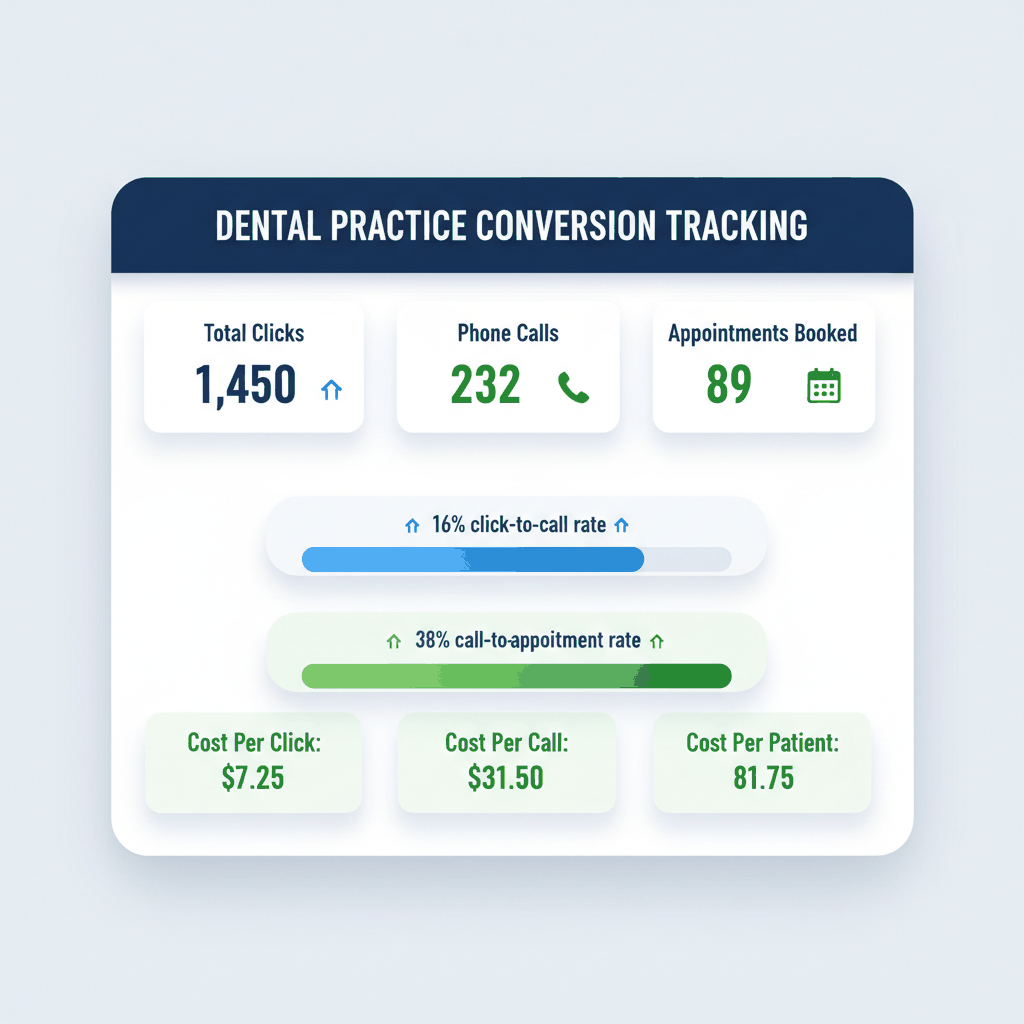
Use separate trackable phone numbers for each campaign so you know exactly which ads generate calls. Call tracking tools like CallRail show which campaigns drive appointments versus general inquiries.
Advanced call tracking setup should include:
Dynamic number insertion on your website
Call recording for quality monitoring
Call scoring that identifies actual appointment bookings
This feedback loop shows which campaigns generate kept appointments and treatment acceptance, not just phone calls.
Track these metrics to ensure your Google Ads budget works effectively:
Cost per lead (CPL): Total spend divided by new patient inquiries
Cost per acquisition (CPA): Total spend divided by actual new patients
Return on ad spend (ROAS): Revenue generated divided by ad spend
Set up Google Ads conversion tracking for online form submissions and phone calls. Import this data back into Google Ads to optimize for actual business results.
Track offline conversions by importing appointment and treatment data back into Google Ads. This shows which keywords and campaigns generate the highest lifetime value patients.
Use Google Analytics 4 to track the complete patient journey across multiple touchpoints. Patients might see your ad, visit your website multiple times, then call to schedule.
Real-world results demonstrate what's possible with properly managed dental Google Ads campaigns. These case studies show both successes and lessons learned.
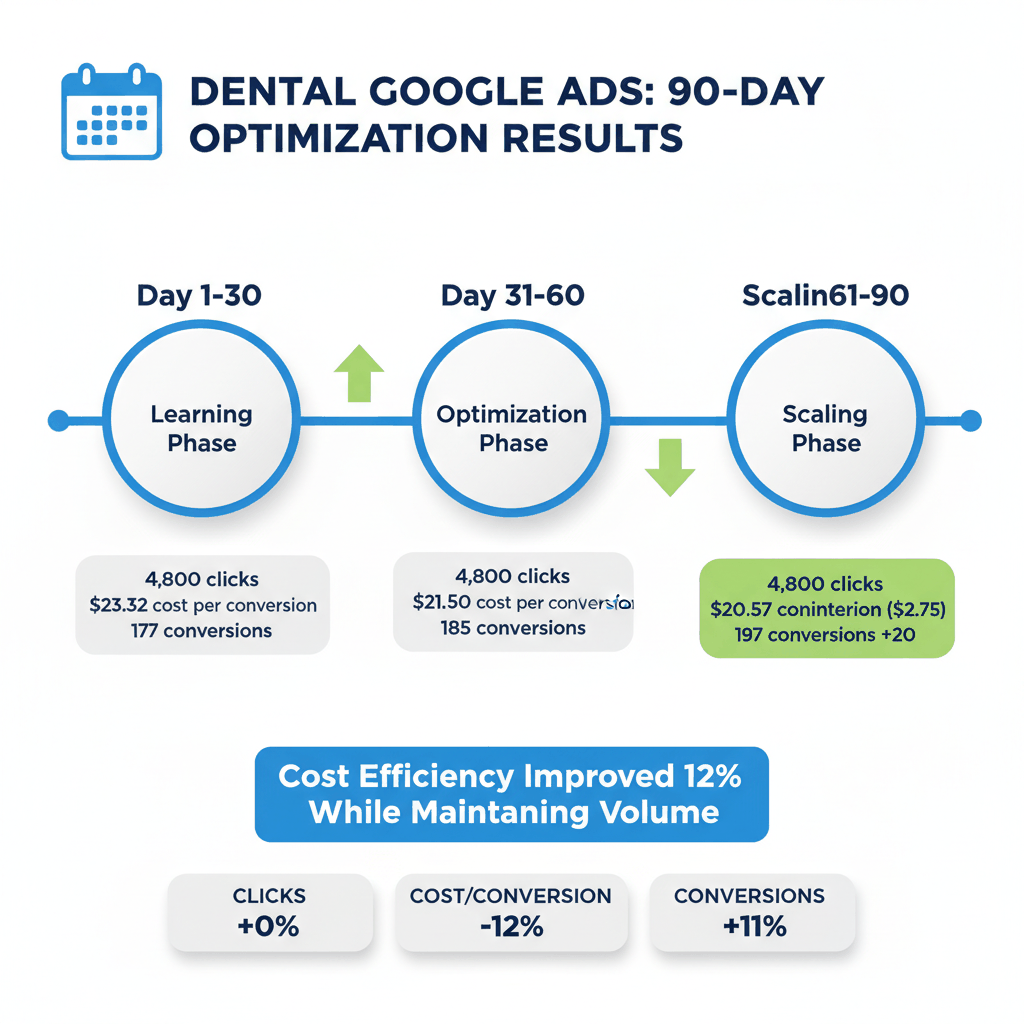
A recent case study shows dramatic improvements over 90 days of campaign optimization:
Conversions increased by 20, reaching 197 total conversions, showing solid growth in appointment requests. Cost per conversion dropped by $2.75, reaching $20.57 per lead, maximizing ad efficiency. Click volume held strong at 4,800 clicks, maintaining visibility in a competitive market.
The practice maintained high traffic volume while dramatically improving cost efficiency. This demonstrates that optimization focuses on better results, not just more traffic.
Another practice noticed decent conversion rates of 5-9% with about 15 leads monthly. After studying competitor landing pages, they created a more focused page highlighting their expertise.
Results after optimization: conversion rates jumped to 13-17%, and lead volume increased from 15 to 30-40 per month. The same ad spend generated twice the results through better landing page relevance.
Over a full year, one optimized PPC strategy delivered over 800 high-intent leads through Google Search Ads while keeping average cost per lead well below the $20 goal.
These results show that even in competitive local markets, data-driven strategies can scale efficiently without sacrificing lead quality. Consistency and optimization matter more than dramatic budget increases.
A practice implementing proper conversion tracking saw dramatic clarity improvements. Over 90 days with tracking, 1,450 clicks produced 232 conversions (16% conversion rate) at $27.05 cost per acquisition.
Before tracking, the same practice couldn't tie a single booking to their ads. They were flying blind with budget allocation. Tracking transformed their ability to optimize and scale profitably.
The dental advertising landscape evolved rapidly in 2026. Understanding current benchmarks helps set realistic expectations and identify optimization opportunities.
Industry-wide performance metrics for 2026 show improvement over previous years:
Average cost-per-click: $6.50-$9.75 in competitive markets (up from $5.25-$8.50 in 2023)
Average conversion rate: 4.2% (improved from 3.8% in 2023)
Click-through rates: 5.44% for dental ads
ROI for optimized campaigns: 300-500%
These improvements show the industry is getting better at turning clicks into appointments through better targeting and landing page optimization.
Google Ads changed more in 2025 than the previous five years combined. AI bidding, Performance Max campaigns, and new match types transformed campaign management.
Successful practices now rely on Google's machine learning for bidding optimization. The platform has more data about searcher intent than any individual practice can access.
Over 70% of dental-related searches come from mobile devices. If your landing pages aren't mobile-optimized or load slowly, you lose patients before they see your offer.
Mobile optimization isn't optional in 2026. It's the primary way patients discover and evaluate dental practices.
How much should a dental practice spend on Google Ads monthly?
A realistic starting budget for dental Google Ads is $3,000-$5,000 per month in ad spend. Successful practices typically allocate 4-7% of gross revenue to total marketing, with Google Ads representing 20-40% of that budget depending on local competition.
What's the average cost per new patient from dental Google Ads?
New patient acquisition costs $300-$500 per patient minimum with well-managed campaigns. DIY campaigns often exceed $1,000 per acquired patient due to targeting mistakes and poor optimization.
How long does it take to see results from dental Google Ads?
Expect 60-90 days before campaigns produce reliable, optimizable data. The first month is largely Google's algorithm learning your audience and calibrating performance. Practices that quit in the first 30 days miss the optimization phase.
Do dental Google Ads work for small practices?
Yes, but small practices need realistic expectations. With proper targeting and budget management, even smaller practices can generate 6-10 new patients monthly from Google Ads. The key is focusing on high-intent keywords and local targeting.
What's the most important metric to track for dental Google Ads?
Cost per acquisition (CPA) is the most important metric. This shows how much you pay for actual new patients, not just leads or calls. Track the complete journey from click to kept appointment to treatment acceptance.
Ready to buy dental leads? Sign up for free with ResultCalls today!

Hello everyone! My name is Alex and I write these blogs to help educate small business owners on different ways to grow their business. My goal is to make lead generation as easy as possible for you. After reading these blogs, I hope you leave with some actionable steps that will get you closer to growing your business :)