You run a plumbing business and need more customers. Your phone isn't ringing enough. Your competitors seem to be getting all the emergency calls.
Google Ads can solve this problem. Plumbing is one of the highest-intent verticals on Google. Someone searching "emergency plumber near me" needs help right now. They're not comparison shopping. They're in pain and need immediate help.
This guide shows you exactly how to create profitable Google Ads campaigns. You'll learn campaign structure, keyword strategy, and budget recommendations. Plus, you'll see real case studies from plumbing companies getting 670 new leads with 60% qualification rates.
By the end, you'll know how to generate consistent plumbing leads and grow your business with targeted advertising.
Table of Contents
Google Ads deliver immediate visibility for plumbing services. Your ads appear at the top of search results when customers need help most. This means you reach people actively searching for plumbing services.
Emergency plumbing searches have the highest conversion intent of any home service. When someone searches "burst pipe repair," they have zero alternatives. They need help within hours, not days.
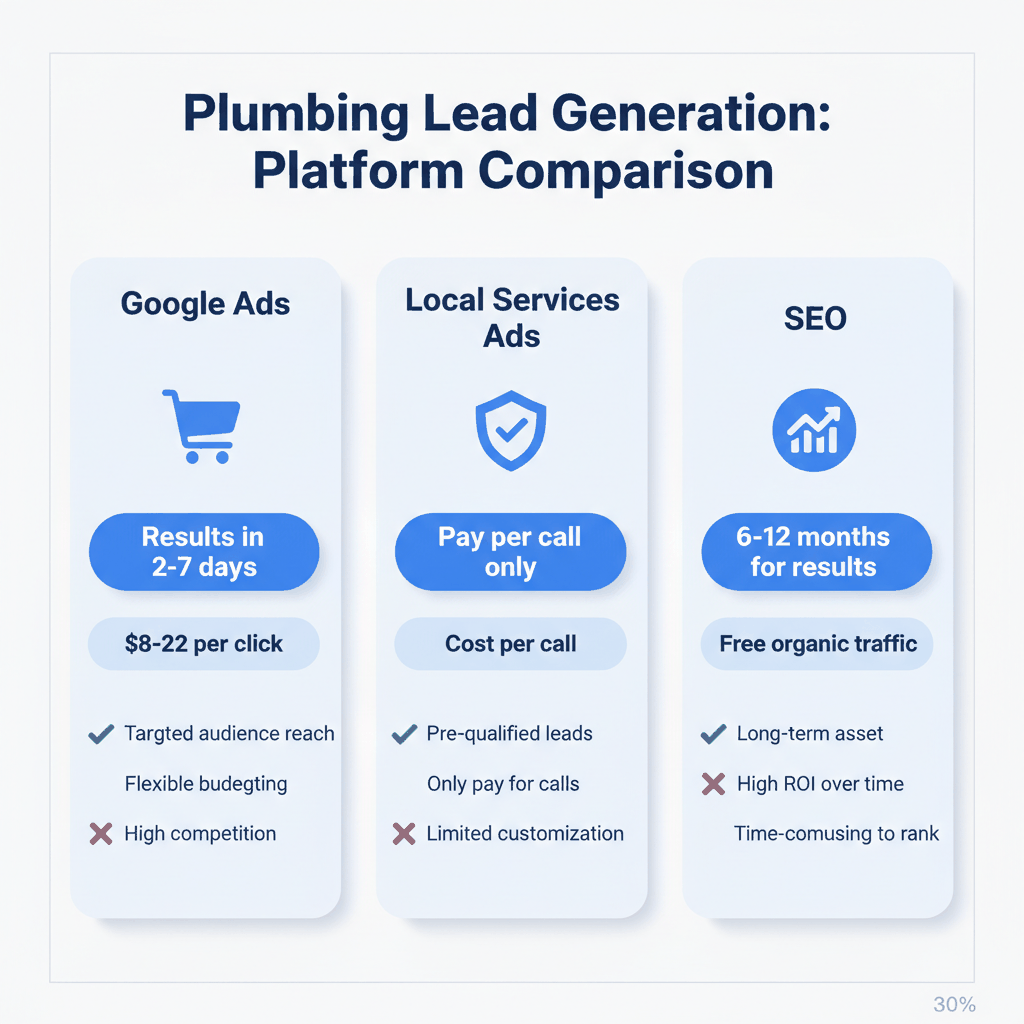
For multi-location plumbing companies, Google Ads provide scalable lead generation. You can target specific service areas and adjust budgets based on demand. Most competitive markets require $2,000 to $3,500 monthly to generate consistent results.
The key advantage is immediate results. Unlike SEO, which takes months to show results, Google Ads can generate booked jobs within 2-7 days of launch. This makes them perfect for new plumbing businesses or seasonal demand spikes.
Many plumbers waste their advertising budget on completely wrong approaches. Here are the biggest mistakes that drain your ad spend without generating qualified leads.
The number one mistake is bidding on irrelevant keywords. Many plumbers bid on "plumbing" which attracts DIY homeowners, not customers who hire professionals. Your bid keywords may not match what prospects actually type when searching.
For example, bidding on broad terms like "plumbing" brings traffic from people looking for DIY solutions. Instead, focus on intent-based keywords like "emergency plumber near me" or "water heater repair."
Plumbers make two location mistakes. They either target too broadly and waste money on areas they can't serve. Or they target too narrowly and miss customers willing to pay travel fees.
The solution is strategic radius targeting around your service areas. Include adjacent neighborhoods where you can charge premium rates for longer travel distances.
Your daily budget gets drained by people who will never become customers. DIY homeowners, job seekers, and people outside your area all click your ads without converting.
Essential negative keywords include: "-DIY," "-jobs," "-training," "-free," "-how to," "-classes." This filters out unqualified traffic and improves lead quality.
Sending every click to your homepage kills conversions. If someone searches "emergency water heater repair" and lands on a generic homepage, they'll leave immediately.
Create service-specific landing pages. Your water heater ad should lead to a water heater repair page with relevant information and clear calls-to-action.
Most plumbers only track form submissions but miss phone calls. Phone calls represent 70-80% of plumbing leads. Without call tracking, Google's AI can't optimize for your most valuable conversions.
Use call tracking numbers unique to each campaign. This shows which keywords generate phone calls and helps optimize your bidding strategy.
Proper campaign structure is the foundation of profitable plumbing Google Ads. Organize campaigns by service type, not location. This allows better budget control and performance optimization.
Create separate campaigns for each main service category:
Emergency Plumbing: "burst pipe repair," "emergency plumber," "plumber open now"
Drain and Sewer: "drain cleaning," "clogged drain," "sewer line repair"
Water Heater: "water heater repair," "water heater replacement," "no hot water"
General Plumbing: "plumber near me," "plumbing services," "pipe repair"
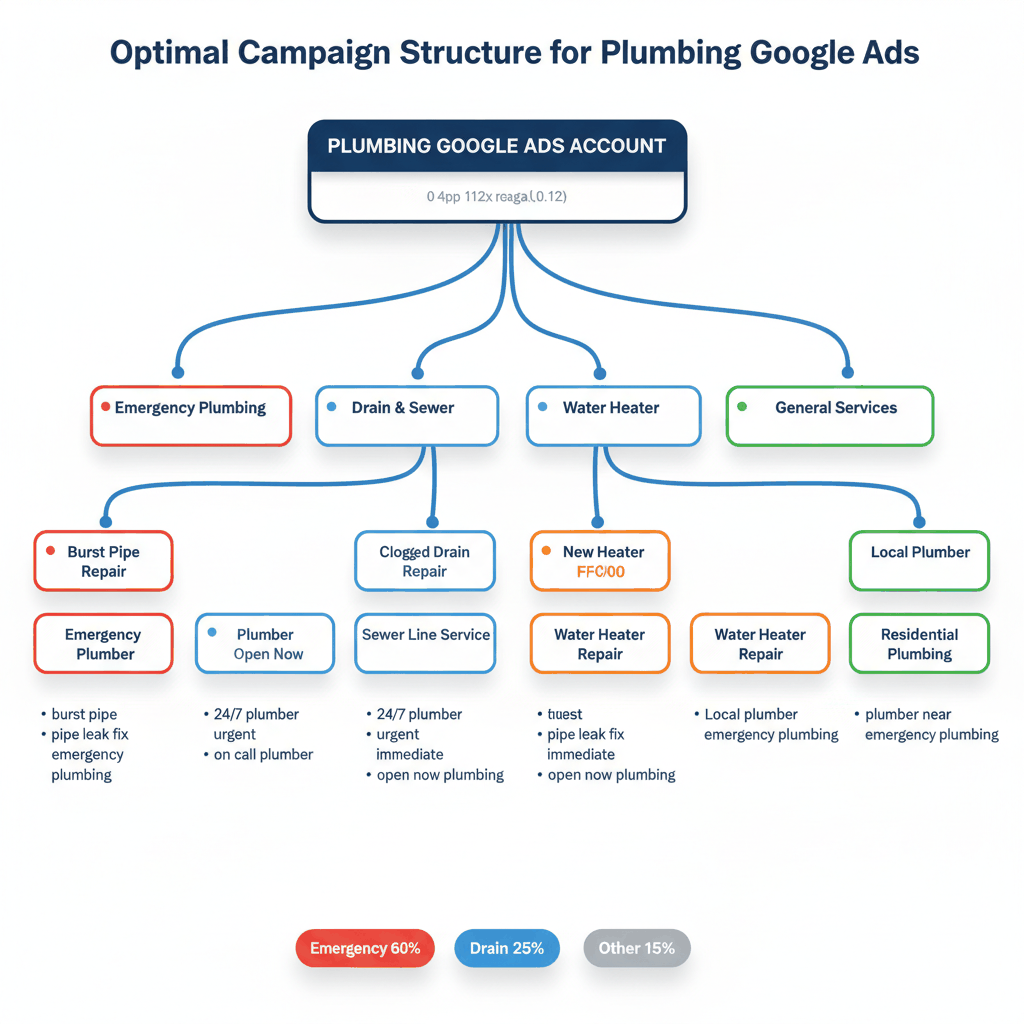
Within each campaign, create themed ad groups. Your Drain Cleaning campaign might have ad groups for Clogged Sink Repair and Sewer Line Cleaning. This ensures highly relevant ads for specific searches.
Keep ad groups tightly themed around specific problems. This improves Quality Score and reduces costs. Each ad group should contain 5-15 closely related keywords.
For example, your "Emergency Water Heater" ad group might include: "water heater not working," "no hot water emergency," "water heater repair urgent." All keywords relate to immediate water heater problems.
Emergency campaigns should run 24/7 with aggressive bidding. These customers need help immediately and price is secondary. Planned service campaigns can use conservative bidding during business hours when customers research options.
Budget planning determines your campaign success. Insufficient budgets prevent Google from gathering optimization data. Too much spending without proper structure wastes money quickly.
Start with a minimum budget of $1,500-$3,500 per month for meaningful results. This generates 20-50 leads monthly and provides enough data for optimization. Highly competitive markets may require $20,000 monthly to dominate search results.
Daily spending should range from $50-$120 for most plumbing companies. Start conservatively with $50 daily, then increase based on performance and lead quality.
Use different bidding strategies based on campaign intent:
Emergency campaigns: Maximize conversions with aggressive bidding
Planned services: Target CPA bidding with conservative goals
Brand campaigns: Manual CPC with low bids to protect your brand
Emergency campaigns should bid highest because customers have zero price sensitivity. Start with 150-200% higher bids for emergency keywords compared to planned service terms.
Allocate 60% of your budget to emergency campaigns. These convert highest and generate immediate revenue. Reserve 25% for drain and sewer services, and 15% for planned maintenance campaigns.
Monitor performance weekly and shift budgets toward highest-performing campaigns. Emergency plumbing typically delivers the best return on ad spend.
Keyword selection makes or breaks your plumbing Google Ads campaigns. Focus on high-intent terms that indicate immediate need for professional plumbing services.
Your highest-converting keywords combine emergency intent with location targeting:
"emergency plumber [city]"
"burst pipe repair [zip code]"
"24 hour plumber near me"
"plumber open now"
These keywords cost $12-22 per click but convert at 15-20% because searchers have zero alternatives. The high cost per click is offset by premium emergency service pricing.
Target specific problems customers face:
Water heater: "no hot water," "water heater leaking," "water heater replacement"
Drains: "clogged drain," "drain cleaning," "slow draining sink"
Pipes: "leaky pipe," "pipe repair," "frozen pipes"
These keywords have moderate competition and strong conversion rates. They typically cost $6-12 per click with good lead quality.
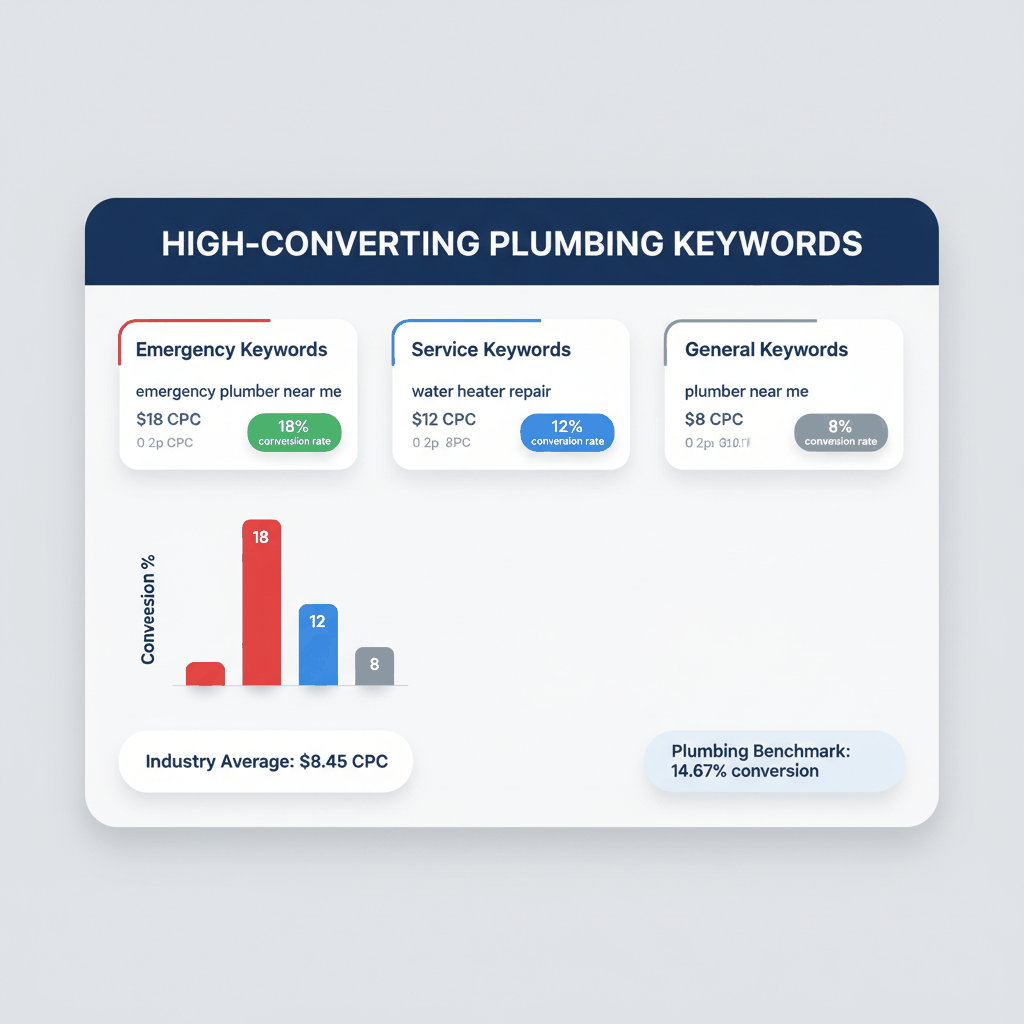
Use exact match for your highest-value emergency terms. This ensures you only pay for precise intent searches. Use phrase match for service and location variants to capture additional traffic.
Avoid broad match entirely until you have 90 days of search term data. Broad match wastes budget on irrelevant searches before you build a comprehensive negative keyword list.
Add these negative keywords to every campaign:
-diy, -yourself, -how to
-jobs, -careers, -hiring
-free, -cheap, -discount
-classes, -training, -school
-parts, -supplies, -tools
These negatives filter out unqualified clicks and improve your cost per conversion. Review search terms weekly and add new negative keywords based on irrelevant queries.
Real case studies show the potential of well-managed plumbing Google Ads campaigns. These examples demonstrate proper strategy implementation and achievable results.
A Southern California plumbing company with six locations struggled with poor Google Ads results. They were spending money but not seeing returns from their advertising investment.
Within one year of professional campaign management, they achieved remarkable results. The company generated over 670 new leads with over 60% being qualified prospects. Cost per lead dropped 38% below industry averages.
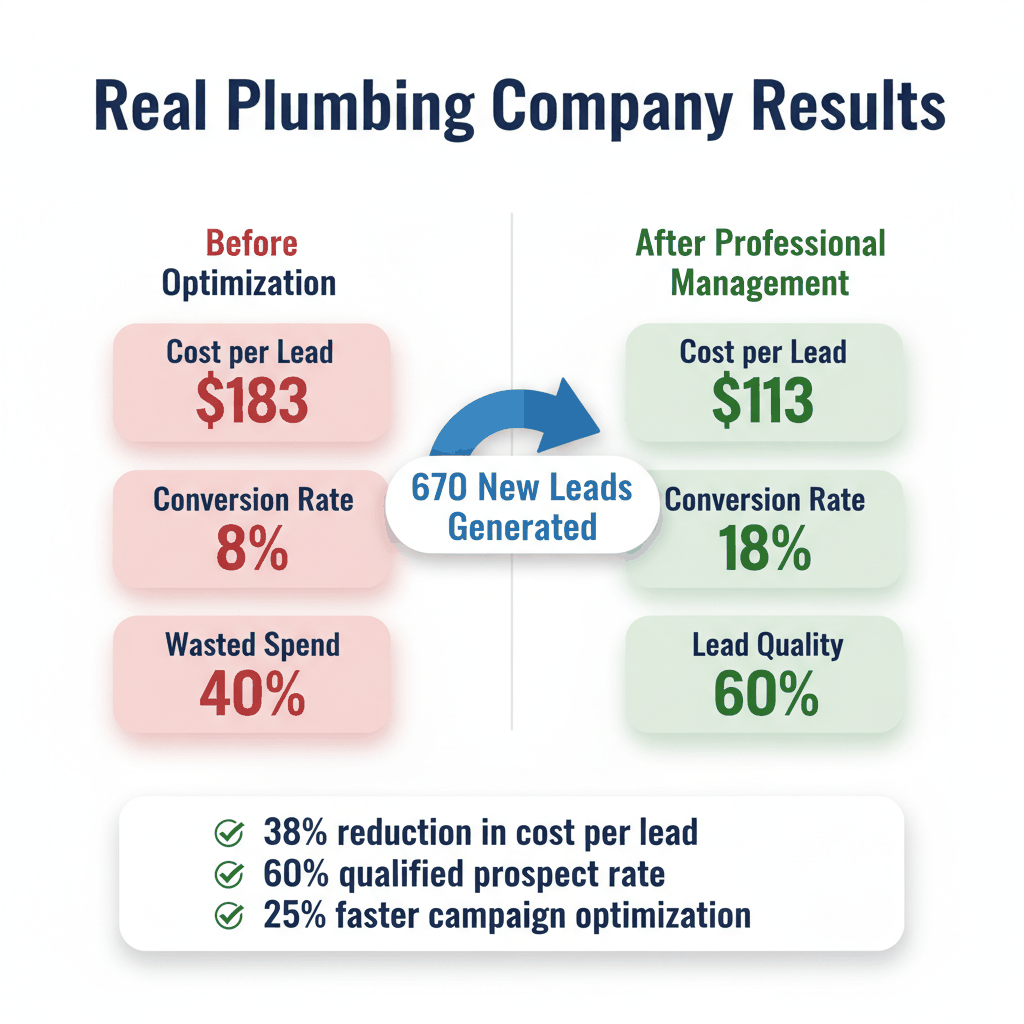
The strategy included attention-grabbing headlines like "Need a Plumber Fast? Call Now!" Each core service received dedicated landing pages with clear calls-to-action and social proof. This matching of search intent to landing page content drove higher conversion rates.
An agency client wanted better ROI from their existing Google Ads campaigns. The plumbing company was getting decent results but felt campaigns could perform better with proper optimization.
The optimization team built more ad groups with highly relevant keyword themes. They created remarketing campaigns to target past website visitors who didn't convert. Although the client spent 59% more year-over-year, results far exceeded the increased investment.
Key improvements included better campaign structure, negative keyword management, and conversion tracking setup. This shows how proper optimization can justify increased ad spend through improved performance.
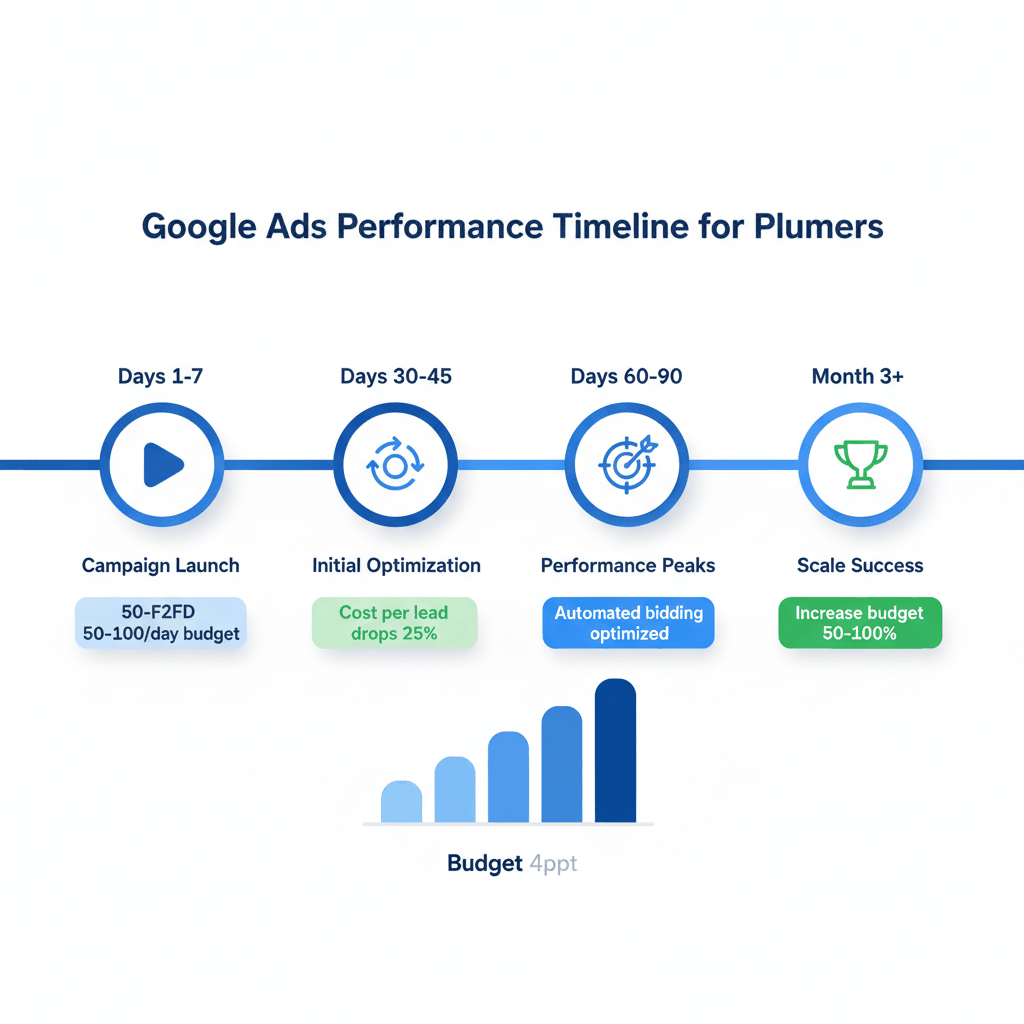
Most properly structured plumber Google Ads campaigns generate booked jobs within 2-7 days of launch. The first 30 days focus on data gathering with higher cost per call and some wasted spend.
By day 45-60 with correct optimization, cost per call typically drops 25-40%. Peak performance arrives around month 3 when automated bidding has enough conversion data to outperform manual strategies.
Professional campaign management accelerates this timeline by implementing proven strategies from day one.
The right tools and integrations maximize your plumbing Google Ads performance. These platforms help track leads, manage campaigns, and prove ROI from your advertising investment.
The most effective strategy uses both Google Ads and Local Services Ads simultaneously. Google Ads provide immediate visibility and detailed targeting control. Local Services Ads appear at the very top of search results and charge per phone call.
Local Services Ads build trust through Google's verification process. They're excellent for emergency plumbing because customers see verified, licensed plumbers at the top of results. Standard Google Ads allow deeper keyword targeting and campaign optimization.
Running both platforms captures maximum search visibility. Local Services Ads handle trust and immediacy while Google Ads provide volume and targeting precision.
Integrate your Google Ads with plumbing management software for complete lead tracking. Housecall Pro helps convert Google Ads leads into booked jobs and repeat customers.
ServiceTitan provides advanced tracking from Google Ads campaigns through job completion. This eliminates wasted spend on leads that never convert to paying customers. You can track revenue attribution back to specific keywords and campaigns.
These integrations show true ROI by connecting ad spend to actual revenue, not just leads generated.
Dynamic call tracking assigns unique phone numbers to different campaigns and keywords. This traces every phone call back to the specific ad that generated it.
Essential call tracking features include:
Campaign-specific phone numbers
Call recording for quality control
Lead qualification scoring
Integration with Google Ads conversion tracking
Call tracking reveals which keywords drive phone leads and helps optimize bidding strategies. Most plumbing companies get 70-80% of leads through phone calls, making this tracking essential.
Weekly performance reports should include cost per call, cost per lead, call-to-quote rate, and quote-to-close rate. This data shows ROI per service type and guides budget allocation decisions.
Track form submissions with a 48-hour conversion window. Many plumbing customers call back within 2 days after initially submitting a form inquiry.
Understanding current market conditions helps set realistic expectations and budget appropriately. Plumbing Google Ads costs continue rising due to increased competition and market demand.
The average cost per click for plumbing services is $8.45 as of 2026. Cost per lead averages $75-183 depending on geographic location and competition levels.
Emergency plumbing keywords cost $12-22 per click but convert at 15-20% due to high intent. Performance Max campaigns average $82 per lead across all plumbing service types.
Most advertisers see cost per lead between $56-101 based on Quality Score, location targeting, and keyword match strategy. Higher competition markets like Los Angeles or New York require premium pricing.
Plumbing demand varies dramatically by season. Winter brings frozen pipe emergencies. Summer increases outdoor plumbing and AC-related calls. Holiday periods see water heater failures from increased usage.
Adjust campaign budgets based on seasonal patterns:
Winter: Increase emergency pipe repair budgets by 40-60%
Summer: Focus on outdoor plumbing and AC drain services
Holidays: Boost water heater repair campaign spending
Spring: Target preventive maintenance and inspection services
Google's AI optimization works best when trained on full seasonal cycles. Plan for 12-month campaign periods to capture all demand variations.
Plumbing businesses achieve an average click-through rate of 4.97% on Google Ads. This ranks lower than other home services due to high ad density in search results.
Conversion rates for home services, including plumbing, average 14.67% according to industry benchmarks. Emergency plumbing campaigns often exceed 20% conversion rates due to urgent customer needs.
Top-performing campaigns achieve cost per acquisition 30-40% below market averages through proper optimization and negative keyword management.
How much should plumbers spend on Google Ads monthly?
Most plumbers need $1,500-$3,500 monthly for effective Google Ads campaigns. Competitive markets may require $5,000-$20,000 to dominate search results. Start with $50-100 daily and adjust based on lead quality and conversion rates.
What's the average cost per lead for plumbing Google Ads?
Plumbing Google Ads cost per lead averages $75-183 in 2026. Emergency plumbing keywords cost more per click but convert better due to high intent. Your actual costs depend on location, competition, and campaign optimization quality.
How quickly do Google Ads generate plumbing leads?
Properly structured plumbing campaigns generate leads within 2-7 days of launch. Peak performance typically occurs around month 3 when Google's AI has enough conversion data for optimization. Emergency campaigns often produce calls within hours of going live.
Should plumbers use Local Services Ads or regular Google Ads?
Use both platforms for maximum effectiveness. Local Services Ads appear at the top of search results and charge per call. Regular Google Ads provide more targeting control and keyword options. Running both captures more qualified leads from different search behaviors.
What are the most important negative keywords for plumbing ads?
Essential negative keywords include -diy, -jobs, -training, -free, -how to, -parts, and -supplies. These filter out unqualified clicks from job seekers, DIY homeowners, and people shopping for plumbing supplies instead of professional services.
Ready to buy plumbing leads? Sign up for free with ResultCalls today!

Hello everyone! My name is Alex and I write these blogs to help educate small business owners on different ways to grow their business. My goal is to make lead generation as easy as possible for you. After reading these blogs, I hope you leave with some actionable steps that will get you closer to growing your business :)