
Your tree service customers aren't searching the same way they did last year. Google's AI Overviews launched in 2024 and changed everything. Now when homeowners search for tree services, they get AI-generated answers at the top of search results.
This shift affects how customers find your business. Over 2 billion monthly users now see AI-powered search results. When someone searches for "emergency tree removal near me," Google doesn't just show website links anymore. It creates an AI answer using information from multiple sources.
The challenge is real for tree service companies. Traditional SEO strategies need updates for AI search. But there's opportunity here too. Businesses that adapt early will capture more customers while competitors struggle with outdated methods.
You'll learn exactly how to optimize your tree service for AI search results. Plus strategies for voice search, local SEO updates, and measuring your success in this new landscape.
What You'll Learn
Google's AI Overviews create new challenges for tree service marketing. Understanding these changes helps you adapt your strategy before competitors catch up.
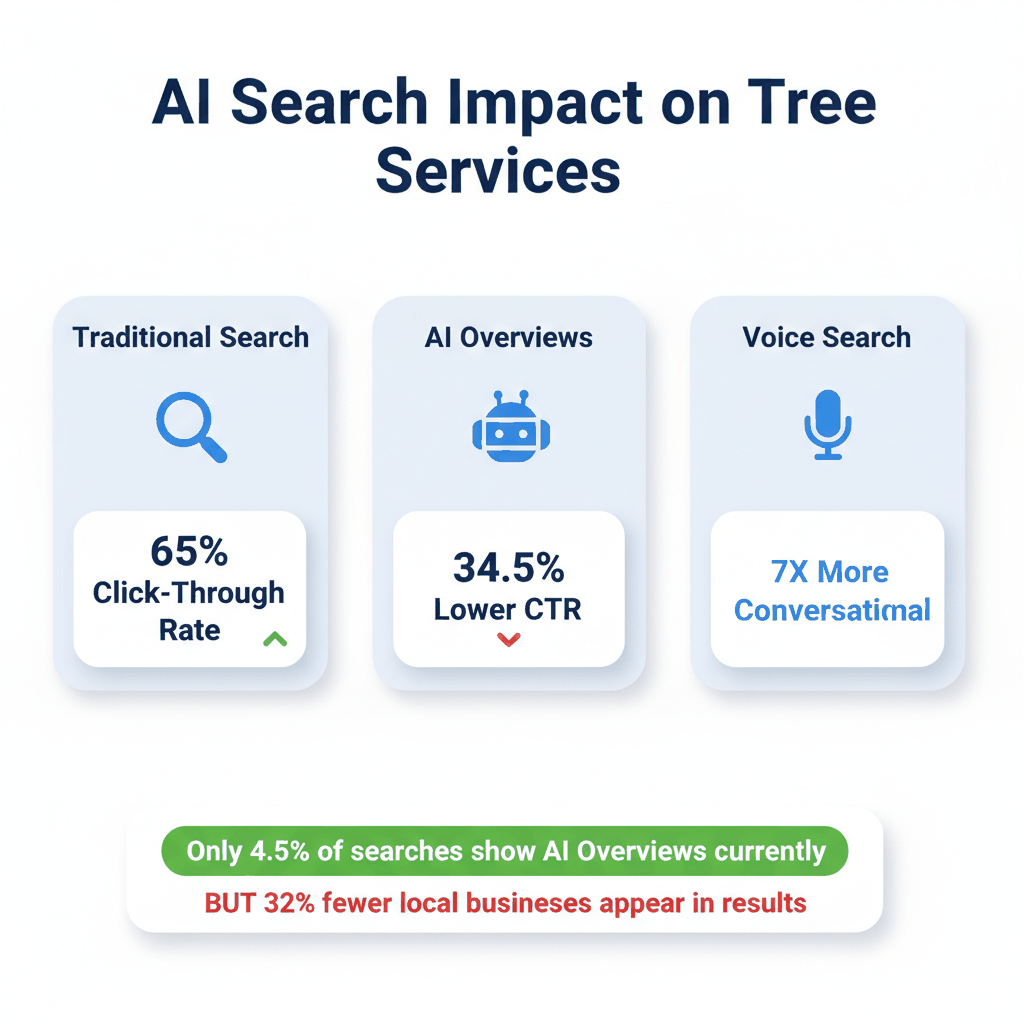
AI Overviews answer questions directly on Google's search page. This means fewer people click through to websites. Research shows a 34.5% decrease in click-through rates when AI Overviews appear.
For tree services, this affects informational searches. When homeowners search "how to trim oak trees" or "signs of diseased maple trees," they might get their answer without visiting your website. Your educational content gets fewer visitors even when it ranks well.
The solution isn't avoiding educational content. Instead, focus on commercial intent keywords. Target phrases like "tree removal service near me" or "certified arborist consultation." These searches lead to business inquiries, not just information gathering.
Traditional local SEO helped tree services appear in Google's 3-pack map results. AI changes this system. 32% fewer local businesses appear in AI-powered local results.
AI selects businesses based on specific trust signals. Your Google Business Profile needs complete information. Every field should be filled out. Hours, services, photos, and regular posts all matter more now.
Plus, AI looks for businesses with recent review activity. A tree service with 50 old reviews ranks lower than one with 20 recent reviews. Set up systems to get fresh customer feedback consistently.
AI Overviews don't appear for every search. Studies show they appear for only 4.5% of searches overall. But certain types of tree service searches trigger them more often.
Longer, conversational searches see AI Overviews 7 times more often. When someone searches "best tree service for storm damage cleanup in Austin," they're more likely to see an AI answer than someone searching just "tree service."
This means optimizing for conversational keywords matters. Think about how customers actually talk when they call your business. Use those natural phrases in your content and website copy.
Optimizing for AI search requires a different approach than traditional SEO. AI systems look for expertise signals and trustworthy information sources.
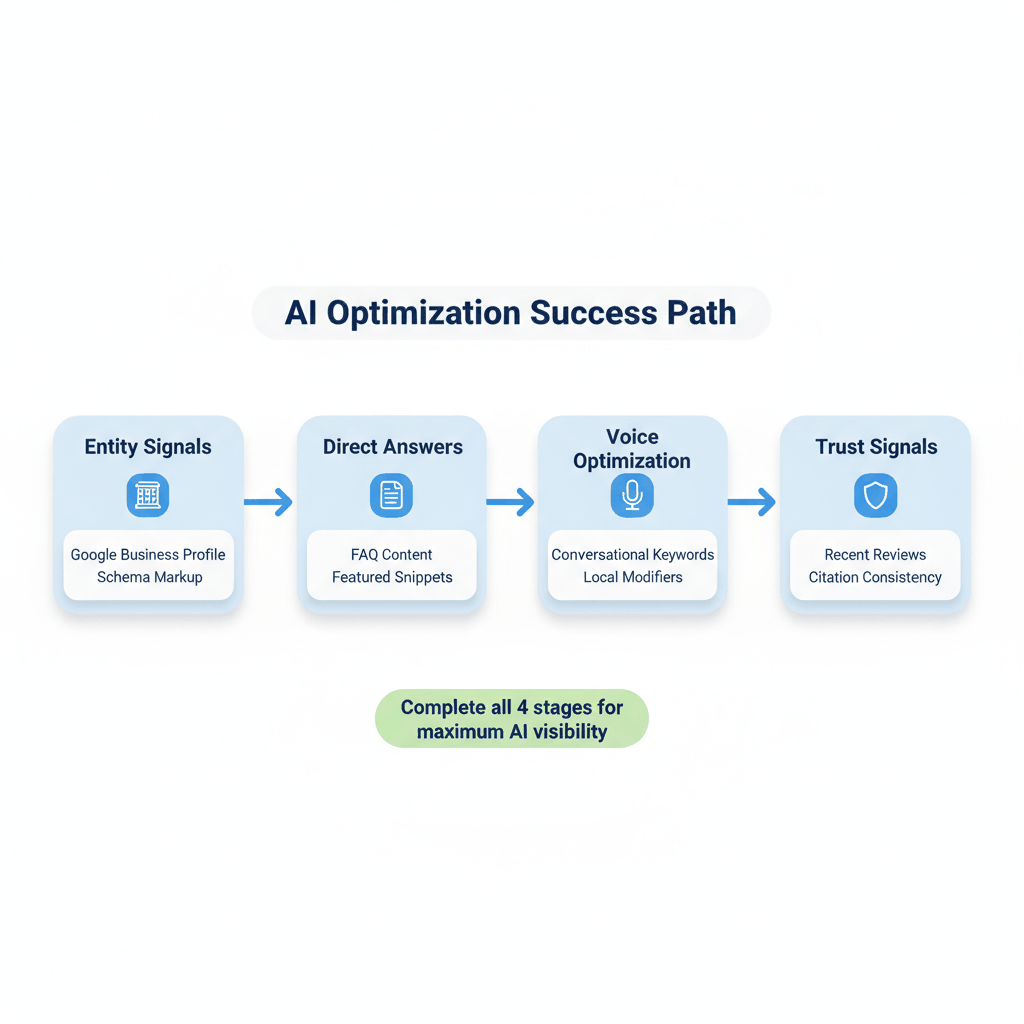
AI treats your business as an entity with specific attributes. Location, services, reputation, and expertise all factor into rankings. Strengthening these signals helps AI understand exactly what your tree service offers.
Start with schema markup on your website. This code tells search engines your business type, location, services, and operating hours. AI systems use this structured data to categorize your business accurately.
For example, add Local Business schema to your homepage. Include your service area, specializations like "ISA Certified Arborist" or "Emergency Tree Removal," and contact information. This gives AI clear signals about your expertise and coverage area.
Complete every section of your Google Business Profile. Add service descriptions for each offering. Tree trimming, stump removal, and emergency services should each have detailed descriptions with local keywords.
AI Overviews pull information from websites that provide clear, direct answers to common questions. Your content needs to be structured for AI to easily extract and use.
Answer common tree service questions concisely. Start paragraphs with the answer, then provide supporting details. For instance, "Tree removal costs $500-$3,000 depending on size, location, and complexity. Large oak trees near power lines cost more than small maples in open yards."
Use FAQ sections on service pages. Include questions customers actually ask during consultations. "How long does tree removal take?" "Do you clean up all debris?" "Are you insured for property damage?" Answer each question in 2-3 sentences maximum.
Content that appears in featured snippets often gets selected for AI Overviews. Target snippet opportunities by answering specific questions in scannable formats.
Use numbered lists for process explanations. "How to prepare for tree removal: 1. Clear the area of vehicles and outdoor furniture. 2. Inform neighbors about potential noise. 3. Mark any underground utilities. 4. Remove valuable plants from the drop zone."
Create comparison tables for services. Show tree pruning vs tree trimming, or emergency vs scheduled services. AI systems like structured information they can easily parse and present to users.
Voice search continues growing as smart speakers and mobile assistants become more common. Tree service content needs to match how people actually speak, not just how they type.
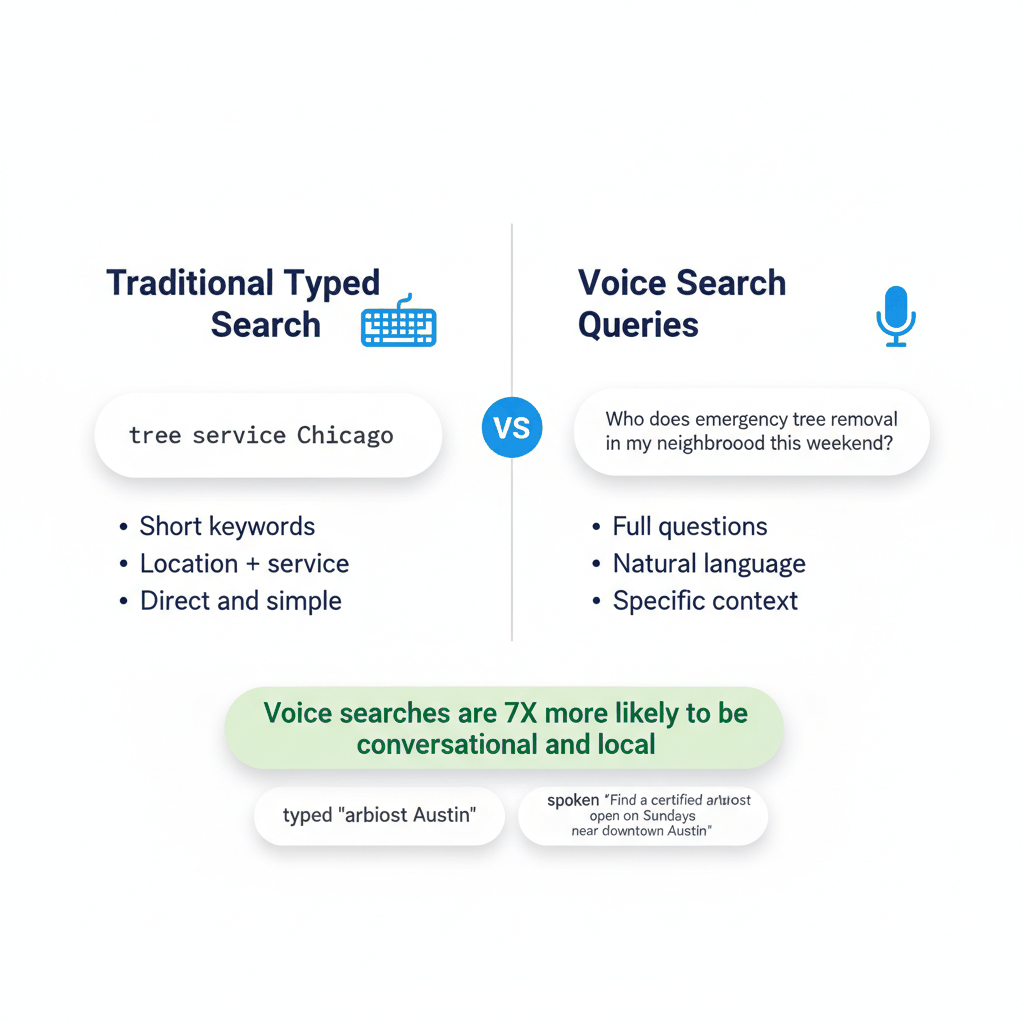
People speak differently than they type. Typed searches might be "tree service Chicago." Voice searches sound like "Who does tree trimming in my neighborhood?" or "Find an arborist open on weekends."
Create content targeting question phrases. "Who removes fallen trees?" "What does emergency tree service cost?" "When should I trim my oak trees?" These conversational keywords match how customers use voice assistants.
Include local modifiers that sound natural when spoken. "Tree removal service near Lincoln Park" or "Certified arborist in downtown Austin." Avoid awkward keyword stuffing that doesn't sound natural when read aloud.
Voice assistants typically read 20-30 words when answering questions. Your content needs concise answers AI can extract and speak clearly.
Start important paragraphs with complete sentences that stand alone. "Tree trimming costs $200-$800 per tree on average." This gives voice assistants a clear answer to extract without additional context needed.
Use transition phrases that work for voice results. "Here's what you need to know," "The bottom line is," or "Most homeowners find that." These phrases signal important information to AI systems.
Many voice searches include "near me" or local references. Your content needs strong local signals to capture these searches for tree service lead generation.
Mention specific neighborhoods, landmarks, and local areas you serve. "We provide tree removal throughout North Austin, including Cedar Park, Round Rock, and Georgetown." This helps voice assistants understand your service territory.
Create location-specific content pages. "Tree Service in [Neighborhood Name]" pages help capture hyperlocal voice searches. Include content about local tree types, common problems in that area, and specific regulations or permits required.
Local SEO for tree services evolved significantly with AI search. Traditional tactics still matter, but new ranking factors require attention.
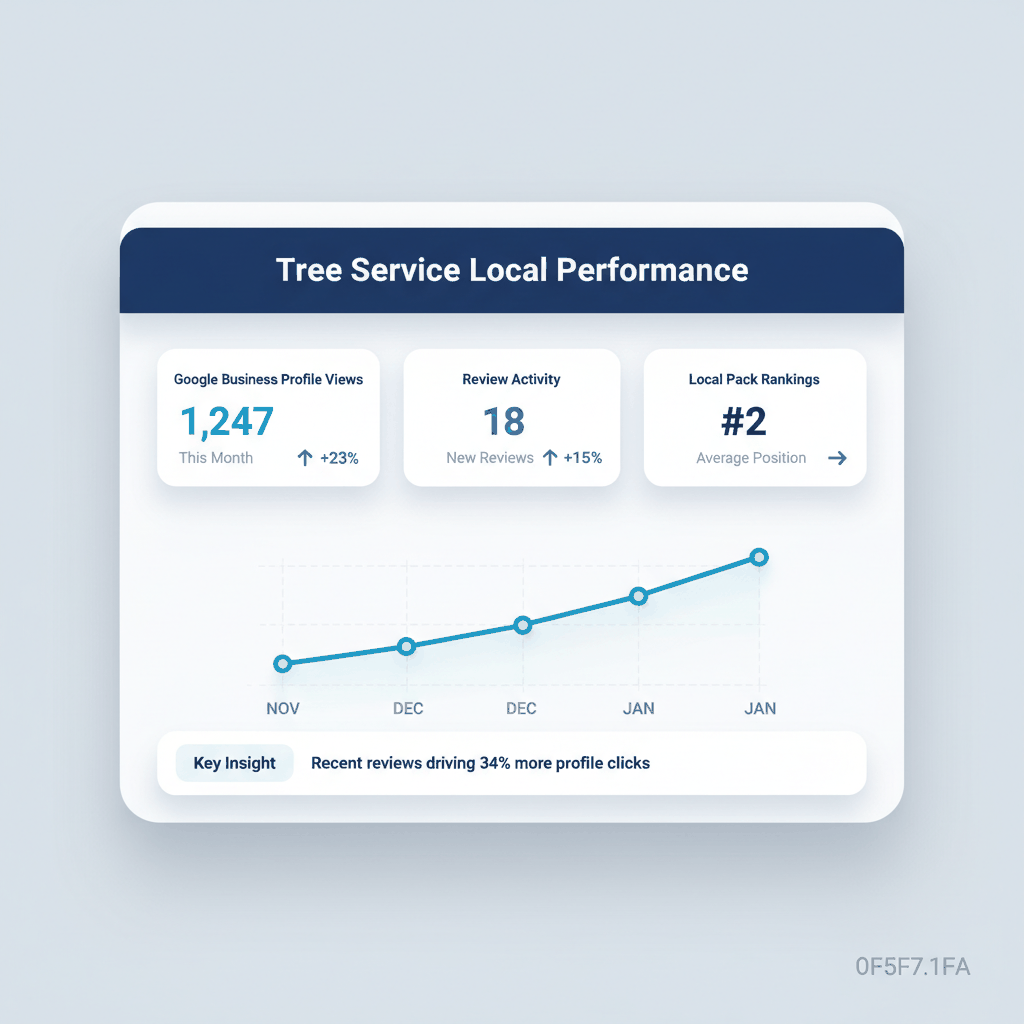
Reviews influence AI search results more than ever. But AI systems look for review recency, not just quantity. A tree service with 20 recent reviews often outranks one with 50 old reviews.
Set up automated review requests after every job. Text customers within 24 hours asking for feedback. Most customers forget to leave reviews unless prompted quickly. Recent positive reviews signal active business to AI systems.
Respond to every review within 48 hours. Thank customers for positive feedback and address any concerns professionally. 85% of consumers trust online reviews as much as personal recommendations. Your responses show professionalism to potential customers reading reviews.
Your Google Business Profile serves as the central hub for local search signals. Complete profiles rank better in AI-powered results than incomplete ones.
Upload high-quality photos regularly. Before/after shots of tree removal projects, equipment photos, and team pictures all help. AI systems consider photo recency and variety when ranking local businesses.
Post weekly updates about projects, seasonal tips, or service availability. Google Business posts expire after 7 days, so consistent posting shows an active business. Include local keywords naturally in posts.
Name, Address, Phone number consistency across the web remains crucial. AI systems cross-reference your business information across multiple sources to verify legitimacy.
Audit your citations on major directories. Yelp, Yellow Pages, Angie's List, and industry directories should all show identical business information. Inconsistent addresses or phone numbers confuse AI systems and hurt rankings.
Claim and update listings on tree service specific directories. Sites like Tree Care Industry Association directories, local Chamber of Commerce listings, and Better Business Bureau profiles all provide valuable citation opportunities.
Traditional SEO metrics need supplements to measure AI search performance. New tracking methods help you understand how AI affects your tree service marketing.
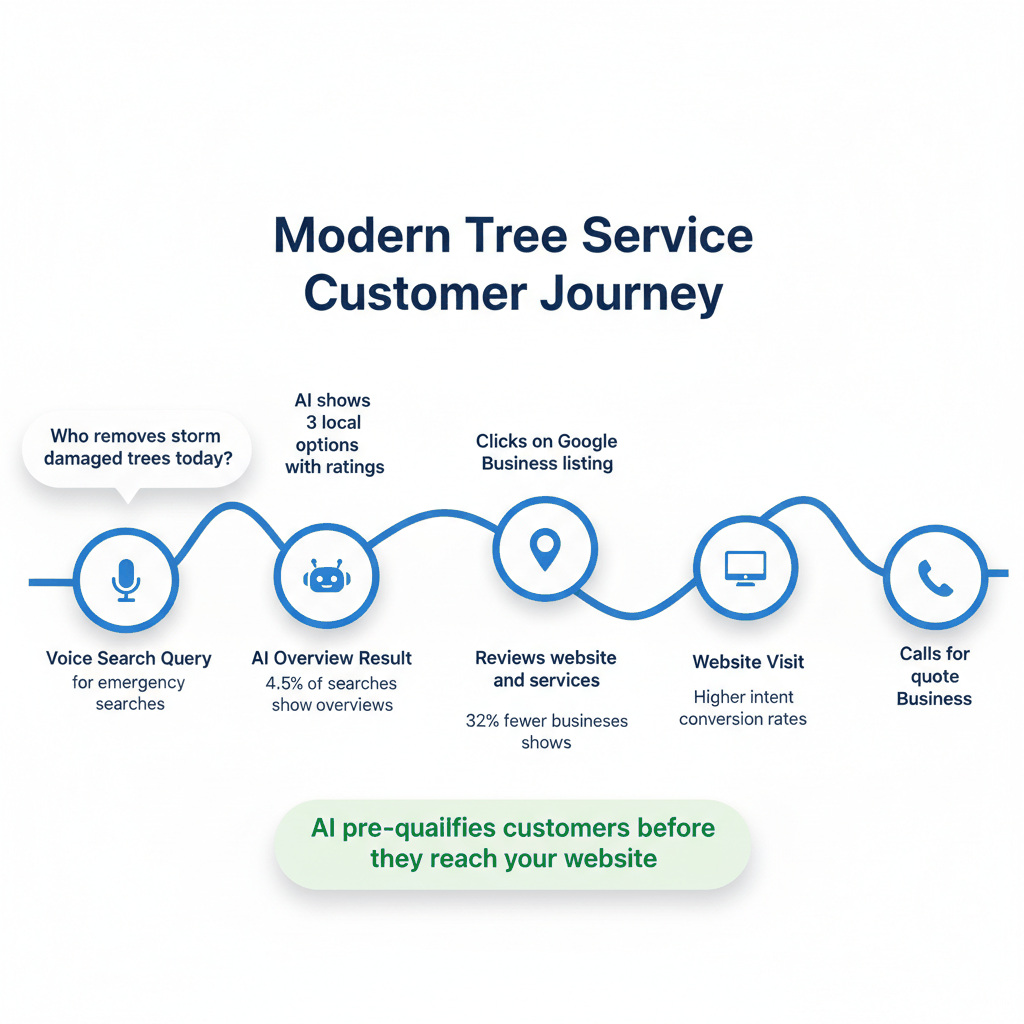
As AI Overviews reduce organic clicks, brand awareness becomes more important. Track searches for your business name, owner name, and branded service names.
Use Google Search Console to monitor branded keyword impressions. Increasing brand searches indicate successful awareness building despite lower overall click-through rates. Strong brands still get clicks even when AI provides direct answers.
Set up Google Alerts for your business name and variations. Monitor when your business gets mentioned online, in local news, or in industry discussions. These mentions build authority signals AI systems recognize.
Local pack rankings matter more with AI search. Tools like Local Falcon help track your position in local results across different locations in your service area.
Monitor rankings for core service keywords plus "near me" variations. "Tree removal near me," "arborist near me," and "emergency tree service near me" all drive high-intent local traffic.
Track click-through rates from local pack results. Higher CTR indicates compelling business listings that stand out from competitors. Test different business descriptions and service offerings to improve performance.
Lower traffic doesn't necessarily mean lower revenue if conversion rates improve. AI may send fewer but higher-intent visitors to your website.
Track the customer journey from search to booking. Use call tracking numbers on different pages to understand which content generates phone calls. Many tree service customers prefer calling over filling out forms.
Measure lead quality improvements. Leads from AI-influenced searches might convert at higher rates because AI pre-qualifies searchers by providing relevant initial information.
How does tree service AI search optimization differ from regular SEO?
AI search optimization focuses on direct answer content and entity signals rather than just keyword rankings. Your tree service needs complete business profiles, recent reviews, and conversational content that AI can easily extract and present to searchers.
What percentage of tree service searches trigger AI Overviews?
Currently about 4.5% of searches show AI Overviews, but longer conversational searches see them 7 times more often. Tree service searches like "best arborist for storm damage cleanup in Dallas" are more likely to trigger AI results than simple searches.
Should tree services still invest in traditional SEO strategies?
Yes, traditional local SEO remains important for tree care businesses. AI search builds on existing ranking factors like citations, reviews, and local content. Focus on both traditional optimization and AI-specific strategies for best results.
How can voice search help tree service lead generation?
Voice search captures high-intent local queries like "emergency tree removal near me" or "who removes fallen trees today." Optimizing for conversational keywords helps capture customers who need immediate tree service help.
What metrics matter most for tree service AI marketing success?
Track local pack rankings, brand search volume, and conversion rates rather than just organic traffic. AI search may send fewer but higher-quality visitors to your tree service website, making lead quality more important than quantity.
Ready to get exclusive tree service leads? Sign up for free with ResultCalls!

Hello everyone! My name is Alex and I write these blogs to help educate small business owners on different ways to grow their business. My goal is to make lead generation as easy as possible for you. After reading these blogs, I hope you leave with some actionable steps that will get you closer to growing your business :)