The truth is, competing on price alone puts you in a race to the bottom. Discount competitors often cut corners on parts, skip proper diagnostics, or lack proper licensing and insurance. Your customers deserve better, and your business deserves fair compensation for quality work.
Smart appliance repair businesses use proven pricing strategies that highlight value over cost. They win quality customers willing to pay for reliable repairs, professional service, and guaranteed results. This approach protects your margins while growing your business.
In this guide, you'll learn how to implement value-based pricing that attracts the right customers. You'll discover flat-rate systems, communication scripts, and competitive strategies that help you charge fair prices without losing jobs.
Most appliance repair businesses struggle with pricing because they focus only on parts and labor costs. This creates multiple problems that hurt profitability and customer relationships.
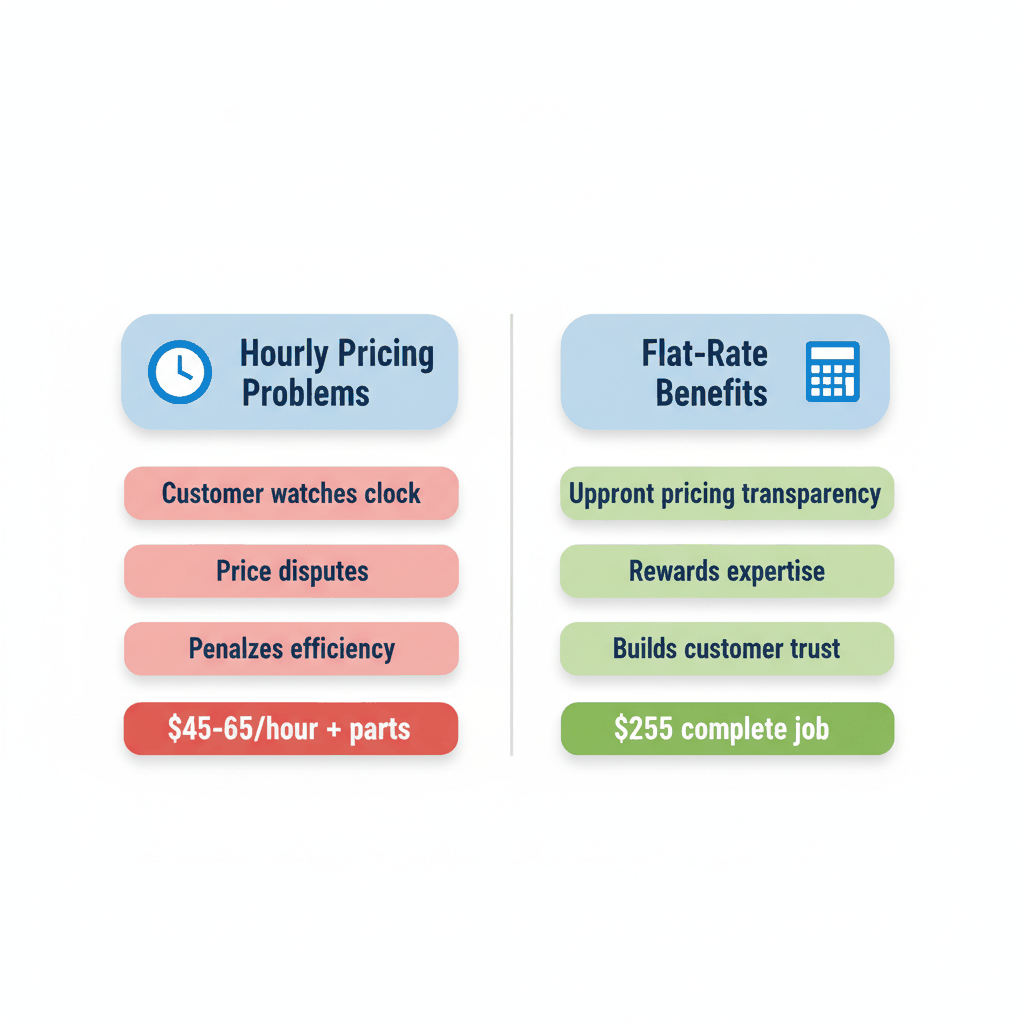
The number one customer complaint involves hourly labor costs. When you present a repair as hourly, customers watch the clock and question every minute. If you complete a $255 repair quickly, customers think your labor rate is too high.
Clock-watching customers create tension during repairs. They see efficient work as overpricing instead of expertise. This damages trust and leads to payment disputes or negative reviews.
Many repair companies don't calculate all elements into every job. They miss costs like travel time, vehicle expenses, insurance, licensing, training, and overhead. This incomplete pricing leads to thin margins or business failure.
According to industry data, well-managed companies see net profit margins of 15-25%. Companies with incomplete pricing struggle to reach 10% margins.
Discount competitors often provide unrealistic quotes that don't account for proper parts, warranties, or professional service standards. They win jobs with low prices but deliver subpar results.
These competitors hurt the entire industry by training customers to expect unrealistic pricing. Quality businesses lose jobs to competitors who cut corners or operate without proper licensing and insurance.
Operating costs continue rising while customers expect lower prices. Fuel costs increased from $1.15 per gallon in 1995 to over $3.50 per gallon in 2025. Insurance premiums, vehicle maintenance, and skilled labor costs all increased significantly.
Meanwhile, customers see cheap appliances at big box stores and question repair costs. This creates downward pricing pressure that makes profitable operations difficult.
Flat-rate pricing solves most common pricing problems by focusing on job value instead of time. This approach benefits both your business and customers through transparent, predictable pricing.
Flat-rate systems price jobs based on the repair needed, not time spent. A dishwasher drain pump replacement costs $255 whether it takes 45 minutes or 90 minutes. Customers know the exact cost upfront.
These job rates consider multiple factors. Parts, labor, equipment, travel time, vehicle expenses, insurance, training, overhead, and profit margins all factor into each price. This ensures every job generates fair compensation.
The Appliance Blue Book provides standardized flat rates for hundreds of common repairs. This professional resource shows customers you use industry-standard pricing instead of making up prices.
Customers prefer knowing exact costs before work begins. Flat-rate pricing eliminates surprises and builds trust through transparent pricing. They can make informed decisions without worrying about time overruns.
Efficient technicians don't penalize customers with higher costs. If you complete a repair quickly, customers appreciate fast service instead of questioning labor charges. This creates positive customer experiences.
Implementing flat-rate pricing can increase profit margins by 5-10%. This pricing model rewards efficiency and expertise while protecting against underpricing jobs.
Experienced technicians earn fair compensation for their skills. Quick repairs generate the same revenue as slower work, encouraging continuous improvement and skill development.
Flat-rate pricing also simplifies estimating and reduces pricing errors. Technicians reference standard job rates instead of calculating costs in the field. This consistency improves customer confidence and reduces disputes.
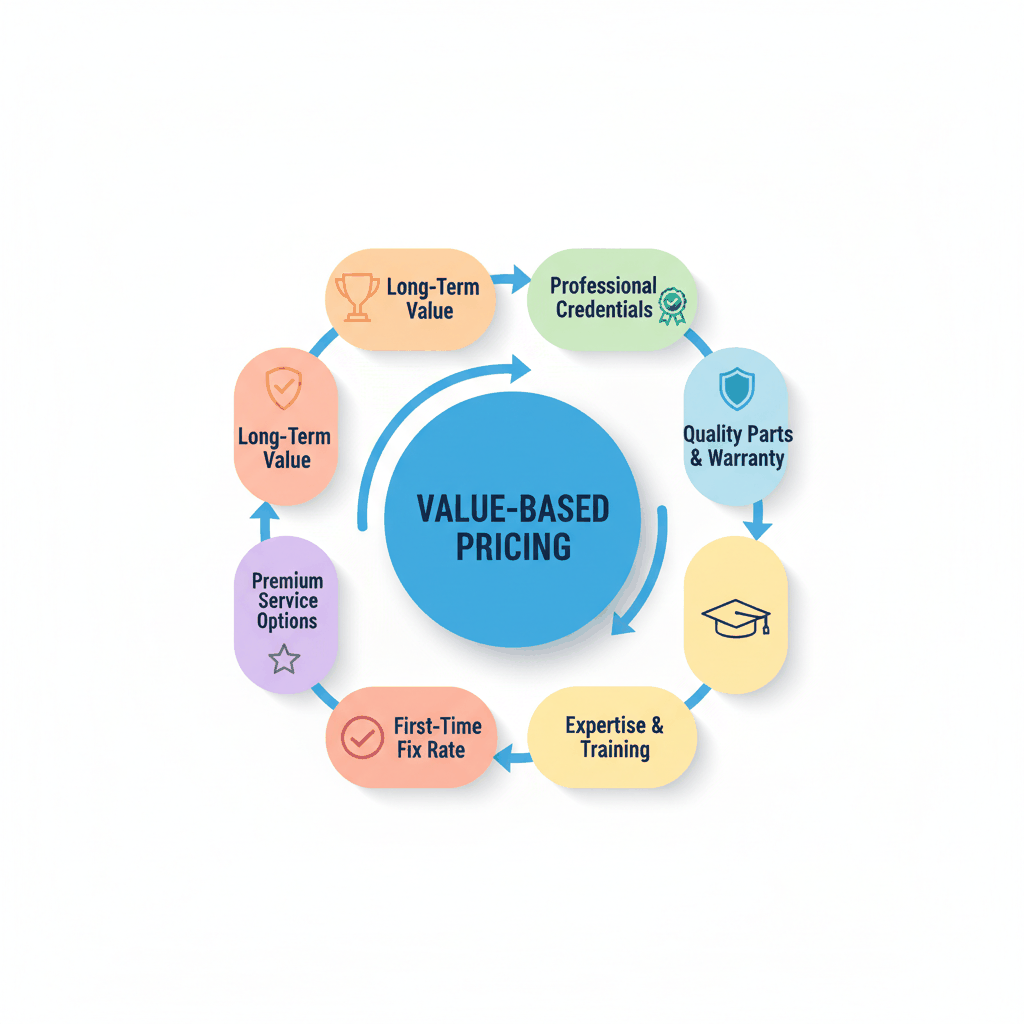
Competing on value instead of price allows you to win quality customers while maintaining healthy profit margins. This strategy focuses on benefits customers receive rather than lowest costs.
Modern appliances cost less than ever, but quality repairs often provide better long-term value. A $300 dishwasher repair extends appliance life for 3-5 years. Replacement costs include new appliance, delivery, installation, and disposal fees.
Help customers understand total replacement costs. A $400 dishwasher becomes $600+ with delivery, installation, and old unit disposal. Professional repair at $285 saves money and avoids replacement hassles.
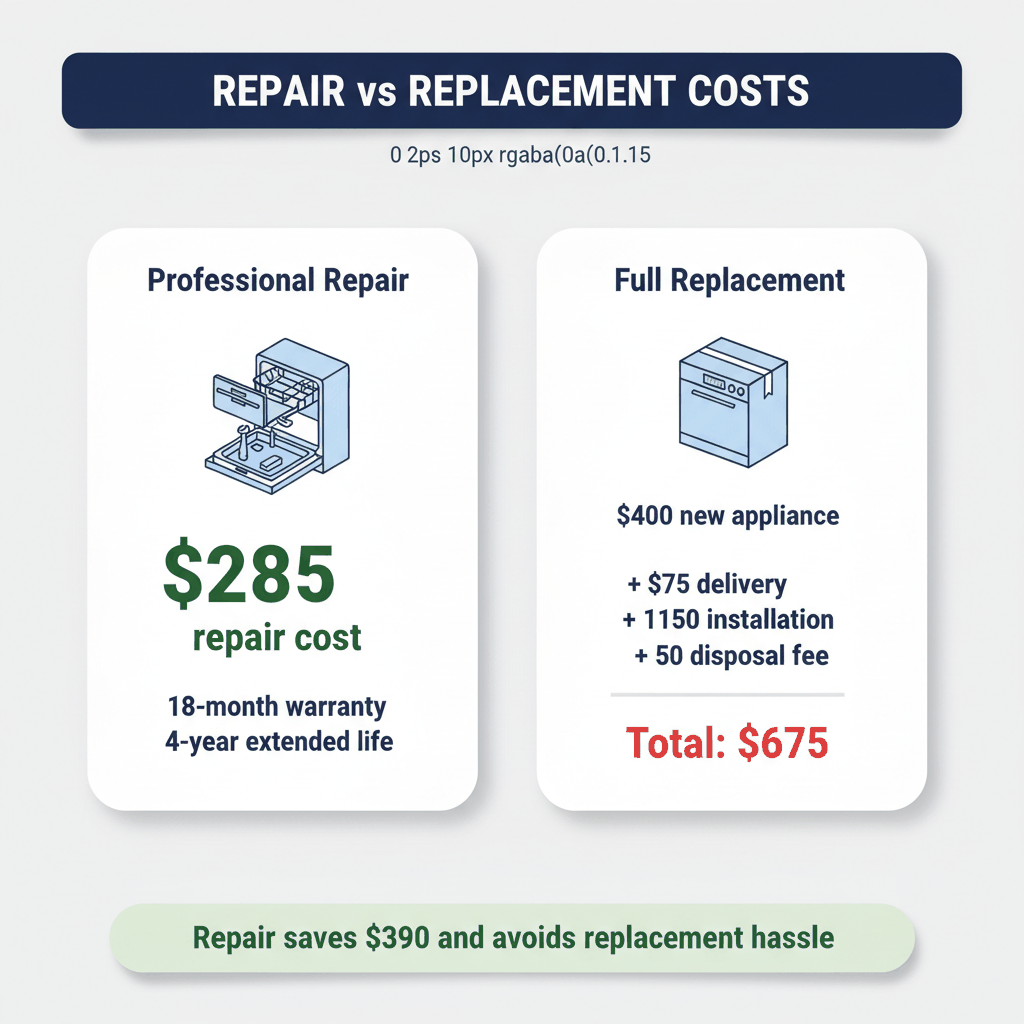
Offer multiple service levels that justify premium pricing. Basic repairs use standard parts with standard warranty. Premium service includes upgraded parts, extended warranty, and priority scheduling.
For example, a basic refrigerator compressor repair might cost $485. Premium service at $585 includes upgraded parts, 24-month warranty, and annual maintenance check. Many customers choose premium options for peace of mind.
High-end appliances command higher prices due to complexity and specialized parts. Built-in luxury refrigerator repairs can exceed $1,000 for complex repairs. These specialized services justify premium pricing.
Discount competitors often lack proper training, licensing, or insurance. Highlight your professional credentials, manufacturer certifications, and comprehensive insurance coverage.
Offer guarantees that discount competitors can't match. Warranty your repairs for 12-24 months while many competitors provide only 30-90 days. This demonstrates confidence in your work quality.
Share your first-time fix rate statistics. Industry average runs around 75%, but quality businesses achieve over 90% first-time fixes. Higher success rates justify premium pricing.
How you present pricing determines whether customers focus on value or cost. Professional communication scripts help justify higher prices and build customer confidence.
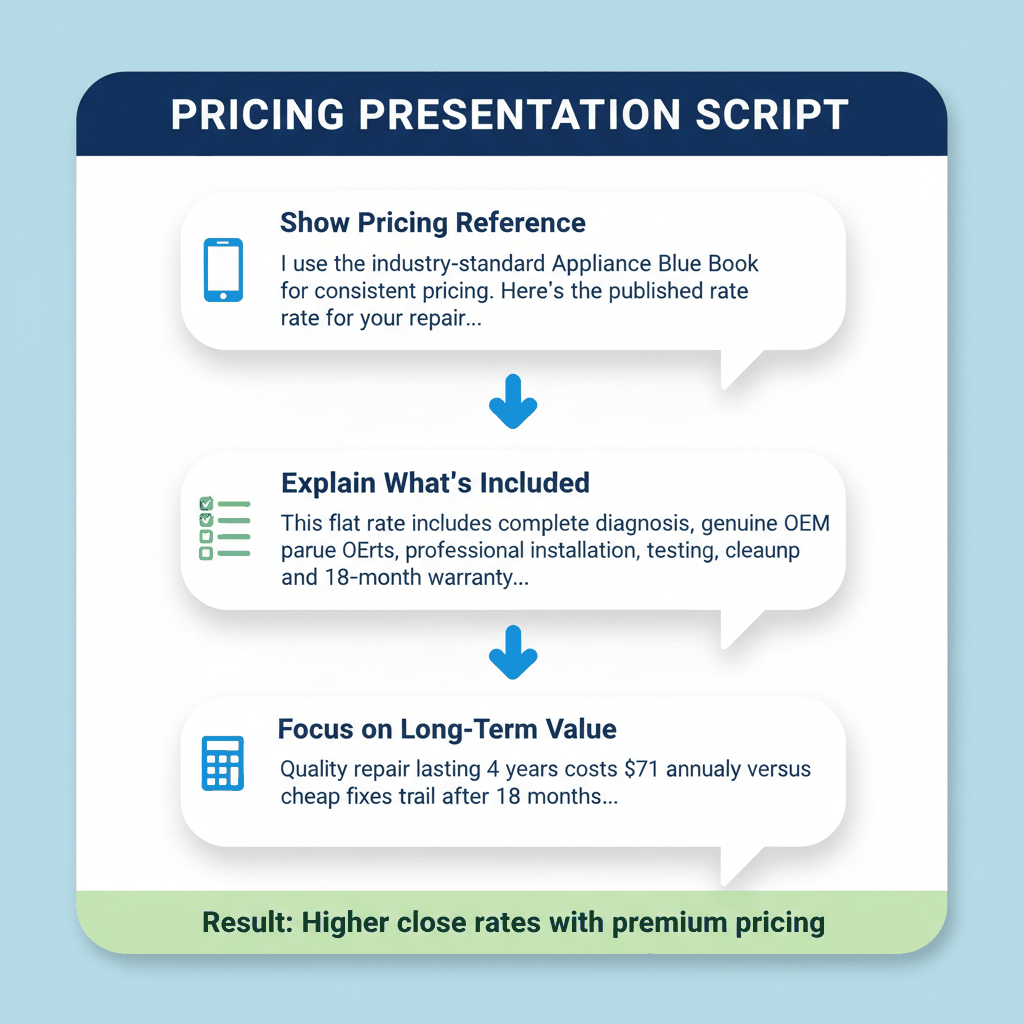
Present pricing using professional references like the Major Appliance Service National Price Guide. Show customers the book or app screen displaying standard job rates. This proves you use consistent, industry-approved pricing.
The United Servicers Association publishes pricing guides based on national averages. These professional resources eliminate customer concerns about made-up pricing.
When customers see published job rates, they understand pricing comes from industry standards, not arbitrary decisions. This builds trust and reduces price objections.
Break down everything included in your service price. Explain that flat rates cover diagnostic time, quality parts, professional installation, cleanup, warranty, and follow-up service.
Compare your service to discount competitors who charge separately for diagnostics, use cheap parts, or provide minimal warranties. Help customers understand why quality service costs more.
For example: "Our $255 repair includes complete diagnosis, genuine OEM part, professional installation, system testing, cleanup, and 18-month warranty. Discount services might quote $150 but add diagnostic fees, use aftermarket parts, and provide only 30-day warranties."
Shift conversations from upfront cost to long-term value. Quality repairs last longer and provide better reliability than cheap fixes. Calculate the cost per year of service instead of just repair costs.
A $285 repair that lasts 4 years costs $71 per year. A $150 repair that fails after 18 months costs $100 per year plus the hassle of repeat service calls.
Modern pricing tools help you calculate accurate job costs, present professional estimates, and manage customer communications efficiently.
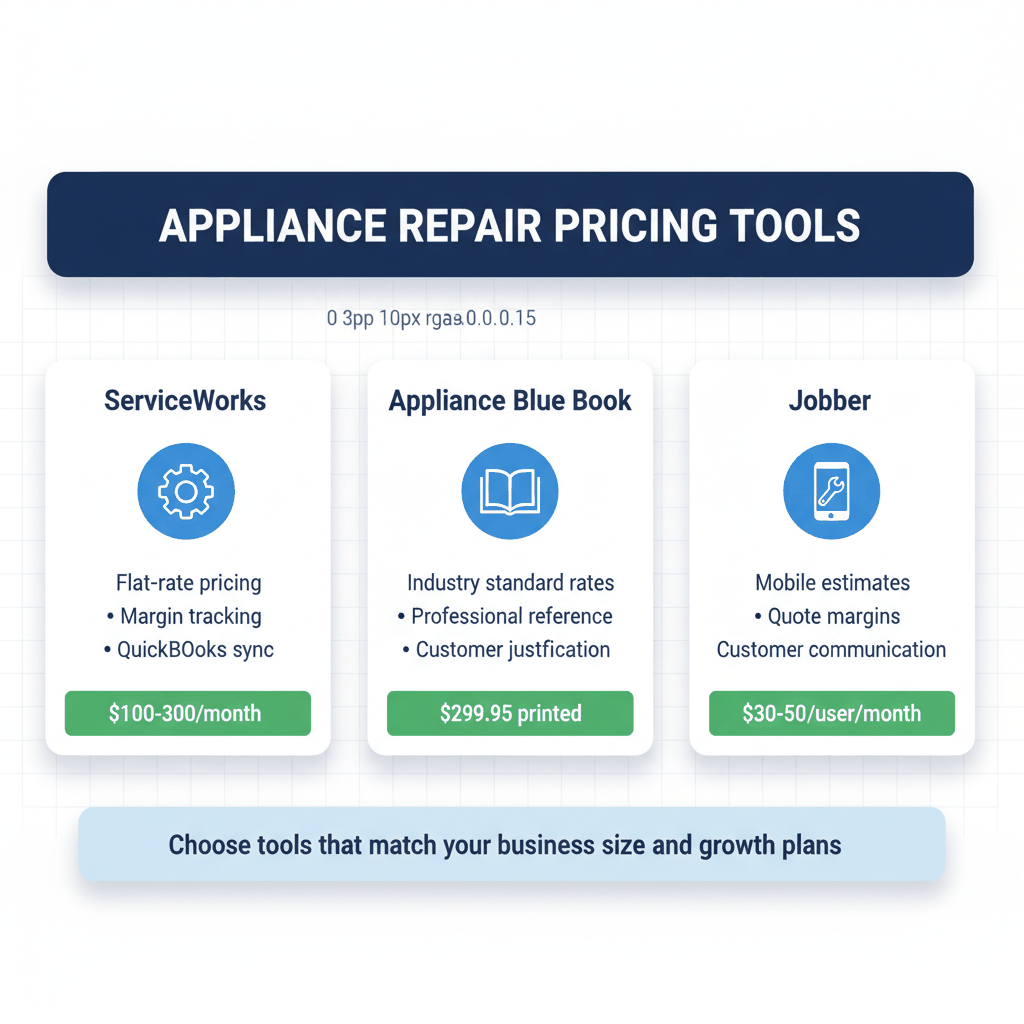
ServiceWorks helps create consistent pricing strategies with customizable service packages. The software shows estimated margins on quotes so you can adjust pricing for optimal profitability. Integration with QuickBooks streamlines accounting processes.
Housecall Pro delivers flat-rate pricing and transparent quotes that maximize profits while earning customer trust. The platform auto-syncs invoices, payments, and financial data to simplify business management.
Jobber shows estimated margins on appliance repair quotes so you can modify pricing in response to job complexity or customer requirements. This helps maintain consistent profitability across all jobs.
The Appliance Blue Book provides standardized pricing for common repairs. The printed book costs $299.95 and covers all major appliances in one resource. This professional reference justifies your pricing to customers.
ServiceTitan's Pricebook gives technicians visual pricing tools and mobile estimates. The platform helps increase average ticket sizes by offering multiple bid options with professional presentations.
Entry-level appliance repair software costs $30-50 per user monthly. Mid-range solutions designed for small to medium businesses start around $100-500 monthly. Enterprise-grade systems begin around $1,000 annually.
Choose software that matches your business size and growth plans. Most platforms offer free trials to test features before committing to annual contracts.
Effective marketing attracts customers who value quality service over lowest price. Focus on benefits, expertise, and results rather than competing on cost alone.
Emergency repair searches convert at 15-25% because customers need immediate help. Target keywords like "refrigerator not cooling," "washer won't drain," and "dishwasher leaking" to reach motivated buyers.
Location-specific keywords help you dominate local search results. Phrases like "appliance repair near me" and "emergency dryer repair [city]" attract customers ready to book service calls.
According to research, 28% of local searches result in purchases. The Google Map Pack captures 50%+ of clicks for local repair searches. You must rank in the top 3 results to capture significant traffic.
Develop content that demonstrates your expertise and educates customers about quality repairs. Blog posts explaining repair processes, maintenance tips, and appliance troubleshooting build authority and trust.
Long-tail keywords like "dryer making loud noise" and "fridge not cooling but lights on" help you capture specific customer problems. These targeted searches convert better than general repair terms.
Voice search optimization becomes increasingly important as customers use smart speakers to find local services. Optimize content for conversational phrases like "who can fix my oven in [city]?"
Case studies demonstrating successful repairs and satisfied customers justify premium pricing. Share before/after photos, customer testimonials, and problem-resolution stories that highlight your expertise.
Online reviews significantly impact customer decisions. Encourage satisfied customers to leave detailed reviews explaining the value they received. Respond professionally to all reviews, including negative feedback.
Track your results and adjust strategies based on performance. Professional lead generation services can help you attract quality customers willing to pay fair prices for expert service.
Show customers industry-standard pricing guides and explain everything included in your service. Compare your comprehensive service to discount competitors who charge separately for diagnostics, use cheap parts, or provide minimal warranties. Focus on long-term value rather than upfront costs.
Flat-rate pricing charges based on the repair needed, not time spent. Customers know exact costs upfront and don't worry about time overruns. Hourly pricing creates customer complaints and penalizes efficient technicians who complete jobs quickly.
Focus on value instead of price by highlighting your expertise, warranties, and quality parts. Create tiered service options and communicate total replacement costs versus professional repair value. Target customers who prioritize quality over lowest price.
Use professional pricing software like ServiceWorks, Housecall Pro, or Jobber to calculate accurate job costs and margins. Reference industry pricing guides like the Appliance Blue Book to justify your rates to customers with standardized pricing data.
Target high-intent local keywords and create value-focused content that demonstrates expertise. Showcase customer success stories and maintain excellent online reviews. Focus on emergency repair searches that convert at higher rates than general repair terms.
Ready to implement a profitable appliance repair pricing strategy that attracts quality customers? Contact ResultCalls today to discuss lead generation strategies that connect you with customers who value expert service. Our proven marketing approaches help appliance repair businesses grow revenue while maintaining healthy profit margins through targeted customer acquisition.

Hello everyone! My name is Alex and I write these blogs to help educate small business owners on different ways to grow their business. My goal is to make lead generation as easy as possible for you. After reading these blogs, I hope you leave with some actionable steps that will get you closer to growing your business :)